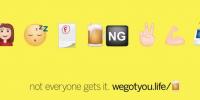
The Partnership for Drug-Free Kids, a national nonprofit dedicated to reducing substance abuse among adolescents, launched a new multimedia campaign for teens that uses emojis to communicate the challenges of negative influences, empowering them to live Above the Influence.
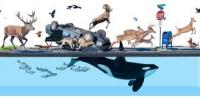
Josh Keyes is a contemporary artist who takes a "satirical look at the impact urban sprawl has on the environment and surmises, with the aid of scientific slices and core samples, what could happen if we continue to infiltrate and encroach on our rural surroundings."
In 2016, the Guggenheim Museum commissioned its very first robotic artwork called Can’t Help Myself (Wannmann, 2016). The artwork is created by two of China’s most controversial artists Sun Yuan and Peng Yu and can be described as a robotic arm that has one specific, life-long duty: to prevent the deep-red, bloodlike liquid, which constantly oozes outwards, from straying too far (Weng, n.d.).
Republican climate sceptics face battle for re-election as green groups hit back: Activists plan targeted campaign to defeat 'Flat Earth Five' group of Republicans in congress who refuse to accept climate science
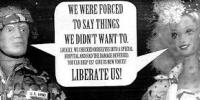
New York Times, DAVID FIRESTONE, Published: December 31, 1993
Your son tears the wrapping paper off his fierce new "Talking Duke" G. I. Joe doll and eagerly presses the talk button. Out comes a painfully chirpy voice that sounds astonishingly like Barbie's saying, "Let's go shopping!"
Does your son:
A) Furiously vaporize the doll with his own phaser rifle?
B) Go shopping with Joe?
Late last year, the New York Times published an op-ed short film written and narrated by Jay Z. The clip was called “The War on Drugs Is an Epic Fail,” and that kind of title was explicit enough for everyone to grasp the entertainment mogul’s general argument, whether they knew anything about drug war or not.
In May 2020, a team of artists, activists, folklorists, and people who lost loved ones to Covid-19 came together to make monthly memorial sites in New York City to remember victims of the Covid-19 pandemic. They continued installing memorials around New York City every month during the summer of 2020.
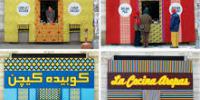
Conflict Kitchen is a restaurant that only serves cuisine from countries with which the United States is in conflict. Each Conflict Kitchen iteration is augmented by events, performances, publications, and discussions that seek to expand the engagement the public has with the culture, politics, and issues at stake within the focus region. The restaurant rotates identities in relation to current geopolitical events.
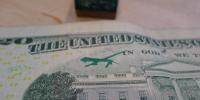
In Drones We Trust, 2014 - Joseph DeLappe
Crowd Sourced, Participatory Rubber Stamp Currency Intervention
FOR FULL PROJECT DOCUMENTATION VISIT: http://indroneswetrust.tumblr.com/
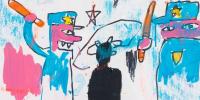
“It could have been me,” Jean-Michel Basquiat would say at the mere mention of the untimely death of Michael Stewart. Stewart, a 25-year-old artist, was allegedly drawing on the walls of the subway on 15 September 1983 when he was approached by transit cops who then placed him under arrest.
Trickery and disguise, usually followed by revealing the truth, are often tactics used by liberal activism, like the Yes Men for example. When used by the right, however, it can have different implications. Pretending to be a CEO or billionaire in order to expose corporate greed and corruption is clearly different then pretending to be a minority. The use of disguise can manipulate and shed light on hierarchies of power.
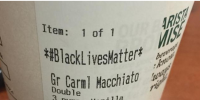
In the wake of the deaths of Alton Sterling and Philando Castile, Black Lives Matter supporters are finding creative ways to make sure the movement is acknowledged everywhere.
When ordering at Starbucks, people have changed their name to “Black Lives Matter” so that, when their order is up, the baristas have to yell out their new moniker.
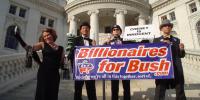
“Some people call you the elite,” George W. Bush joked to his wealthy funders, “I call you my base.” Whether candidate Bush meant it as a joke or not, the Billionaires for Bush (B4B) campaign used humor, street theater and creative media actions to show the country how true the quip was.
Mass media using propaganda to brainwash citizens. Confusion and ignorance causing a divide. People rising up against an oppressive government. Humans being torn between rage and love. These are the themes of Green Day’s widely successful 2004 album, “American Idiot.” These themes still sound familiar. Nearly two decades later, the world, especially the United States, faces these same issues.
A CALL TO ARTISTS:
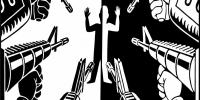
The American Friends Service Committee (AFSC) has created a new, nationally touring poster exhibit called All of Us or None: Responses and Resistance to Militarism. The exhibit will launch in June and is already scheduled to travel to Chicago, Greensboro, Providence, and San Francisco with many other stops anticipated. We are looking for some additional work to include in this show.
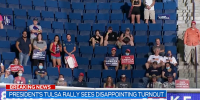
Users on the social media app TikTok are claiming some credit for the disappointing turnout at the president's rally in Tulsa, Oklahoma, over the weekend, after a weeks-long campaign to artificially inflate the number of people registered to attend. The prank may have helped lead the Trump campaign to boast about more than a million people seeking tickets for the rally — while only about 6,200 ended up filling seats.
In 2007, Andrew Danziger had an architecture class assignment at the University of Texas at Austin to propose an urban intervention in Austin. The goal was to think about public art in unexpected ways. One classmate dreamed up a blank traffic sign; another suggested putting a bench at a bus stop that lacked one. Danziger hit on the idea of installing swings in surprising places, and then he went beyond the assignment by actually doing it.
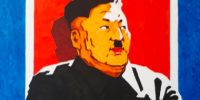
Song Byeok is one of the most acclaimed Korean artists living today. He is from North Korea, where he was a propaganda artist for the North Korean government for two decades. After defecting in 2002, Byeok has turned his prolific creativity into powerful, satirical art using North Korea’s ruling culture as motifs.
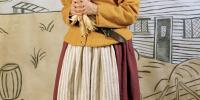
This installation of 13 photographic self-portraits explores European-American heritage, my family and their role in the history of racism, colonization, genocide, and classism. The ancestors, real and imagined, span over 2000 years from the Celtic Iron Age to the present day. The life size portraits are accompanied by audio diaries from the perspective of each character.
Jordan Peele discovered halfway through the making of “Get Out” what story he wanted to tell: A horror-thriller for black audiences that delivered a searing satirical critique of systemic racism.