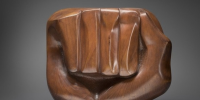
Sculptor and printmaker Elizabeth Catlett (1915-2012) used her art to advocate for social change in both the U.S. and her adopted country of Mexico. Much of her work focuses on the experience of African American life and political struggle during the middle of the 20th century. Her posters of well-known activists, including Angela Davis and Malcolm X, were widely circulated at the time.
In 2009, the dissident artist created a work to honour the thousands of children who died in the Sichuan earthquake. He recalls how the project, Remembering, angered China’s rulers – and changed his career for ever
This is an edited extract from The Start podcast
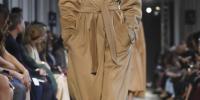
A woman dressed in western clothes and a hijab is a common sight across Europe’s capital cities – a fact now reflected on the catwalk at Milan fashion week.
Halima Aden, a Somali-American model, is fast becoming fashion’s face of 2017, currently stealing the show at fashion week from the catwalk superstar Gigi Hadid.
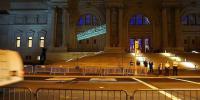
On Tuesday evening, at the end of an action staged by Occupy Museums at the Metropolitan Museum of Art to protest the unveiling of the David H. Koch Plaza, three members of The Illuminator were arrested. Earlier in the evening, police had moved protestors to a cordoned area on the opposite side of the street from the museum; a substantial police presence remained throughout the evening, but no other arrests took place.
On completion the 100 Faces project will consist of 100 Portraits of Americans who have been to the theaters of war in Iraq or Afghanistan (OEF,OIF). Each portrait is accompanied by a placard featuring a statement written by the person pictured and a brief biography of the person pictured. The biographical information and the statement reflect the person at the time of the creation of the portrait.
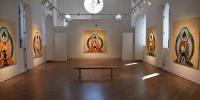
This is a series of paintings reflecting the struggle and sacrifices made by the Tibetan people for independence. The author is Tenzing Rigdol, who is a Tibetan and influenced a lot by the Dalai Lama and traditional Tibetan culture. The paintings are full of Tibetan cultural elements. For instance, the characters created in the paintings are Tibetan monks, who are the typical representatives of their culture.
Song Dong's Waste Not consisted of a single installation comprising over 10,000 commonplace, domestic items of daily life that had been used and amassed by the artist’s mother (Zhao Xiangyuan) over fifty years.
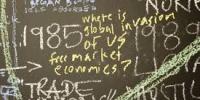
"SOA Cycle, and what it later became, which is called the Democracy Cycle, is a group of seven large works that approach the question of democracy. What is democracy? How is it constructed? How is it implemented? Is it something that is to be thought of in relation to its political influence? Or is it something that plays out in terms of cultural and social, and even emotional terms, for instance?
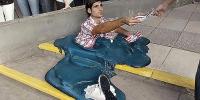
A young man melting into a puddle of himself is something you don’t see everyday, much less in a busy public square. Yet this humourous but surprisingly effective spectacle is the latest effort by the Red Cross of Argentina to raise awareness about climate change.
Share Your Water Story invites every global citizen to participate in a creative conversation around the different ways in which water impacts our lives. The project encourages people to contribute original expression of any kind via online platforms on the global justice issue of water and sanitation.
In conjunction with the GUTS world tour, Olivia has launched Olivia Rodrido’s Fund 4 Good, a global initiative committed to building an equitable and just future for all women, girls and people seeking reproductive health freedom.
A portion of the proceeds from all ticket sales at the GUTS world tour will go towards the Fund 4 Good.
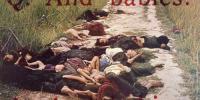
Ronald Haeberle took a color photograph of the bloody corpses of men, women, and children after the Mai Lai Massacre during the Vietnam War in in March 1968, initially publishing it in Life magazine. Later the image was used by the Art Worker's Coalition to create the infamous poster, "And babies.," which superimposed "Q: And babies? A: And babies" in red letter across the top and bottom of the image.
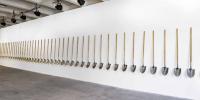
An artist in Culiacan, Mexico—which has the highest rate of gun deaths in the country—has found a way to transform the agents of death into seeds of life.
In 2008, artist Pedro Reyes started running television ads urging locals to exchange their guns for food coupons to be redeemed at local stores.
The campaign—Palas Por Pistolas, or “Shovels for Guns"—collected 1,527 guns, which Reyes publicly smashed with a steamroller.
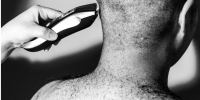
In this black-and-white image, there are no strands of hair or remnants of makeup to be found, except a shaved head belonging to a South Korean. Jeon photographed this image in 2019 for her exhibition that aimed to "destroy the socially defined idea of a woman” (Kuhn 1). The visuals in this image is a brazen response to the conventional beauty standards that has been gripping South Korean women.
On July 4, 2012, several members of MicCheckWallSt, a subsidiary group of Seattle's larger Occupy Wall Street that formed in December, 2011, anonymously checked into a room at the historic Roosevelt Hotel in Downtown Seattle.
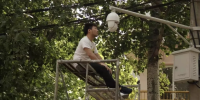
Ge Yulu’s artistic practice playfully pulls at the strings of a social system that, although seemingly all-encompassing, is in fact a malleable structure consisting of individual human beings. For his 2016 project Eye Contact, Ge positioned himself in front of a surveillance camera and stared directly into the lens for hours, then negotiated with a security guard to buy the footage.
One of the defining features of politics in the 21st century has been the way online cultural phenomena can cross over into the “real” world.
Unfortunately, perhaps because the internet seems to bring out the worst in people, those phenomena have largely been, well, awful.
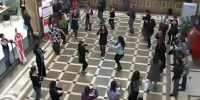
Unas clientas esperan tranquilamente en un banco, cuando empieza a sonar una extraña canción en el hilo musical. Una clienta se sale de la cola y comienza a bailar con brío flamenco, y sorprendentemente el resto de clientes se le unen en una compleja coreografía con mucho desparpajo.