About us
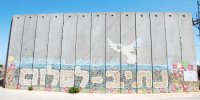
"Path to Peace" - is a joint mosaic creation, by thousands of people, towards hope, love, and happiness among all people. The creation is placed upon the border wall that divides the Gaza Strip and Israel, adjacent to the homes of Moshav Netiv HaAsara.
The creation is seen from both sides of the wall, spreads on the gray security wall and completely changes the place's atmosphere.
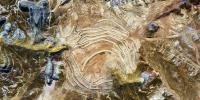
At first, you don’t know what you’re looking at. A gray expanse of uneven geometry surrounded by undulating brown. Shift your perspective a bit and it might be a close-up of a distressed textile, with subtle hues and textures surfacing as your eyes adjust.
And then the horizon comes into focus. Now you know where you are. In the distance are the classic jutting buttes of Monument Valley, familiar to anyone who’s ever seen a John Ford Western.
The Fundred Dollar Bill Project, initiated by artist Mel Chin, is a collaborative art project aimed at raising awareness and mobilizing action against the environmental and health threat of lead contamination. It encourages individuals to create their own unique interpretations of $100 bills, symbolizing the value of human lives and the need for a lead-free future.
When Bay Area activists Moms 4 Housing began their campaign, they were fighting gentrification and institutional poverty. Now, as California's housing crisis compounds during the COVID-19 pandemic, their work has taken on new significance.
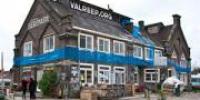
In the summer of 2011, squatters take over an unused building, once an animal shelter, and begin renovating it into a social and cultural center for a neighborhood on the outskirts of Amsterdam. They call it Op de Valreep ("in the nick of time").
“My intention was not to disappear in the environment but instead to let the environment take possession of me” Said Liu Bolin. With his strong photography, Bolin vanishes into the city, creating a powerful statement about our relationship, as humans, to our surroundings.
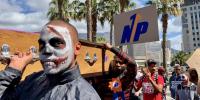
The Yes Men join Reclaim the City in their fight against unjust housing policy. On September 30, 2019, a horde of zombies attended a "#natsneverdie rally" at the Cape Town Civic Centre in order to celebrate Mayor Dan Plato and the Mayoral Committee and to support their policies, which are increasingly similar to those of the National Party under Apartheid.
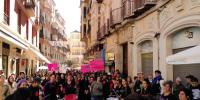
On October 6th, 2007, we beat a new world record. Thousands of people in cities all across Spain simultaneously shouted: “You won’t own a house IN YOUR WHOLE FUCKING LIFE!” The decibels radiating from this collective cry were registered by an interactive meter, baptized “The Fuck-o-meter” for the occasion.
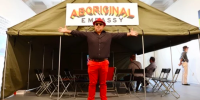
Richard Bell has often called himself ‘an activist masquerading as an artist’. Aboriginal journalist and radio broadcaster Daniel Browning has suggested that Bell is also ‘a megaphone.
National Public Radio (NPR):
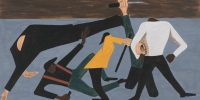
There's no historical marker outside Jacob Lawrence's childhood home in New York City's Harlem neighborhood.
But Khalil Gibran Muhammad, director of the Schomburg Center for Research in Black Culture, has an idea of what it might say: "Here lived one of the 20th century's most influential visual artists, a man named Jacob Lawrence, who was a child of southern migrants."
La Casa Invisible project was started in 2007 in Malaga, Spain, when a group of socially involved participants squatted in a run-down building, aiming to eventually claim the legal rights to the property (Moor & Smart, 2016). The space was opened to local artists and creators, quickly becoming a hub for free local music, performances, and seminars as well as creating an important meeting space for social groups (Moor & Smart, 2016).
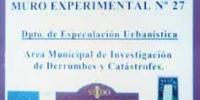
This action was suggested in the workshop assembly by a neighbor of Arrayán street itself. At the end of this street giving the market there was a wall in a state of collapse that
concerned the neighborhood. On several occasions, either neighbors or from the same Peña Bética in front of them, they had
given by the City Council, but without results. And every day having to go all the way through that gorge with two
During the economic crisis of 2008, bankers in Spain took advantage of the economically disadvantaged, and the artwork La Fiera en Sevilla, or the Wild Animal in Sevilla in English, brings attention to this money-centric act from the bankers. La Fiera refers to the bankers at the time that used predatory methods in their actions to forcibly evict poor people from their houses.
The new exhibit “MESH” at Portland Art Museum features Indigenous contemporary artists advocating for change
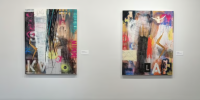
Visual artist, writer and activist Ka’ila Farrell-Smith says she considers herself a wartime artist.
She is a member of the Klamath tribes and lives in Modoc Point, Oregon. When asked about how history influences her work, the answer weaves through over 150 years of white colonization and Indigenous struggles in the West:
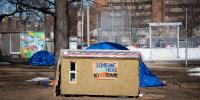
On his way to work on a construction site, Khaleel Seivwright surveyed the growing number of tents lining an intercity highway and in parks with increasing discomfort. How would these people survive Toronto’s damp, frigid winters, let alone the coronavirus, which had pushed so many out of overcrowded shelters?
He remembered the little shanty he had once built out of scrap wood while living on a commune in British Columbia.
Bogus building inspection notices with the forged signature of city Building Inspection Director Frank Chiu appeared on buildings in San Francisco's South of Market area, prompting an investigation by exasperated city officials.
The Ogden Ar(t)chives Mailbox is a community project that was initiated by Ogden poet, Angelika Brewer. The project involves a metal sculpture of a mailbox, which has various decorative elements such as a typewriter, a birdcage, and a heart. The mailbox serves as a platform for the public to submit their creative works such as poems, drawings, letters, or anything that can fit in an envelope.
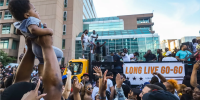
In response to white gentrifiers trying to silence go-go music on the corners of Florida Avenue and 7th Avenue, activists and D.C. residents poured into the streets by blasting go-go music and celebrating its rich history within the city. For those unfamiliar, go-go music is at the heart of D.C. culture and features live bands playing covers of, and sometimes original, music with all different types of drums and other percussion instruments.
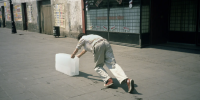
What is Francis Alÿs known for?
Francis Alÿs is known for using poetic and metaphorical techniques to highlight the political and social realities of his city. Often, the issues he addresses range from national border politics to globalism and areas of conflict in his community and the effects of modernism.
"Late last night, an autonomous group of activists placed posters throughout the subway system, blocking out advertisements with their own materials protesting Israel's bombing campaign in Gaza.
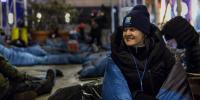
Covenant House has started a ‘Sleep Out’ movement that shines light on the youth homelessness crisis and raises funds for young people who seek shelter. "Covenant House empowers young people to overcome homelessness and trafficking by providing them with safe housing, food and clothing, and relentless support. Sleep Out events are held for people who want to join the movement as they give up their bed for one night in NYC.
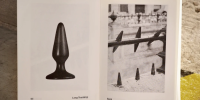
Hostile architecture—urban design features like ground spikes that deter the homeless from lying down or slanted benches that prevent lingering—inscribes exclusion into our streets. In response, a Chinese artist will launch the Free Butt Plug Catalogue, an art-activism project that documents fifteen such spikes and anti–loitering benches across London and pairs each with a commercially available butt plug of the same shape.
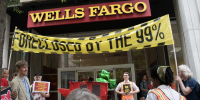
On the eve of Wells Fargo’s annual shareholders meeting in San Antonio, TX on Tuesday, home defenders, students, community groups, and activists in ten cities took peaceful action against the bank. Petitions signed by thousands of people were delivered to Wells Fargo branches and offices across the country calling on CEO John Stumpf to change the bank’s predatory practices.
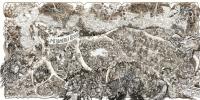
The Beehive Design Collective is a wildly motivated, all-volunteer, activist arts collective dedicated to “cross-pollinating the grassroots” by creating collaborative, anti-copyright images for use as educational and organizing tools. We work as word-to-image translators of complex global stories, shared with us through conversations with affected communities.