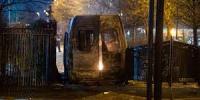
LONDON (AP) — An anti-migration protest outside a hotel housing asylum-seekers in northwest England turned violent and resulted in the arrests of 15 people, local police said Saturday.
The Merseyside Police department said a police officer and two civilians sustained minor injuries during the disturbance on Friday night in Knowsley, a village located 13.5 kilometers (8.4 miles) from the city of Liverpool.
The Stanford Daily:
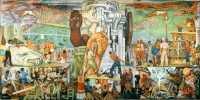
There is no word short of “spectacular” that better describes the experience of examining “Pan American Unity,” Diego Rivera’s 1940 mural, housed since 2021 at the San Francisco Museum of Modern Art (SFMOMA). The piece is the crux of SFMOMA’s soon-closing exhibition, “Diego Rivera’s America,” curated by James Oles and Maria Castro.
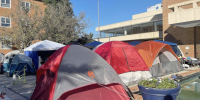
Dozens of Howard University students are sleeping outdoors in a tent encampment on campus grounds to protest what they describe as "poor" and "unlivable" conditions in the college dormitories.
Students told ABC News that portions of the university living quarters have mold and insect and rodent infestations, as well as leaky ceilings and flooding -- all of which they say put their health at risk.
On October 6th, 2007, we beat a new world record. Thousands of people in cities all across Spain simultaneously shouted: “You won’t own a house IN YOUR WHOLE FUCKING LIFE!” The decibels radiating from this collective cry were registered by an interactive meter, baptized “The Fuck-o-meter” for the occasion.
When Bay Area activists Moms 4 Housing began their campaign, they were fighting gentrification and institutional poverty. Now, as California's housing crisis compounds during the COVID-19 pandemic, their work has taken on new significance.
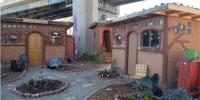
Members of three organizations – Artists Building Communities, Essential Food and Medicine, and Living Earth Structures – have built a kitchen, clinic, free store, stage, toilet, oven, and shower with and for a homeless community near Wood Street in West Oakland.
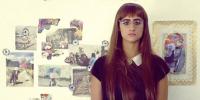
It was October 31st, 2012, when a new artist appeared on social media. In a series of video clips, she proposed with a soft and slow speech that Peru hide its poverty. Her project consisted of installing vinyl pieces to avoid what she called "the visual pollution." She titled the project Don't be poor, be fashion(able).
Benito Antonio Martínez Ocasio, better known to the world as Bad Bunny, has once again proven that his artistry goes far beyond reggaeton and trap. On January 5, 2025 — the eve of Puerto Rico’s cherished Three Kings Day — the Puerto Rican superstar released DeBÍ TiRAR MáS FOToS, an album that both celebrates his homeland and delivers a sobering message about its uncertain future.
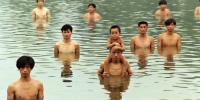
Zhuang Huan invited more than 40 men - laborers, fishermen, construction workers––who had recently migrated to Beijing from other areas of China to participate. Zhang Huan said, “In order to find these workers, I visited many of the shacks where they live.”
The collective Ndaku Ya La Vie Est Belle, a group of Kinshasa street performers turn their bodies into living sculptures, and use them to political ends. Among the artists is Jared, who regularly takes to the streets dressed as Robot Annonce. The costume, made from broken radio parts, is designed to raise awareness of fake news. “People receive so much incorrect information and many inaccuracies are spread. I want to fight this,” says Jared.
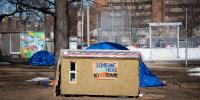
On his way to work on a construction site, Khaleel Seivwright surveyed the growing number of tents lining an intercity highway and in parks with increasing discomfort. How would these people survive Toronto’s damp, frigid winters, let alone the coronavirus, which had pushed so many out of overcrowded shelters?
He remembered the little shanty he had once built out of scrap wood while living on a commune in British Columbia.
In response to white gentrifiers trying to silence go-go music on the corners of Florida Avenue and 7th Avenue, activists and D.C. residents poured into the streets by blasting go-go music and celebrating its rich history within the city. For those unfamiliar, go-go music is at the heart of D.C. culture and features live bands playing covers of, and sometimes original, music with all different types of drums and other percussion instruments.
It's an evocative image — and it was intended to be: Diana, Princess of Wales, wearing a protective visor and flak jacket, walking through a live minefield in Huambo, Angola. The image of the princess, at the time one of most famous women in the world, surrounded by danger, made headlines across the world.
La Casa Invisible project was started in 2007 in Malaga, Spain, when a group of socially involved participants squatted in a run-down building, aiming to eventually claim the legal rights to the property (Moor & Smart, 2016). The space was opened to local artists and creators, quickly becoming a hub for free local music, performances, and seminars as well as creating an important meeting space for social groups (Moor & Smart, 2016).
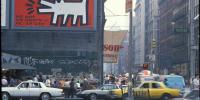
It’s the radiant baby, the barking dog and the dancing man; the badges and the t-shirts; the unmissable mural spelling out CRACK IS WACK. Keith Haring’s career was short but spectacular, and he leaves behind a lasting legacy. From his chalk drawings in city-wide subway stations, to his collaborations with the superstars of his day, Haring’s life was founded on a belief in the power of people to change the world.
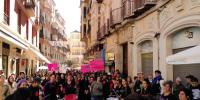
Just over a decade ago on May 15, 2011, a wave of social outrage began as the Spanish people collectively decided that they had had enough of the corruption, cuts, and inequalities affecting their country.
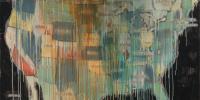
"State Names" is a painting by Jaune Quick-To-See Smith. You immediately recognize the outline of the United States, but at the same time, that map is obscured and made difficult to read. It’s at once recognizable and not recognizable. She describes her use of icons as a ploy, as something that brings the viewer closer, and they think they know what they’re going to see.
The ZAD (zone à défendre, or “zone to defend”) in Western France is 4000 acres of wetland, farmland and forest that was originally intended to be built into an airport in 1965 but is now an autonomous territory occupied by 40 different collectives looking to reclaim the land. There are around 200 people living permanently on the zone, in addition to some 2,000 people coming and going.
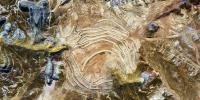
At first, you don’t know what you’re looking at. A gray expanse of uneven geometry surrounded by undulating brown. Shift your perspective a bit and it might be a close-up of a distressed textile, with subtle hues and textures surfacing as your eyes adjust.
And then the horizon comes into focus. Now you know where you are. In the distance are the classic jutting buttes of Monument Valley, familiar to anyone who’s ever seen a John Ford Western.
During the economic crisis of 2008, bankers in Spain took advantage of the economically disadvantaged, and the artwork La Fiera en Sevilla, or the Wild Animal in Sevilla in English, brings attention to this money-centric act from the bankers. La Fiera refers to the bankers at the time that used predatory methods in their actions to forcibly evict poor people from their houses.
The new exhibit “MESH” at Portland Art Museum features Indigenous contemporary artists advocating for change
Visual artist, writer and activist Ka’ila Farrell-Smith says she considers herself a wartime artist.
She is a member of the Klamath tribes and lives in Modoc Point, Oregon. When asked about how history influences her work, the answer weaves through over 150 years of white colonization and Indigenous struggles in the West:
Brian Larney is an AI.tivist or American Indian artist. He is also an Artivist where he performs Artivism, a concept that includes art as a form of activism.
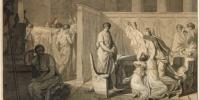
Jacques-Louis David was an active member of the French Revolution, and his works often depicted his political affiliations. David’s painting The Lictors Bring to Brutus the Bodies of His Sons portrays the scene of Brutus, an important figure of the Roman Republic, reacting to the death of his sons. Since they wanted to overthrow the government and restore the monarchy, Brutus ordered their death.