change
region
medium
issue
pol
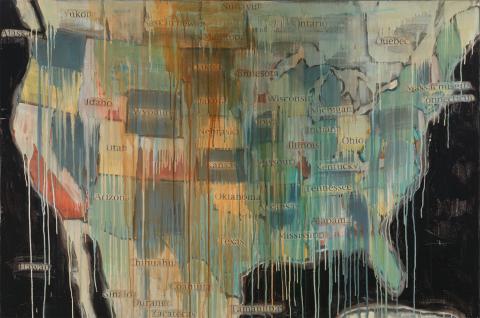
"State Names" is a painting by Jaune Quick-To-See Smith. You immediately recognize the outline of the United States, but at the same time, that map is obscured and made difficult to read. It’s at once recognizable and not recognizable. She describes her use of icons as a ploy, as something that brings the viewer closer, and they think they know what they’re going to see.
There are a lot of state names that are indicated here in this type that’s large and feels very educational, but some are clearly missing. Some of the names that are present are obscured and then some of the names of the states are missing altogether. And so, one of the questions that often comes up fairly soon after you start to engage with this work is why do we see the names of some states but not other states?
“State Names” is a work about the etymology of the names of US states. The states that are remaining in the work, these are names of states that come from Indigenous sources. The states that have been removed, those are names that have European origins.
The outlines of the states are largely obscured.
Names are missing, boundaries are obscured, there’s dripping paint. You get a sense that what we’re looking at is a contested space in a lot of ways. And so when you see the dripping paint, what does that evoke? Is it blood? Is it tears? Is something melting?
We’re reminded that these state boundaries are not ones that were at all relevant to Native American peoples.
It does reinforce how arbitrary those boundaries are. Smith has said that her maps are points of departure for the political treatment of Native people. She has also said that she cannot say strongly enough that her maps are about stolen lands.
Smith has been a leading contemporary American artist since the 1970s, and she works in a variety of media. Smith is an enrolled member of the Confederated Salish and Kootenai Tribes of the Flathead Nation. She began making maps for exhibitions that were responding to the Columbus quincentennial in 1992.
Smith was trained as an Abstract Expressionist, and we may think of maps and Jasper Johns. We may think of collage, because what she has here, the names of the states, those are clippings that are then put over the paint, and then the paint is put over the clippings. We have these really rich layers in this work.
“State Names” was created in 2000, half a century after Pollock and Johns and Rauschenberg, and artists who so evidently had an impact on her work, but she’s drawing on that art historical mid-20th century tradition to say something about her own identity and the identity of her people.
Her work really challenges us to think about identity in different ways, about heritage in different ways, about history in different ways. We don't just have state names, we have the names of areas outside of the boundaries of the United States. The boundaries between states, it’s a very arbitrary distinction, as is the boundaries between countries here. And so while the work is called “State Names,” we have the top of Mexico just below the southern border of the United States. We have the bottom part of Canada.
The dripping paint combined with the black oceans really does contribute to this ominous feel. Once you look at a work like “State Names,” you might not think about the name Arizona, or Ohio, or Nebraska in the same way, because you’re thinking about the history of that name.
When we think about our history in a different way, it also asks us to think about our present in a different way.