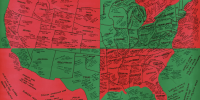
Counterspace is an independent curatorial platform functioning as the first decolonial thinktank mapping cultural activism worldwide. It shapes collectively decolonial toolkits with common tools and resources, and a global directory browsable by continent, praxis, and social construct, as a Beuys-inspired ‘social sculpture’ revisited, and an alternative map of the universe.
The running world will come together for a virtual run on Friday, May 8, to celebrate and honor the life of Ahmaud Arbery, who was reportedly shot and killed while out on a run on February 23.
When Behnaz Babazadeh was young, her family moved from Afghanistan to the US. She loved almost everything about her new home — especially America’s amazing selection of candy — but she also loved wearing her familiar pink-flowered headscarf, which she’d grown used to wearing as part of her school uniform in her old home.
To foster interests and understanding of the accomplishments of women writers of color. To bring together the Student body of Pratt to explore the literary contribution, showcase the artistic quality and celebrate the contributions of women writers of...
Unfortunately, those who struggle for a more equal and democratic society are not the only ones who can make use of creative forms of activism. The following example shows how creative strategies can also be employed by those who have less wholesome intentions in mind.
Frank Waln, a 25 year old Native American hip hop artist, tours the country and Canada performing and teaching motivational workshops to students across the country. He took to rap at a young age when he found a cd (Eminem's The Marshall Mathers LP) on the side of the road. Growing up on the Rosebud Sioux Reservation of South Dakota, he realized that the hip hop music genre was an outlet for expressing pain and frustration.
The term “Afrofuturism” was coined in the 1990s by the cultural critic Mark Dery, who recognized a preoccupation with the future in the work of a number of black artists. Ever since, it has remained a term that is retrospectively applied to seemingly disparate artists, from Missy Elliot to Toni Morrison. What unites the movement is a shared fascination with the black experience, particularly in America.
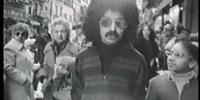
Adrian Piper disguised her identity, changing her race, sex, and social class in order to experiment in public situations and gauge people’s reactions. She investigated how outwardly visible identity markers (like skin color) impacted others’ perceptions of her character. By manipulating her (apparent) identity to produce reactions, she demonstrated the power and influence of stereotypes (Piper, 1996).
The National Memorial for Peace and Justice, opening to the public on April 26, 2018, will become the nation’s first memorial dedicated to the legacy of enslaved black people, people terrorized by lynching, African Americans humiliated by racial segregation and Jim Crow, and people of color burdened with contemporary presumptions of guilt and police violence.
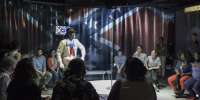
"Four theatrical spaces and the full inventory of of 3LD Art & Technology Center were enlisted in the transformation of the space into SupremacyLand, a dystopian theme park where white supremacy and racist carnage was raised and twisted into totally immersive, experiences.
The Enchanted Doll is the famous brand of the Russian jeweler artist and designer Marina Bychkova who makes absolutely incredible porcelain and polyurethane dolls for adults. Marina was born in the city of Novokuznetsk in the USSR and since 1997 she lives in Vancouver, Canada.
By Andrea Long-Chavez
The recognizable figure of a Latino gardener is a common sight for most Southern California locals. But if you happen to see the cardboard painting of a gardener propped up against a chain link fence or hedge, chances are you’ve just seen the public art of Los Angeles-based artist Rarmio Gomez, Jr.
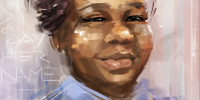
When I watched them kill Elijah McClain, I couldn’t make any art for days. It had been week after week after week of gut-wrenching stories of Black lives taken from this earth too early. I wasn’t sure if I could handle another one. After seeing the way Elijah pleaded for his life while walking home from the convenience store, it was so hard for me to watch and process.
After J.Cole posted a song that implies that Noname can get her message across to a wider audience if she changes her tone, she releases another song in response. However, instead of explicitly responding to his critique, she uses the controversy to shed light on the death of Black female activist Oluwatoyin Salau, who was killed by her assaulter.
The Publixtheatre Caravan is the English name for a travelling project of the Volxtheater Favoriten, a Vienna-based international theatrical troupe that has been creating site-specific theatrical interventions in public space as well as stage-based performances since 1994. It is a political and artistic project that is part of the No Border Network and the Platform for a World Without Racism.
In September 1971, after years of mistreatment and months of simmering tensions, more than 1,200 of the 2,200 inmates at the Attica Correctional Facility in upstate New York took control of the prison in protest of its substandard conditions and openly racist corrections officers.
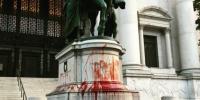
Just weeks after activists staged an alternative tour of the American Museum of Natural History to call for its removal, among other things, the equestrian statue of Teddy Roosevelt was vandalized early Thursday morning.
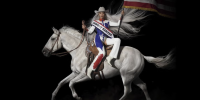
Can’t say she didn’t warn us: As per her Instagram message last week, Cowboy Carter, the Act II sequel to 2022’s Renaissance, is a Beyoncé album, not a country album.
During the Black Lives Matter protests in Richmond, VA, the two fourteen-year-olds posed in a powerful photo in front of Confederate General Robert E. Lee’s statue. Ava had originally arranged an appointment with photographer Marcus Ingram, but as she and Kennedy posed in front of the graffiti-covered monument with their fists firmly jutted in the air, several photographers began snapping pictures.
"MASK" is an art exhibition that explores the uses and meanings of masks, and ones feelings about them. Masks throughout history have taken many forms and have served many purposes. They have been used in construction, scientific research, technical manufacturing, medicine, the theater, and warfare.
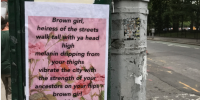
You’ll find Johanna Toruno on the streets of NYC plastering pictures of her flower-filtered poetry, Kendrick Lamar, and Selena on blank walls, street lights and buildings. When I came across The Unapologetically Brown Series on Instagram I was intrigued not only by the name but by the concept of being unapologetic and brown as the premise for a body of street art.
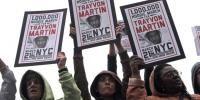
A march took place Wednesday evening in Manhattan calling for justice in the case of Trayvon Martin. He was an unarmed black teenager who was shot to death by a neighborhood watch captain in Florida last month.
The protracted queue. That was the first thing I noticed when I arrived. It was winding, unending and impossible to see exactly where it began. I asked one of the security guards if he had any indication as to the waiting time. His response was a “your guess is as good as mine” shrug. As the mammoth line snaked around the building, my heart sank further – it is a myth that Brits love to queue; we feel compelled to, we don’t love it.