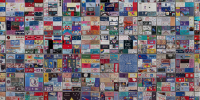
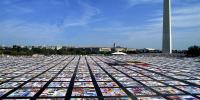
The Quilt was conceived in November of 1985 by long-time human rights activist, author and lecturer Cleve Jones. Since the 1978 assassinations of gay San Francisco Supervisor Harvey Milk and Mayor George Moscone, Jones had helped organize the annual candlelight march honoring these men. While planning the 1985 march, he learned that over 1,000 San Franciscans had been lost to AIDS.
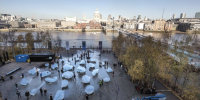
Danish-Icelandic artist Olafur Eliasson has extracted 30 blocks of glacial ice from the waters surrounding Greenland and placed them in public spaces across London, where they will be left to melt.
Called Ice Watch, the temporary installation is meant to serve as a visual reminder of the impact of climate change on the environment.
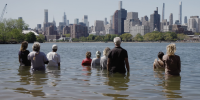
A site-specific, community-engaged process: Sarah and NYC collaborators gathered at the water’s edge every month from September 2020 (when the work was initially scheduled to take place but was postponed due to the pandemic) until September 2022, to build Kin To The Cove, a site-specific community-powered environmental public art process that connects local residents to the Cove and Water that surrounds NYC.
Founded in India, this collective creates participatory murals that transform public spaces into affirmations of love and resistance. Collaborating with marginalized communities, they co-create artworks that challenge narratives of fear and oppression
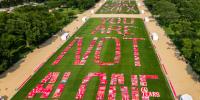
The Monument Quilt is a large quilt that serves as a memorial for survivors of rape and abuse. It contains over 3,000 stories from individuals who have experienced gender-based violence, and allows visitors to add their own stories by writing, painting, or stitching onto red fabric. The project took place over a span of six years, during which the organizers traveled to 49 states and 33 cities in the U.S.
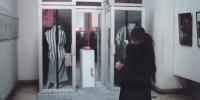
Xiao Lu was one of the most influential women in contemporary Chinese art, better known for provoking performance art works and sharp social commentaries. Her works address sensitive social and cultural issues that counter mainstream attitudes and values. In 1989, she put her work "Dialogue" up for exhibition at the National Art Museum of China in Beijing.
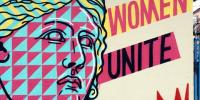
El Rey de la Ruina, aka The King of Ruin, is a local artist based in Madrid, Spain, who creates artistic activist pieces that range from the impact Covid-19 had on the social life of people in Spain, to the impact gentrification has taken on various groups of people. He tends to utilize (at least in his more recent pieces) bright colors and fun, geometric shapes in his art.
Horror stories about treacherous boat journeys from Africa to the Mediterranean far too often make headline news. The men, women and children fleeing their homes to start a new life in Europe become faceless numbers in the media, and are ‘othered’ by conservative politicians for their own agenda.
In her 2021 graduation project from the Central Academy of Fine Arts (CAFA), Chinese performance artist Zou Yaqi staged a provocative social experiment titled “21-Day Survival Challenge.” For three weeks, Zou assumed the persona of a wealthy socialite, using counterfeit luxury items, strategic self-presentation, and social engineering to access elite spaces in Beijing—such as five-star hotel lobbies, first-class airport lounges, and high-end restaurants
This week's Swede of the Week is Tomas Gunnarsson, whose quest to find Sweden's "Sexist of the Year" has found a viral following across the country. He says Swedes who buy into the 'most equal country in the world' label are delusional.
Who was the most sexist person in Sweden in 2013?
Cleve Jones's powerful vision for memorializing those lost to AIDS was realized in October 1987 in Washington D.C. It showcased the artistic contributions of people who'd lost loved ones to the virus from a number of US metropolitan centers. The quilt has continued to grow for the nearly 40 years since. By 1992, the AIDS Memorial Quilt included panels from every state and 28 countries.
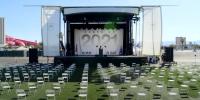
A gun violence prevention group has released videos in which they trick famous pro-gun figures into addressing a sea of empty chairs, representing children and teenagers who were shot and killed before they could graduate from high school.
Change the Ref, a gun safety organization founded by Patricia and Manuel Oliver, whose son Joaquin was murdered in the Parkland, Florida, school shooting, released the videos Wednesday.
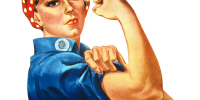
It’s been a historic year for women. There are more serving in Congress than ever before, and a record number are currently running for president in 2020. But even with these significant gains, women—both in the U.S. and around the world—can still find gender equality elusive.
"Under the Same Sky" bearing the name and the first part of my project completed. I collected the letters written to 40 Armenian young people from 40 random Turkish young people. The mutual translations of all letters and video subtitles were made. Letters and photographs are handed out to young people, friendships are being established.
Björk and the French artist Aleph have collaborated on an immersive, AI sound piece that recreates extinct animal calls, set to run at the Pompidou Centre, in Paris, from November 20 until December 9. It will play as visitors travel on escalators in the art museum, as part of its “Biodiversity: Which culture for which future?” forum.
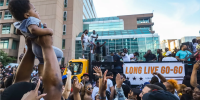
In response to white gentrifiers trying to silence go-go music on the corners of Florida Avenue and 7th Avenue, activists and D.C. residents poured into the streets by blasting go-go music and celebrating its rich history within the city. For those unfamiliar, go-go music is at the heart of D.C. culture and features live bands playing covers of, and sometimes original, music with all different types of drums and other percussion instruments.
On July 2nd, 2013, after attending the Gas Exporting Countries Forum (GECF) conference, Bolivian President Evo Morales departed Russia from Vnukovo Airport in Moscow aboard his presidential plane. However, a "leak" suggested that Edward Snowden was aboard, which led Spain, France, and Portugal to close their airspace to the aircraft, to then be grounded in Austria.
Introduction: The Ambulatory Free States of Obsidia
The Ambulatory Free States of Obsidia is a tiny, Matriarchal, Micro-nation located at the confluence of feminism and geography.
Grand Marshal Yagjian's Great Vision for The Ambulatory Free States of Obsidia came in 2015 when its land claim was 'liberated' from a former lover’s house for a greater purpose.
The aim of the action is to create a fractal network of poets, where their poems will be recited, recorded, set to music, will be activistically acted as performance material in order to resist the censorship of art.
The field of action is the poets who will be born and the network that will be created by the restless artists.
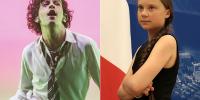
Greta Thunberg has made her musical debut on a single by the 1975. On a track called The 1975, a version of which traditionally opens each of the British band’s albums, the 16-year-old environmental activist restates her position on the need to act on the climate emergency.
Created a platform to showcase disparities that are therein in public basic schools verses the private schools.
Simple a call to duty bearers to act on the deplorable physical learning environment existing in the public schools , because the environment impacts teaching and learning.
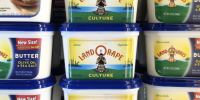
Stickers imitating the Land O Lakes Butter packaging are being placed in grocery stores over the original packaging. The packaging has been altered to say "Land O Rape - Culture" by street artist Recycled Propaganda.
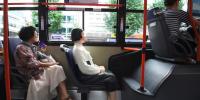
Buses serving several routes in central Seoul have acquired a new and highly controversial passenger: a barefoot “comfort woman”, wearing a traditional hanbok dress with her hands resting on her knees.
Tamms Year Ten is an all-volunteer grassroots coalition of artists, prisoners, men formerly incarcerated in Tamms, family members and other people of conscience. In 2008, at the ten-year anniversary of the opening of the Tamms supermax prison, the group launched a legislative campaign to call for its reform or closure. Men were originally supposed to be there for one year—but at that point 1/3 of them had been in solitary confinement the entire decade.
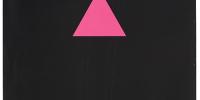
This is a prime example of the marriage of art and activism. The Silence = Death poster is simple but extremely powerful representation of the obstacles the AIDS movement was facing (suppression of gay people + their problems, lack of awareness surrounding the pandemic).