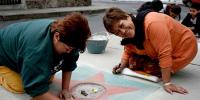
Children in marginalized communities often lack access to healthy foods, especially fresh fruits and vegetables. Poor nutrition, in turn, has significant negative impacts on a child’s health and ability to focus in school. Learning and academic achievement often plummet.
Operation Christmas was a campaign launched by the Colombian military during the Christmas season to encourage FARC guerrillas to demobilize.[1] The military selected nine 75-foot trees along paths the insurgents used and decorated them with Christmas lights and a message encouraging them to come home.
#NYTIMES Why are there no U.S. anti-slavery monuments? http://antislaverymonument.org project is an answer.
Standing 60 feet tall, corten steel of two hollow chain links the upper one broken.
“I am a silkworm.” Liang Shaoji has repeatedly used this phrase to describe his work, underscoring his preoccupation with the materiality of silk and the technology of sericulture, or silk farming. For more than twenty-five years, Liang Shaoji has raised silkworms and trained them to spin silk onto different objects in his Nature series.
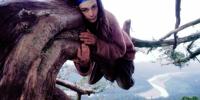
Forest activist and environmentalist Julia Butterfly Hill spent two years (Dec. 10, 1997-Dec. 18, 1999) living 180 feet high, on two six-by-six-foot platforms, in the canopy of a thousand-year-old redwood tree named Luna to help make the world aware of the plight of the redwood forest.
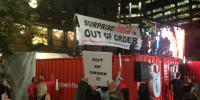
In March 2013 we started a grassroots boycott movement against Coca-Cola for exploiting legal loopholes to kill off container deposit recycling in the Northern Territory. We simply used the same successful strategy as the ANZ Out of Order action, putting out of order signs on Coca Cola vending machines and posting the photos on social media.
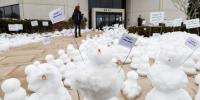
500+ snowmen appeared outside the office of Senator Chuck Schumer in Melville Monday, Feb. 15, 2021. The snowmen appear to be placed there by climate activist @pricecarbonplz. (Source: Newsday, https://www.newsday.com/long-island/photos-of-the-day-1.50139710)
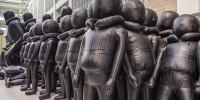
The exhibition Law of the Journey is Ai Weiwei’s multi-layered, epic statement on the human condition: an artist’s expression of empathy and moral concern in the face of continuous, uncontrolled destruction and carnage.
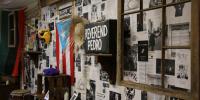
Spread over three institutions — the Bronx Museum of the Arts; El Museo del Barrio in East Harlem; and Loisaida Inc., a cultural center in the East Village — this show departs from straight political history by presenting the Young Lords as a cultural phenomenon as well as an ideological one, with a highly developed instinct for visual self-projection, right down to having an official party photographer, the gifted Hiram Maristany.
Tranvía Cero is a group of artists from Ecuador who have been creating artistic projects with the aim to empact community lives and change the ideas of art as an exclusive terrain. The describe their goal as a redefinition of art through the social engaging experiences.
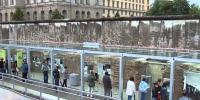
It was once the most feared address in Berlin, a place easy to enter but very hard to leave. Now the ruins of the former engine room of Nazi terror at Prinz Albrecht Strasse in Berlin have been preserved in a new exhibition space open to the public from tomorrow.
In 1982, for documenta 7, Beuys proposed a plan to plant 7000 oaks throughout the city of Kassel, each paired with a basalt stone. The 7000 stones were piled up on the lawn in front of the Museum Fridericianum with the idea that the pile would shrink every time a tree was planted. The project, seen locally as a gesture towards green urban renewal, took five years to complete and has spread to other cities around the world.
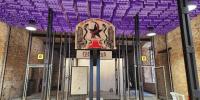
The Mexican Pavilion is an immersive space based on a 1:1 scale fragment of the expanded model of the campesino basketball court, an infrastructure that has become repurposed as a space for poly- and pluri-valent processes of decolonisation in Mexico’s indigenous communities.
Park(ing) day is a community of artists, activist, students and everyday people who, on September 21, every year and across the world, collaborate to transform parking spaces into green and friendly spaces. They invite reflections and discussions on the significance of nature and quality of life in urban areas. Park(ing) day encourages people to take over public spaces, reclaim their space, and imagine how sustainable and green cities can be.
ODBK is an activist organization that aims to create a more equal, diverse, inclusive, transparent and democratic art world. ODBK seeks to do this by diversify and increase the number of people who understand and engage with contemporary art.
"Story Time" emphasizes the significance of knowing the cultural histories of various nations and milieus, for it is precisely this knowledge that represents the first common point on the way towards understanding other cultures arriving in Europe with migratory flows. The invited artists will reinterpret cultural histories and cultural contexts from both European and Arabic worlds.
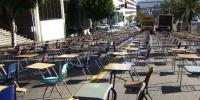
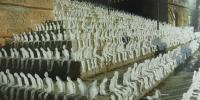
School desks placed by parents, district graduates and activists block a street in front of the Los Angeles Unified School District headquarters in a demonstration against student dropout rates Tuesday, April 8, 2014, in downtown Los Angeles. Protest organizers say the 375 desks are there to represent the 375 students who drop out of the district every week during the school year.
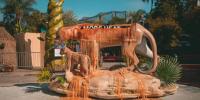
American artist Bob Partington created a wax sculpture of a Florida panther and her cub to display at a nonprofit zoo in Tampa, Florida this September.
When it debuted, the sculpture looked like nothing special. But as the wax began to melt under the heat of the sun, the bodies of the endangered species started to disintegrate. Within a couple days, the mother panther’s melting body revealed a simple message: “More heat, less wildlife.”
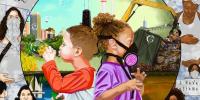
Two children stand back-to-back, but they are facing two very different Chicagos. One child blows bubbles in a park under blue skies. The other wears a gas mask against a backdrop of scrap metal and billowing smokestacks.