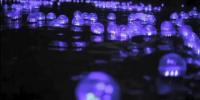
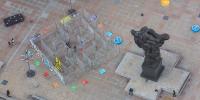
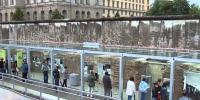
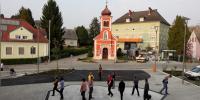
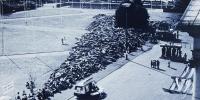
"As of October 2009, Retznei boasts a new centre. In the middle of the square the black contours of a concrete surface stand out, reminiscent of the shape of a pond. If you step on the Platform, you notice that the ground gives slightly and that it sways. Invisibly but noticeably, water reveals itself as a key component of this art work by Michael Kienzer. The water carries the Platform and us, while we are walking or standing on it.
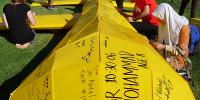
Media artist Joseph DeLappe announces the completion of “The Drone Project: A Participatory Memorial” on the campus of Fresno State University in California.
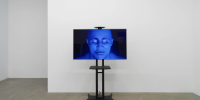
If you assign no sound to the redaction in I'm Blue (If I Was █████ I Would Die), it has the same amount of syllables as its referent, the first line of the chorus from Eiffel 65's 1999 chart-topping single, I'm Blue. The last word in that line is spelled out "da," but when you listen to Jeffrey Jey's compressed scatting, it sounds more like "die."
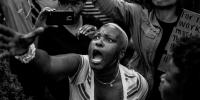
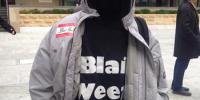
As Black History Month commemorations start to wind down, one festival is just gearing up. Afropunk the Takeover — Harlem, running from Tuesday through Feb. 25, will celebrate black culture with music, art, film screenings, discussions and comedy.
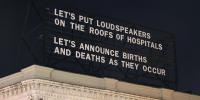
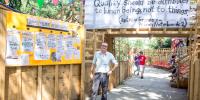
The Last Billboard is a 36-foot art installation located in Pittsburgh, Pennsylvania. Created in 2013, it features a steel frame and removable wooden letters that must be arranged by hand. Each month a different artist, activist or individual is invited by creator and curator, Jon Rubin, to come and utilize the billboard space. The participants share messages over this medium in the form of thoughtful questions, esoteric musings, or other visual means.
The Guardian:
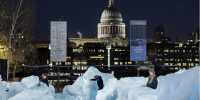
Olafur Eliasson is putting the chill into climate change. The revered Scandinavian artist has placed 24 large blocks of centuries-old ice, harvested from the Nuup Kangerlua fjord in Greenland, in a circle outside the Tate Modern in London, with another six on display in the City.
Colombian ad agency Lowe SSP3 is starting a Christmas-themed campaign to entice guerrilla fighters out of the jungle to turn themselves in. The agency may have created an advertising-to-guerrillas award category after winning a gold Cannes Lion in the outdoor category and half a dozen Grand Prix awards at other shows this year for its first holiday effort, last December.
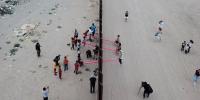
"ALBUQUERQUE — For a brief moment — just a half-hour over the weekend — a simple piece of playground equipment served as a bridge between the United States and Mexico."
“Actions that take place on one side have a direct consequence on the other side,” Ronald Rael
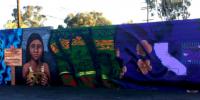
(Honoring our Origins, Ourselves and our Dreams) is an all-womyn and womyn-identified crew from the northeast San Fernando Valley dedicated to creating awareness through public art.
An installation by architecture studio Rael San Fratello, which connected children in the US and Mexico via a trio of seesaws slotted into the countries' border wall, has been crowned the Design of the Year.
Dubbed the Teeter-Totter Wall, the project was in place for only around 40 minutes in July of 2019 and hoped to foster a sense of unity at the divisive border, which was highly politicised under the Trump administration.
Blair Holt was shot and killed while he shielded another classmate from the bullets a gunman sprayed on a CTA bus in Chicago in 2007. His father is a police officer and his mother is a fire department chief, and that’s what they had taught him to do.
A set of interactive experiences at the Sziget festival in Budapest, aimed at social change to improve every day life of trans and gender-nonconforming persons.
The US prison system is one of the world’s great shames. A quarter of the world’s prisoners are being detained in a country that represents only 5% of the world’s population. It is a system that has been compared to a modern-day version of the Jim Crow laws.
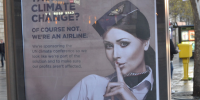
Brandalism, an organization out of the UK that aims to reclaim public spaces from advertisers, used Black Friday to protest "partner" brands to the COP21 Climate Conference.
Anonymous artists contributed subvertisements that criticized these brand for their hypocrisy in saying they are advocates for the environment when more often than not they are the worst contributors to the problem.
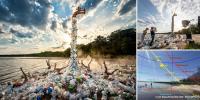
Benjamin Von Wong’s latest art-as-activism installation looks like something Photoshopped onto reality. A large brass-looking faucet, suspended in the air, pours a river of plastic out of its spout.
This protest installation was first used in 2016 at Standing Rock when the community banded together to protect the Missouri River from a Dakota Access Pipeline.
Topic: Displaced people
Concept: Explore and communicate some of the issues around displacement in a global, European and Irish context.
Date of action: 11th March 2.30 to 4.20 pm
Place: Emmett Place, Cork City, Ireland
“Gravity of Equilibrium” revolves around Mass Shootings in USA. Mass shootings and guns are an incredibly divisive topics, one that is nearly impossible to engage opposing viewpoints in a discussion about. The majority of gun related debates devolve into charged arguments with parties feeling threatened. This effectively creates an environment where new perspectives and inputs are unable to be processed.
In 1982, for documenta 7, Beuys proposed a plan to plant 7000 oaks throughout the city of Kassel, each paired with a basalt stone. The 7000 stones were piled up on the lawn in front of the Museum Fridericianum with the idea that the pile would shrink every time a tree was planted. The project, seen locally as a gesture towards green urban renewal, took five years to complete and has spread to other cities around the world.
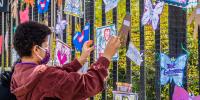
In May 2020, a team of artists, activists, folklorists, and people who lost loved ones to Covid-19 came together to make monthly memorial sites in New York City to remember victims of the Covid-19 pandemic. They continued installing memorials around New York City every month during the summer of 2020.
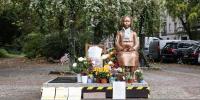
Photo taken on Oct. 15, 2020 shows a "comfort women" statue in Berlin, capital of Germany. The statue was built to commemorate the more than 200,000 girls and women from 14 countries and regions, so-called "comfort women," who were sexually enslaved by the Japanese military during World War II. (Xinhua/Shan Yuqi)
It was once the most feared address in Berlin, a place easy to enter but very hard to leave. Now the ruins of the former engine room of Nazi terror at Prinz Albrecht Strasse in Berlin have been preserved in a new exhibition space open to the public from tomorrow.
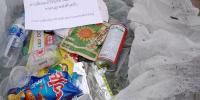
Officials in Thailand had an unorthodox approach to deal with visitors who left a tent filled with litter in a national park: mail the trash to the offenders.