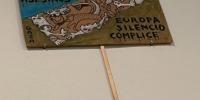
In 1989, playwright, actor, and activist Safdar Hashmi was fatally attacked by political thugs while performing a street play outside of Delhi. His death led to the founding of Sahmat, an influential artist collective that has taken a consistent stance against the threats of religious fundamentalism and sectarianism in India through a vibrant mix of high art and street culture.
In this black-and-white image, there are no strands of hair or remnants of makeup to be found, except a shaved head belonging to a South Korean. Jeon photographed this image in 2019 for her exhibition that aimed to "destroy the socially defined idea of a woman” (Kuhn 1). The visuals in this image is a brazen response to the conventional beauty standards that has been gripping South Korean women.
The rise in feminism and feminist advocacy has changed history forever in terms of how women are viewed and treated in society. Though great progress has been made, women are still fighting for their rights even today. Abortion and body vulnerability are just two issues that are still being confronted and fought for in the public view.
Forensic Architecture's Cloud Studies is a project that investigates the impact of toxic clouds on colonised and oppressed communities. The clouds, originating from sources like tear gas, industrial emissions, chemical weapons, and forest fires, often go unaddressed due to doubt and denialism.
This article was published on the guardian website:
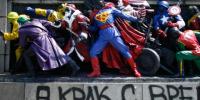
-Russia not amused at Red Army statue re-invented as Superman and friends-
Clenched teeth in Moscow over 1950s war memorial in Sofia given makeover by spray-painting street artist
By Tom Parfitt in Moscow
The Guardian, Wednesday 22 June 2011
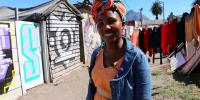
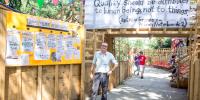
At the age of just 30, Palesa Ngwenya is helping transform these areas through her position as development coordinator of Maboneng Township Arts Experience. “We turn homes in the townships into art galleries,” says the young South African woman, who grew up during apartheid. “It’s about showing people that you can use what you have to do things that can change your life."
The Origins of Totalitarianism:Donald Trump reads Hannah Arendt
AI video and sound. 2024, 24:30mins
YouTube link: https://youtu.be/RzWi51prZlA?si=hTUP4F-_nOSijbba
Brian Larney is an AI.tivist or American Indian artist. He is also an Artivist where he performs Artivism, a concept that includes art as a form of activism.
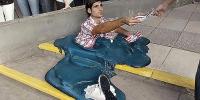
A young man melting into a puddle of himself is something you don’t see everyday, much less in a busy public square. Yet this humourous but surprisingly effective spectacle is the latest effort by the Red Cross of Argentina to raise awareness about climate change.
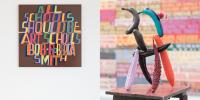
Bob and Roberta Smith has been at the forefront of activist art for 2 decades; so who better to ask about how art is responding to these politically bleak times?
Created by and for women, Broccoli is an independent print magazine based in Portland, Oregon. Although intended for cannabis users, Broccoli is an art and lifestyle magazine that bills itself as “playful, informed, eclectic, and thoughtful.” It encourages the discovery and appreciation of cannabis through explorations of art, culture, and fashion.
Vince Staples mentioned Long Beach's Ramona Park approximately 80 times on his debut album Summertime '06 and even allotted the park two of its own tracks: "Ramona Park Legend Pt. 1" and "Ramona Park Legend Pt. 2." "The sun come down and guns come out, you know Ramona Park."
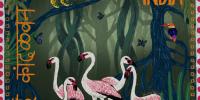
Anjali Mehta is an illustrator from New Delhi, India. She is primarily known for her graphic shapes, gentle lines, bold colors, and strong female subjects. She is also designing a series titled Enroute Extinction that uses the same bright colors and familiar layout of a postage stamp. This series highlights animal species in India that are at risk of extinction.
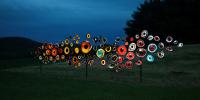
Australian recycling initiative MobileMuster, a free mobile phone recycling program that accepts all brands and types of mobile phones, teamed up with artist Chris Jordan and college students from Melbourne, Australia to create a public installation. The installation, which is composed of over 8,000 discarded mobile phones, was presented in Melbourne during the Sustainable Living Festival, which takes place in February.
“Teilchenbeschleuniger” ist ein investigatives Kunstprojekt des Künstlerduos 431art, welches Atomenergie kritisch reflektiert. Der “Teilchenbeschleuniger” verteilt Teilchen namens “Jülicher Törtchen”, “Brokdorfer Mürbchen” oder “Muffins Fukushima” an die Bevölkerung.
A disability / textile arts project, challenging assumptions about disabled artists & highlighting shoddy treatment of disabled people by current government:
https://shoddyexhibition.wordpress.com/
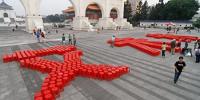
A large chair installation work featuring the Chinese name of detained artist and activist Ai Weiwei was set up in Taipei Saturday --the 22nd anniversary of the Tiananmen SquareMassacre -- to call for Ai's release.
Bei Ling, an artist from China who has been barred from enteringhis home country since 2000, used 1,001 empty chairs to piece together the three characters of Ai's name in Liberty Square at 6: 04p.m.
This piece is fascinating because of its use of just a few words and country names, muted colors, and the recreation of famous art. The artist used this canvas to depict a concern about events happening in the Gaza strip.
Birds Watching I, 2018 was created for Storm King Art Center's Indicators: Artists on Climate Change, in partnership with NRDC, which ran from May–Nov 2018, and featured 100 U.S. climate-threatened species derived from Audubon's first report. That work was reinstalled as a public sculpture in Chicago on the elevated 606 Bloomingdale Trail between St. Louis Ave. and Kimball Ave. and is fully-accessible via the Spaulding Ave. ramp.
Aníbal López, also known by his government identification number A-153167, is a pioneer of performance art in Central America. ArtBus describes his work as, "Generally aimed at immersing viewers into the region’s social and political tensions, his works combine the dry language of 1960/1970s conceptual art with the revolutionary ethos of a Latin American guerrillero.
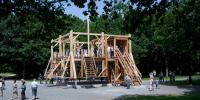
Sam Durant is an LA based artist who engages in social, cultural and political issues through his interactive public sculptures. Durant is interested in investigating historical narratives and their contemporary communities. From 2005-2010 Durant was part of the collective Transforma Projects, a grassroots cultural rebuilding initiative in New Orleans. One of his most recent interactive public sculptures Scaffold is on view at the Hague.
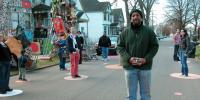
The Heidelberg Project is an outdoor art project in Detroit, Michigan. It was created in 1986 by artist Tyree Guyton and his grandfather Sam Mackey ("Grandpa Sam") as an outdoor art environment in the McDougall-Hunt neighborhood on the city's east side, just north of the city's historically African-American Black Bottom area.