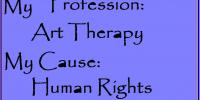
We demand that AATA respond to Karen Pence's stated commitment to our field by asking her to publicly take action for the rights of LGBTQIA people, Native people, Black and Brown people, Muslims, survivors of sexual assault, people with disabilities, immigrants, refugees and all people who are in danger as a result of the policies of the current administration.
Her name is ISIS-chan. And she's how nerds around the world are trying to silence violent ISIS terrorist propaganda.
It starts with the vibrant worldwide community that loves Japanese anime. Some of them have created a cute animated character as a sort of ISIS mascot.
The goal? Hijack the terrorist group's message and replace it with a girl that's oh-so-adorable.
Alexandria "Lexi" Aniyah Rubio was looking forward to playing volleyball when she got to junior high. She dreamed of going to law school one day, and she loved astrology, butterflies, and the color yellow.
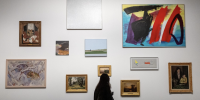
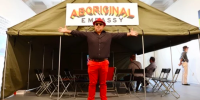
Richard Bell has often called himself ‘an activist masquerading as an artist’. Aboriginal journalist and radio broadcaster Daniel Browning has suggested that Bell is also ‘a megaphone.
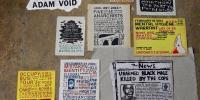
The prints exhibited June 2013 at Firestorm in Asheville NC, will comprise two separate bodies of work; Chelsea Ragan’s combination screen print / woodblock print / painting / drawings graphically detail police shootings of young black males from across the country, and Adam Void’s hand-painted screen prints state the facts of important national news stories that have been swept under the rug of mainstream corporate media.
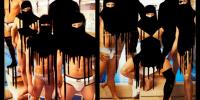
Princess Hijab is an anonymous female street artist working primarily in Paris, France. Her art centres on veiling the main characters of subway advertisements using black paint. Few facts are known about Princess Hijab.
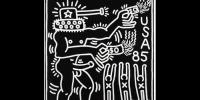
It's this symbolism and the characters that repeatedly appear in Haring's work that provide the backbone of an exhibition opening March 16, 2018 at the Albertina Museum in Vienna. On view through June 24, 2018, "Keith Haring. The Alphabet," comprises 100 of the artist's works, from subway art and drawings to sculptures and paintings.
Photography has long been associated with acts of resistance. It is used to document action, share ideas, inspire change, tell stories, gather evidence and fight against injustice.
This group exhibition at the SLG, organised in collaboration with the V&A, brings together works by international artists and collectives who are using the camera to challenge and move beyond traditional protest photography.
DOHA — In an interview with the Paris Review in 1993, the late Toni Morrison once said,
I think of beauty as an absolute necessity. I don’t think it’s a privilege or an indulgence. It’s not even a quest. I think it’s almost like knowledge, which is to say it’s what we were born for.
For an art project about the effects of white privilege and the disturbing ways in which its effects are built into our society, Risa Puno’s The Privilege of Escape is a surprisingly fun, even enjoyable experience.
Swiss doctors are expanding the range of prescriptions for patients with mental health conditions and chronic illnesses to include strolls in public gardens, art galleries and museums.
The city of Neuchatel, in western Switzerland, launched the pilot project with doctors last month to help struggling residents and to promote physical activity.
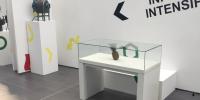
How did a pineapple become a postmodern masterpiece?
The aesthetic merits of tropical fruit inadvertently entered Britain’s national cultural conversation after two students jokingly placed a store-bought pineapple on an empty table at an art exhibition this month at Robert Gordon University in Aberdeen, a port city in northeastern Scotland.
Rooted in Native American and indigenous practices,[11] restorative justice is a set of principles and practices that aims to help communities heal from conflict and harm by developing a common understanding of the root causes and effects.[12] Restorative justice can occur in a variety of different contexts: in the workplace, at schools and within, or instead of, the criminal justice system.
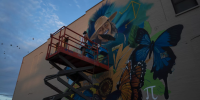
Spanish street artist El Rey de la Ruina uses murals and installations to critique inequality and government policies. His works, especially during the pandemic, voiced concerns over healthcare, housing, and public resources in Madrid’s urban spaces.
Chanel Miller is a Palo Alto–born artist and writer. She first came into the public eye as “Emily Doe,” the victim of a 2015 Stanford University sexual assault whose impact statement presented in court went viral. Miller relinquished her anonymity in 2019, when she published the acclaimed memoir, “Know My Name.” "I was, I am, I will be" is Miller’s first commissioned artwork for a museum and is on view through February 2022.
In the 1980s, Holzer and Lady Pink used New York as a backdrop for their artworks: Holzer wheatpasted posters and slogans on walls throughout Manhattan, and Lady Pink spray-painted graffiti on buildings and subway cars. The two also collaborated on a series of paintings on canvas, such as this work, for which Holzer composed phrases and Lady Pink did the painting.
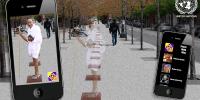
Imagine affecting the global cultural Landscape through art and technology use. Imagine one-mile long installation in 100 city locations worldwide, each mile-long install is of 250 bronze plaques of different Peacemakers. Then imagine its own App that when any smartphone is pointed at one of the plaques an entire timeline biographical history of that peacemaker becomes available.
Vetements' trademark is for subverting the fashion industry’s ways of doing things. Following its recent return to the runway after a short one season break, designer Demna Gvasalia has unveiled his latest project.
From Black Power to Migrants’ Power
BY Robin Cembalest POSTED 01/22/13
As ’60s activist art enters museums, a new generation is creating an iconography of protest for today
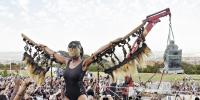
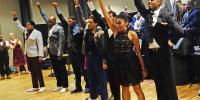
At the New Orleans Swing Dance Festival the all African-American dance troupe The Rhythm Ambassadors were presented along side an African-American iteration of the Preservation Hall All-Star band with African-American vocalist Taryn Newborne to deliver the message that the African-American Lindy Hoppers were going to be protest until their rhythm is better presented...i.e.
Inspired by the ecological disaster unfolding across the planet and driven by empowering underrepresented people, Moule, a painter, illustrator, and graphic designer, creates art that makes a statement.
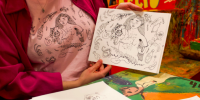
Dressed in a magenta blazer and wearing bright pink lipstick, she is as colourful and spirited as one of her illustrations.
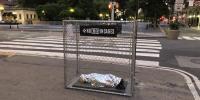
The ad agency Badger & Winters in collaboration with immigrant rights nonprofit organization Refugee and Immigrant Center for Education and Legal Services (RAICES) installed 20 cages with mannequins representing immigrant children inside across New York City. Each cage had a sign that said #NoKidsInCages and played audio of a child crying.
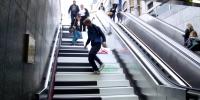
“Piano Stairs” is an interactive playful musical stairway installation created into the Odenplan underground station of Stockholm to make people use stairs more often than elevator. The project was part of a Wolkswagen initiative called “The fun theory” whose main objective and mission is to “change people’s behaviour for the better by making it fun to do.”
Slippery When Wet proposes a wet ontology of Hong Kong—a city in ongoing transfiguration shifting into an uncanny vision of itself. Hong Kong secretes, leaving a trail of ink, tears, humidity, logistic flows, and leaks.
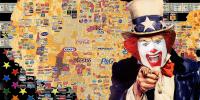
Ever get to thinking about how a food desert can pop up in the middle of a major city? One major reason is corporate fast food and manufactured goods. Food deserts are defined as urban neighborhoods and rural towns without ready access to fresh, healthy, and affordable food.