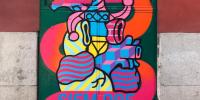
Spanish street artist El Rey de la Ruina uses murals and installations to critique inequality and government policies. His works, especially during the pandemic, voiced concerns over healthcare, housing, and public resources in Madrid’s urban spaces.
"Surround Congress”: as soon as we’d heard this, in our minds we were there. To make the Government resign and demand they start a new constituent process seemed like a great idea. We immediately got to work.
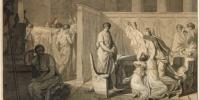
Jacques-Louis David was an active member of the French Revolution, and his works often depicted his political affiliations. David’s painting The Lictors Bring to Brutus the Bodies of His Sons portrays the scene of Brutus, an important figure of the Roman Republic, reacting to the death of his sons. Since they wanted to overthrow the government and restore the monarchy, Brutus ordered their death.
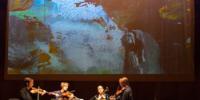
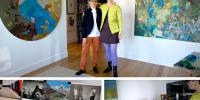
This month’s blast of arctic air may have roused climate-change skeptics. But the composer Laura Kaminsky and the painter Rebecca Allan were unfazed. Holed up in their apartment in Riverdale in the Bronx on one of the coldest days in decades, these longtime artist-activists were doing what came naturally: fighting the planet’s warming.
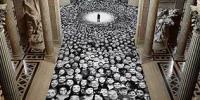
After winning the TED Prize on March 2, 2011, the French-artist JR launched the Inside Out Project, in his first TED Talk. Using his own artistic practice as inspiration, this participatory platform helps individuals and communities to make a statement by displaying large-scale black and white portraits in public spaces. Through their “Actions,” communities around the world have sparked collaborations and conversations.
A CALL TO ARTISTS:
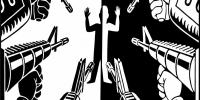
The American Friends Service Committee (AFSC) has created a new, nationally touring poster exhibit called All of Us or None: Responses and Resistance to Militarism. The exhibit will launch in June and is already scheduled to travel to Chicago, Greensboro, Providence, and San Francisco with many other stops anticipated. We are looking for some additional work to include in this show.
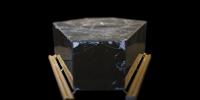
The Mirror Casket project is a sculpture, performance, and visual call to action designed and orchestrated by a collaborative of St. Louis community artists in response to the shooting death of Michael Brown on August 9, 2014 in Ferguson, MO.
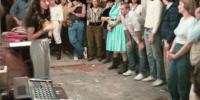
Adrian Piper's "Funk Lessons" (1982-84) was a series of performances and collaborative events in which the artist taught white participants about black funk music, its culture, and its history, aiming to deconstruct stereotypical ideas about Black culture.
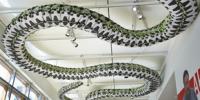
On May 12, 2008, a massive earthquake in China’s Sichuan province killed approximately 90,000 people. Ai Weiwei created this serpentine sculpture, made of backpacks, to commemorate the more than 5,000 school children who were killed when their shoddily constructed schools collapsed.
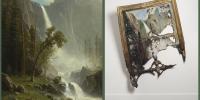
“Nature’s Nation: American Art and Environment” is an important exhibition organized by the Princeton University Art Museum is on view at the Peabody Essex Museum, in Salem, Massachusetts, from February 2 through May 5, 2019.
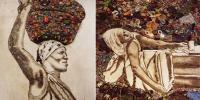
In 2008, my work as an artist took me to a gigantic landfill outside Rio de Janeiro called Jardim Gramacho. After operating for more than 30 years, the sanitary facility, once one of the largest in the world, had reached its maximum capacity and was on the eve of closing permanently.
Two pairs of dusty, pastel-orange roller skates. A ram's skull. Several meters of tangled, bright red rope. They aren't the sort of items you'd find in the great fashion houses of Europe or on North American catwalks.
But, for unconventional Chinese designer and performance artist Wan Yunfeng, they are perfect.
From his small apartment in eastern Beijing, Wan makes fashion that only he wears.
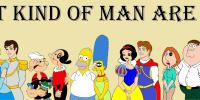
In a dark nod to International Women's Day, artist aleXsandro Palombo has turned to the world of cartoon characters to shed light on the horrors of domestic violence. His series, "No Violence Against Women," transforms iconic animated women into victims of abuse, resulting in a familiar yet ultimately disturbing collection of illustrations.
Mural artists add color and flavor on 800 South in the Granary District of downtown Salt Lake City. There’s an old-fashioned bar on the side of a locally-owned brewery, and a Southern Utah landscape on another building. Down the street, on the south corner of 800 South and 300 West, there’s a new mural that’s far more potent.
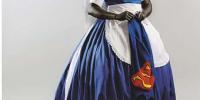
The work of South African artist Mary Sibande tells the tale of her alter-ego Sophie, a domestic worker who finds refuge in dreams where she emancipates herself from the ghoulish realism of an ordinary existence, cleaning other people's homes.
Exploring the construction of identity within post-apartheid South Africa, Sibande's work probes the stereotypical contextualisation of the black female body.
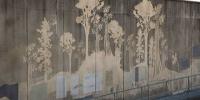
Reverse graffiti is form of street art that involves carving into the dirt and dust that surrounds us. Artists subtract from a surface in order to create a negative image within the positive, often quite dark layer of grime.
The sneaker brand Converse has commissioned an indigenous artist in Australia to create a gigantic mural with a surprising twist. The Melbourne mural plays homage to indigenous urban identity and was painted with a special type of pollution-absorbing paint that “cleans the air,” according to the agency behind the project, Amplify.
El Rey de la Ruina (The King of the Ruin) has become an act of powerful recognizable symbolism throughout Madrid. In terms of his popular heart symbolism, the artist chose the organ, a heart, as one of his favorite symbols because he was diagnosed when he was little with cardiomegaly, an abnormal increase in the volume of the heart, which is what inspired this organ as his prize art symbol.
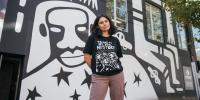
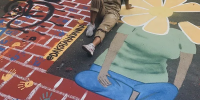
“As a Black woman, I can grow absolutely anywhere," Aiyanna explains. "I can adapt to any storm, any weather, any changes. In the Black community, that's something that we're really good at.”
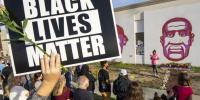
So when Aiyanna, 25, was asked to contribute the first L in a Black Lives Matter mural made by a group of artists in downtown Charlotte, North Carolina, she knew her letter would include a flower person.
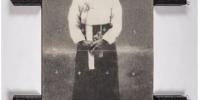
In the series The History of Korean Women, Cho's suggests that the cost of that gain cannot be paid for by a cultural amnesia masking the pain and suffering of previous generations. Here the semantic emphasis is on the official - the status of women and their contribution to the survival and growth of Korea. Their efforts have gone uncelebrated due to their relegated status within a five hundred year old social system.
This month’s blast of arctic air may have roused climate-change skeptics. But the composer Laura Kaminsky and the painter Rebecca Allan were unfazed. Holed up in their apartment in Riverdale in the Bronx on one of the coldest days in decades, these longtime artist-activists were doing what came naturally: fighting the planet’s warming.
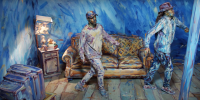
Transfixed by racial, political, and socioeconomic tensions saturating the news, movement artists Jon Boogz and Lil Buck, enveloped by the art of Alexa Meade, switch off the TV and release their emotion into a stirring dance that is both a lament and a spirited call to action.
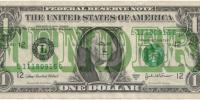
Title 18, Part 1, Chapter 17 of the United States Criminal Code:
"Whoever mutilates, cuts, defaces, disfigures, or perforates, or
unites or cements together, or does any other thing to any bank bill,
draft, note, or other evidence of debt issued by any national banking
association, or Federal Reserve bank, or the Federal Reserve System,