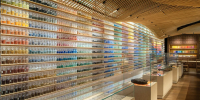
Established in 2015 in the Tennōzu neighborhood of Tokyo, and attracting industry professionals and art enthusiasts from both Japan and abroad, PIGMENT TOKYO has emerged as an art supply store specializing in the materials and tools used in traditional Japanese painting, such as mineral pigments, washi paper, and brushes. However, it’s more than just a store.
About us
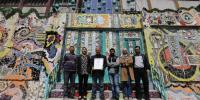
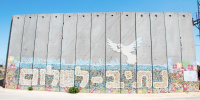
"Path to Peace" - is a joint mosaic creation, by thousands of people, towards hope, love, and happiness among all people. The creation is placed upon the border wall that divides the Gaza Strip and Israel, adjacent to the homes of Moshav Netiv HaAsara.
The creation is seen from both sides of the wall, spreads on the gray security wall and completely changes the place's atmosphere.
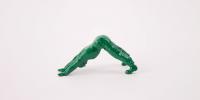
If something is a total opposite to war, that is the practice of yoga. Concentrating or relaxing your muscles and mind in order to release tension, is something a soldier would never have the luxury to do under the dangerous circumstances of war.
Inventor Dan Abramson thought of a amazingly creative and beautiful way to connect the two, by creating “Yoga Joes”, a series of simple green plastic army men that have some killer… yoga moves.
A group of Syrian artists in Damascus has created the world's biggest mural made of recycled materials, a rare work aimed at brightening public space in a city sapped by war and sanctions.
The brightly coloured, 720-sq metre work was constructed from aluminum cans, broken mirrors, bicycle wheels and other scrap objects and displayed on a street outside a primary school in the centre of the Syrian capital.
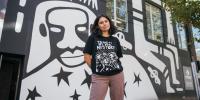
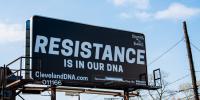
Shooting Without Bullets incubates young artist activists and eliminates systemic barriers in art and society for Black and Brown youth, all while spreading bold messages of justice and equity across Northeast Ohio and beyond. In Our DNA, their new public art initiative, uplifts Cleveland’s Black history to catalyze present and future racial equity, social justice, and civic engagement efforts across Cleveland communities.
“Badass Indian Pinups” is a series of paintings by Indo-Canadian artist Nimisha Bhanot, that features paintings of Indian women being confident and sexually liberated.
IMPEACH
An online exhibition of art work by twenty artists
Katherine Aoki, Deborah Harris, Nicolas Lampert,Cicely Cottingham,
Art Hazelwood, Ilse Schreiber-Noll, Priscilla Stadler, Tim Fite, Anne Q McKeown, Anne Dushanko Dobek, Robyn Ellenbogen, Joseph O’Neal, Donna Coleman, Robert Geshlider, Michael Dal Cerro, Leona Strassberg Steiner, Barbara Madsen, Ray Must, Carol Radsprecher and Patricia Dahlman
In 2016, Zhou Zhenfeng, who was a student at a college in Hebei at the time, discovered that there were a lot of waste tires in the streets and alleys. Zhou Zhenfeng learned that tires are made of infusible or refractory polymer elastic materials. It takes hundreds of years for these materials to decompose in the soil to the extent that they do not affect the growth of plants.
The Dreamland Artist Club project was named after one of the famous amusement parks in Coney Island. The project consisted of more than 25 artists coming together to repaint rides and make custom signs, murals and scenic backdrops for the legendary neighborhood. Most of the artists that participated in this project were from New York City and therefore had a particular interest in the visual culture of the city.
The streets of the Cairo suburb Manshiyat Naser, nicknamed "Garbage City," are lined with trash, and the people who live there — Coptic Christians who make their living sorting through it and recycling anything they can — are called zabaleen, or "garbage people."
The sneaker brand Converse has commissioned an indigenous artist in Australia to create a gigantic mural with a surprising twist. The Melbourne mural plays homage to indigenous urban identity and was painted with a special type of pollution-absorbing paint that “cleans the air,” according to the agency behind the project, Amplify.
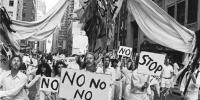
This year marks the 50th anniversary of one of this country’s most beloved theater companies. Founded in New York City in 1963, the Bread and Puppet Theater’s first productions ranged from puppet shows for children to pieces opposing poor housing conditions. The group’s processions, involving monstrous puppets, some about 20 feet high, became a fixture of protests against the Vietnam War. "We don’t have playwrights in the theater.
In Tunisia, a country gripped by economic uncertainty and still in the midst of rebuilding its identity after the Arab Spring, hip-hop culture is viewed as part of an ongoing dissident movement. Just a few events, such as the recent Mafia Wallitili Festival in the heart of downtown Tunis, offer the local hip-hop community an opportunity to share their values with the broader population.
The Amplification Project: Digital Archive for Forced Migration, Contemporary Art, and Action (https://theamplificationproject.org) is a crowdsourced community digital archive aiming to raise the visibility of art and cultural productions inspired, influenced, or affected by forced migration and refugeehood.
In a visually captivating public art venture, the Audonon Mural Project seeks to raise awareness for species of birds threatened by climate change in a rather unconventional way—street art. A collaboration between the National Audubon Society and Gitler &_____ Gallery, scatterings of stunning avian themed murals are cropping up throughout John James Audubon’s old Manhattan neighbourhood.
By Joe Laur
Members of the creative collective Neozoon, a group of artists based in Paris and Berlin, are staging a protest against using animal furs as fashion by turning fur coats into street art graffiti.
Apparently, they are taking furs and fur garments and reshaping them into animals in action on streets, along alleyways, against walls and even on trees in parks.
These two works on canvas were made with my own blood, using the severed distal phalanx of my index finger as the painting instrument. They are connected to my solo anti-war action in Copenhagen in September 2026.
Their central messages are “No to War!” and “Peace & Love!” The index finger—the finger used to pull a trigger—became the central symbol of my refusal to participate in aggression and the killing of other people.
These graffiti artists were given carte blanche over an entire warehouse to do with what they wanted. The result? Everything from the soundtrack from the videography, editing and the painting is just absolute brilliance.
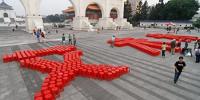
A large chair installation work featuring the Chinese name of detained artist and activist Ai Weiwei was set up in Taipei Saturday --the 22nd anniversary of the Tiananmen SquareMassacre -- to call for Ai's release.
Bei Ling, an artist from China who has been barred from enteringhis home country since 2000, used 1,001 empty chairs to piece together the three characters of Ai's name in Liberty Square at 6: 04p.m.
Chinese artist and activist Ai Weiwei has recreated the image of drowned infant Alan Kurdi that in 2015 became the defining symbol of the plight of Syria’s refugees.
For the recreation, Ai lay on a pebbled beach on the Greek island of Lesbos. His pose was similar to that of Kurdi’s lifeless body, which washed up on a beach near the Turkish town of Bodrum and was captured in a September 2015 photo.
Anthony Papa was arrested for a drug crime and with no prior offenses was sentenced to 15 years to life in prison for violating New York's harsh drug laws. While in prison, Papa began to document his inner struggles via painting and ultimately earned a pardon from New York governor and has gone on to actively fight the drug war in his years since release.
Jenny Hozler has mined declassified U.S. government documents for the series Redaction Paintings meticulously silk-screened works that depict blacked-out handprints of American soldiers accused of committing crimes in Iraq.
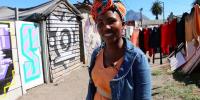
At the age of just 30, Palesa Ngwenya is helping transform these areas through her position as development coordinator of Maboneng Township Arts Experience. “We turn homes in the townships into art galleries,” says the young South African woman, who grew up during apartheid. “It’s about showing people that you can use what you have to do things that can change your life."
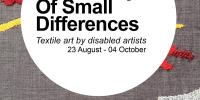
An exhibition of textile-based work by disabled artists, organised in protest at the inaccessibility of an exhibition by a popular artist, when it came to Leeds.
"Intrabody Wireless Network" is a show of eighteen drawings and collages by Dmitry Borshch, in which he shows the architecture of such networks, their components referred to as nanomachines (biological, physical, chemical sensors, routers, antennas, interface devices), options for communicating (molecular, electromagnetic – in the terahertz band, acoustic, nanomechanical), and this type of network's applications (human, plant, industrial)