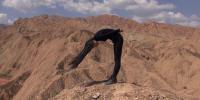
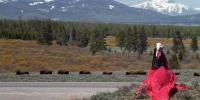
Tong Wenmin is a Chinese performance artist affiliated with works exploring movement, interaction, and humanity. Her art is a relationship between human behavior and the natural world, a round dynamic between physicality and environmental elements. One of her most compelling works, "FLYING THE WIND," is outstanding in merging performance art with a deeper exploration of the interaction between humans and nature.
Counterspace is an independent curatorial platform functioning as the first decolonial thinktank mapping cultural activism worldwide. It shapes collectively decolonial toolkits with common tools and resources, and a global directory browsable by continent, praxis, and social construct, as a Beuys-inspired ‘social sculpture’ revisited, and an alternative map of the universe.
In Pittsburgh, Memphis and Los Angeles, massive billboards recently popped up declaring, “Birds Aren’t Real.”
On Instagram and TikTok, Birds Aren’t Real accounts have racked up hundreds of thousands of followers, and YouTube videos about it have gone viral.
Last month, Birds Aren’t Real adherents even protested outside Twitter’s headquarters in San Francisco to demand that the company change its bird logo.
Creative Time, Social Practice Archive: In 1989 actress/writer Rhodessa Jones was conducting classes at the San Francisco County Jail. Working with female inmates, she developed material for a performance piece called Big Butt Girls, Hard-Headed Women based on their lives and shared experiences.
As Black History Month commemorations start to wind down, one festival is just gearing up. Afropunk the Takeover — Harlem, running from Tuesday through Feb. 25, will celebrate black culture with music, art, film screenings, discussions and comedy.
Tamms Year Ten is an all-volunteer grassroots coalition of artists, prisoners, men formerly incarcerated in Tamms, family members and other people of conscience. In 2008, at the ten-year anniversary of the opening of the Tamms supermax prison, the group launched a legislative campaign to call for its reform or closure. Men were originally supposed to be there for one year—but at that point 1/3 of them had been in solitary confinement the entire decade.
I was born in the 90s, but I’m not a Born Free; it was before South Africa became a democracy. Many believe that my generation doesn’t have anything to protest against. Given that police threw stun grenades at a student protest outside parliament last month, that is far from the truth.
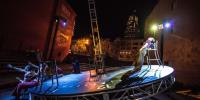
"There is a tragic timeliness to Flyaway Productions' Meet Us Quickly With Your Mercy. As the nation grapples with systemic racism and police brutality, as well as the COVID-19 pandemic, choreographer Jo Kreiter's new aerial work seeks to amplify the call for ending the mass incarceration that disproportionately affects people of color.
The Uganda National Contemporary Ballet (UNCB) presented a new powerful and moving production advocating for the child soldiers all over the world at the National Theatre in Kampala.
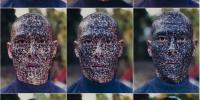
One of the most critical artists on the contemporary art scene is Zhang Huan. His works are of great social insight and unique in how he applies his artistic expression. He thus makes them an almost visual feast with a peek into the multilevel structure of modern society. One such work is the masterpiece "Family Tree," which shows how art can mould our social cognition through multilayered symbolism and profound imagery.
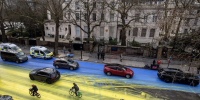
Yesterday morning (23 February), Led by Donkeys staged a protest in front of the Russian embassy in London, creating a large-scale public artwork in solidarity with Ukraine. The group poured litres of yellow and blue paint on each side of the carriageway on Bayswater Road. Activists then used brushes to create a Ukrainian flag that would stretch the length of the embassy.
A series of performances orchestrated by Lila Roo, to bring awareness to the past, present and future issue of the physical and energetic violence against the First Nation of the native buffalo and peoples of the United Sates of America in the past few hundred years. Lila worked alongside activists, the buffalo and First Nation musicians and spiritual leaders to create multi-sensory blessings for the blood spilt.
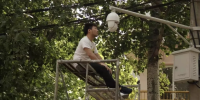
Ge Yulu’s artistic practice playfully pulls at the strings of a social system that, although seemingly all-encompassing, is in fact a malleable structure consisting of individual human beings. For his 2016 project Eye Contact, Ge positioned himself in front of a surveillance camera and stared directly into the lens for hours, then negotiated with a security guard to buy the footage.
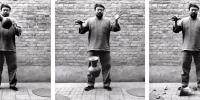
Dropping a Han Dynasty Urn (1995) by Ai Weiwei is a highly provocative work of art. This series of three black and white photographs portray the artist holding a 2,000-year-old Han dynasty urn that, frame by frame, he drops, it falls, and shatters. As much a work of photography as a work of performance art, in each still an unaffected Ai looks directly at the camera aware of his destructiveness.
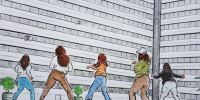
The Islamic Republic has always frowned upon dance but recently even a simple choreographed or ‘synchronized movement’ – as the regime calls it – has become an act of protest.
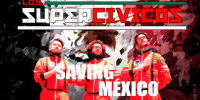
Acting on a tip from a disgruntled neighbor, two comedians dressed as drag queens confronted parking officers in broad daylight.
The pair wanted to know why the officers, who so ruthlessly enforced parking limits, had never so much as given a warning to the local fruit salesman, whose battered Ford Explorer sat illegally parked all day, every day, in the upper-class neighborhood of Polanco.
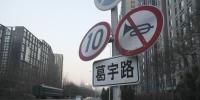
In 2017 Ge Yulu became a national sensation in China. That year, he submitted his final project as a student at the Central Academy of Fine Arts in Beijing, revealing the unnamed road in Beijing that he had claimed in 2014 as his own. Because the Lu character in his name means road, he erected a sign for Geyu Road that blended seamlessly into the setting.
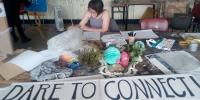
We were aiming to raise awareness and empathy around the theme of loneliness and disconnection, by engaging with passers by on a personal level and helping them to think about what they could do to make others feel less disconnected.
Our City is a startup nonprofit based in Oakland and working with cities everywhere. They work with governments, cultural institutions, companies, community organizations, designers, and residents to produce
events, installations, and workshops that use public design to improve cities.
AMNA NAWAZ: Since anti-government protests erupted in Iran last year, people around the world have taken to social media to show their support.
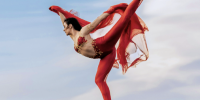
That includes an Iranian American ballerina who's tapping into her own heritage and her art, in solidarity with those pushing for more rights.
The "NewsHour"'s Julia Griffin reports for our arts and culture series, Canvas.
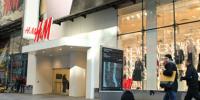
On a freezing Friday in January, Khmer-American artist Kat Eng sits in front of retail giant H&M’s Time Square store working on a manual sewing machine. For eight hours, Eng stitches together U.S. dollar bills while wearing a surgical mask and bloodstained shirt. Her performance “</3 Less Than Three” protests the way fast fashion and consumer culture creates oppressive conditions for Khmer workers.
For the completion of her residency as the NYU Steinhardt 2023-24 Scholar-in-Residence, Dominique Jackson collaborated with NYU students to honor the fem queen (trans women) and their historical meaning to not only ballroom but popular culture at large.
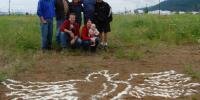
On Saturday, June 22, a group of friends will meet at one of the more than 4,000 natural gas wells that have been drilled by hydrofracking in Pennsylvania. Instead of picket signs, however, they'll be carrying a picnic basket. For an event they're calling "Picnic on the Gas," they'll strive to show that it is possible to live with creativity and even joy in gas drilling country.
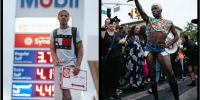
There were still bloodstains outside the Midwood Mobil gas station on Friday night; a fresh sign taped to a lamppost read “A Hate Crime Happened Here.” This is the place where, less than a week prior, 28-year-old O’Shae Sibley, a gay Black dancer and choreographer, made a pit stop with friends after a Jersey beach day.