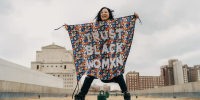
Sewing and textiles have always been a part of the artist Aram Han Sifuentes’ life. Her South Korean immigrant parents operated a dry cleaning business, and she mended her own clothing from a young age.
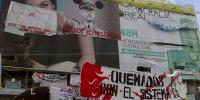
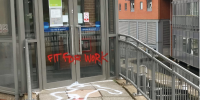
Graffiti art is particularly viewed as a powerful form of social protest, and the (illegal) act of defacing can be as important as the message itself. Artist Void One has been arrested on numerous occasions for his politically-charged interventions.
“I didn’t set out to make political art but art is a platform where I can vent my frustrations” – Void One.
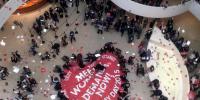
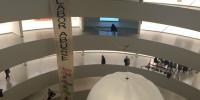
A thirty-nine-foot banner was unfurled in the rotunda of a sparsely-attended Guggenheim Museum this evening, the latest action carried out by the Gulf Ultra Luxury Front (G.U.L.F.) activist group. Decrying labor abuse at the museum’s planned Abu Dhabi outpost, the banner announced the forthcoming “Countdown” campaign by Gulf Labor, the larger collective of artists and activists of which G.U.L.F. is an offshoot.
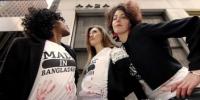
‘MADE IN BANGLADESH’: NEWYORKERS RAISE AWARENESS ABOUT WORKER EXPLOITATION IN FASHION INDUSTRY
New York City – Models are marching along the biggest shops in Fifth Avenue, wearing faux bloodied shirts with statements 'Made in Bangladesh’, ‘Support Cheap Labor.’
Myths about ethical consumption: ineffective, expensive and subordinate
"A Night of Philosophy and Ideas is a thinker’s lollapalooza. The free, 12-hour weekend lyceum at the Brooklyn Public Library includes spirited debate, live music, theater, performance art pieces, and film screenings. At any given hour, five or six different events will be taking place simultaneously. Visitors are encouraged to come and go as the spirit moves them.
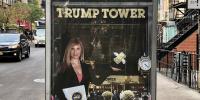
NEW YORK, Ny., Nov 19, 2018 - Two artists, Actress/Creator/Native New Yorker Maia Lorian and collaborator veteran NYC Street Artist Abe Lincoln Jr. bring to you “A Presidential Parody.” In a nation that seems to place higher value on the American dollar over the American life, the artists felt it was time to release an ad campaign that reflects Trump’s “all American” values.
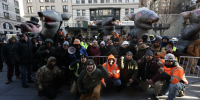
A fat cat, a pig wearing a top hat and five rats. All seven inflatables faced the 34th Street entrance of the Empire State Building last Thursday, two weeks into a protest by members of Laborers Local 79 who rallied, hundreds strong, in the afternoon shadow of the props.
With the intention of recognizing the work of the Latin American carreteros (garbage pickers) that collect recyclable materials in wheel carts, and increase environmental consciousness, artist Mundano created “Pimp My Carroça"
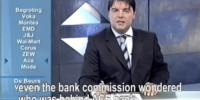
ACE Bank was a hoax bank developed as part of a bigger campaign by Netwerk Vlaanderen, a Belgian organization concerned with banks’ responsibilities for what they invest in. ACE bank was an elaborate deception, with a headquarters in central Brussels, parodying other banks. It claimed to be investigating whether there was a market for its special way of doing business.
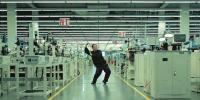
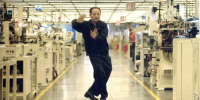
Whose Utopia? is a color film which is 19 minutes 58 seconds long. It was originally commissioned by the Siemens Arts Program back in 2005. The projector-style video is based on the work and social lives of assembly line workers at OSRAM’s light bulb factory in the Pearl River Delta in China. This area has received huge numbers of immigrants from inland provinces seeking work and better lives in the wake of Beijing’s booming economy.
From Public Delivery:
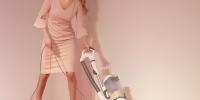
"The art piece, which was showcased at the Flashpoint Gallery in Washington D.C. from February 1 to 17, 2019, allowed visitors to interact with it. The audience had a pile of crumbs placed right in front of the three-walled setup, which they would through and watch as ‘Ivanka’ vacuumed them all up.
Shackles. Cotton. The Big House.
Americans tend to think of slavery in terms of chattel slavery. Plantation Slavery. Slavery where human beings are bought, sold, and owned. The kind outlawed in the United States by the Emancipation Proclamation in 1863.
Slavery as a relic of the 19th Century.
“Six of us lived, worked, slept in a 10-by-10 (foot) room without a bed, bathroom, or clean water,” Nasreen Sheikh remembers.
In state capitals and street protests, women’s rights activists have been wearing red robes and white bonnets based on “The Handmaid's Tale,” the 1985 novel that is now a series on Hulu.
Silent, heads bowed, the activists in crimson robes and white bonnets have been appearing at demonstrations against gender discrimination and the infringement of reproductive and civil rights.
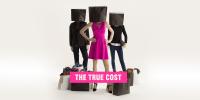
The True Cost is a 2015 documentary film directed by Andrew Morgan that focuses on fast fashion. It discusses several aspects of the garment industry from production—mainly exploring the life of low-wage workers in developing countries—to its after-effects such as river and soil pollution, pesticide contamination, disease and death.
Just over a decade ago on May 15, 2011, a wave of social outrage began as the Spanish people collectively decided that they had had enough of the corruption, cuts, and inequalities affecting their country.
Whose Utopia? was made by the Chinese artist Cao Fei and filmed at the OSRAM lighting factory in Foshan in the Pearl River Delta in southern China during 2005 and 2006. It was commissioned as part of a project entitled ‘What Are They Doing Here?’ that was run by the Siemens Art Program from 2000 to 2006 and involved Chinese artists undertaking six-month-long residencies at industrial facilities across the country.
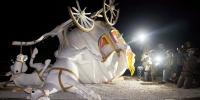
“He describes it as a “family theme park unsuitable for small children” – and with the Grim Reaper whooping it up on the dodgems and Cinderella horribly mangled in a pumpkin carriage crash, it is easy to see why.
Banksy’s new show, Dismaland, which opened on Thursday on the Weston-super-Mare seafront, is sometimes hilarious, sometimes eye-opening and occasionally breathtakingly shocking.
Work ideology centers around sustainable work. Through fifteen interviews, workers and prospective workers were interviewed about their experiences with work and the job search. Those interviews are analyzed and compiled on work ideology. However, work ideology goes further than showcasing the interview results, it allows for anonymous responses to be entered as well, expanding the research’s accessibility to every worker.
National Public Radio (NPR):
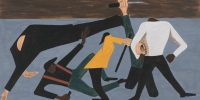
There's no historical marker outside Jacob Lawrence's childhood home in New York City's Harlem neighborhood.
But Khalil Gibran Muhammad, director of the Schomburg Center for Research in Black Culture, has an idea of what it might say: "Here lived one of the 20th century's most influential visual artists, a man named Jacob Lawrence, who was a child of southern migrants."
Cosmic Generator presents a network of characters working in nonsensical, and at times absurd, economies. Artist Mika Rottenberg uses footage from actual discount dollar stores in Calexico, CA; Mexicali, Mexico; and Yiwu, China to recreate the imaginary “life” of a product, from its production in the factory to the moment it is sold.
At noon today, a group of artists and activists including members of the Gulf Ultra Luxury Faction (known as G.U.L.F.) unfurled a large parachute in the atrium of the Guggenheim Museum, demanding to meet with a member of the institution’s board of trustees to discuss the labor conditions at its Abu Dhabi site.
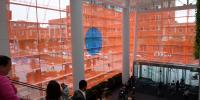
UNLESS by Stephanie Cardon is a vibrant floor-to-ceiling installation that fills the main entryway of Boston’s landmark Prudential Center. Commissioned by Boston Properties and curated and produced by Now + There, UNLESS explores sustainability, climate justice, and how taking action together can create positive change.
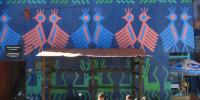
Nestled on the banks of Lake Atitlán in Guatemala, Santa Catarina Palopó is a small town brimming with vibrant colors and stunning natural views. Despite its natural beauty and cultural heritage, the community struggled with economic development and poverty for years until they had the opportunity to harness the power of art and transform the town.
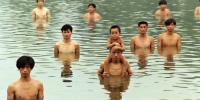
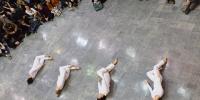
Zhuang Huan invited more than 40 men - laborers, fishermen, construction workers––who had recently migrated to Beijing from other areas of China to participate. Zhang Huan said, “In order to find these workers, I visited many of the shacks where they live.”
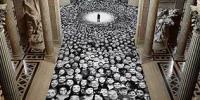
After winning the TED Prize on March 2, 2011, the French-artist JR launched the Inside Out Project, in his first TED Talk. Using his own artistic practice as inspiration, this participatory platform helps individuals and communities to make a statement by displaying large-scale black and white portraits in public spaces. Through their “Actions,” communities around the world have sparked collaborations and conversations.