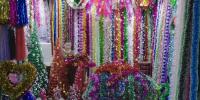
With the intention of recognizing the work of the Latin American carreteros (garbage pickers) that collect recyclable materials in wheel carts, and increase environmental consciousness, artist Mundano created “Pimp My Carroça"
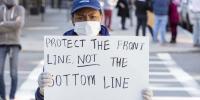
Essential workers at major companies like Amazon, Instacart, and Target across the United States on Friday protested for better safety protections, working conditions, and pay during the coronavirus pandemic.
Cosmic Generator presents a network of characters working in nonsensical, and at times absurd, economies. Artist Mika Rottenberg uses footage from actual discount dollar stores in Calexico, CA; Mexicali, Mexico; and Yiwu, China to recreate the imaginary “life” of a product, from its production in the factory to the moment it is sold.
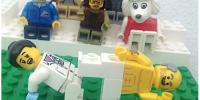
LEGOVC is a fictional, made up, 100% fake, plastic, 'pantomime villain' Vice Chancellor of a fake British University struggling as his utter managerial brilliance crumbles in the face of sustained strike action by his staff after their pension scheme is slashed.
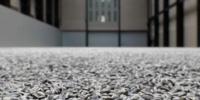
Ai Weiwei's installation Sunflower Seeds is a profound commentary on both historical and contemporary issues through the medium of art. First exhibited at Tate Modern in London from October 12, 2010, to May 2, 2011, the work features an astonishing one hundred million handcrafted porcelain sunflower seeds, spread across the gallery's 1,000 square meter Turbine Hall to a depth of ten centimeters.
Singaporean artist Lee Wen’s series Journey of a Yellow Man (1992–2012), one of his most famous and long-standing performances, was not simply a personal affront, it was a political affront. At the intersection of Asian art history, critical race theory, and migration and diasporic studies, one is never far (enough away) from the chromatic framing of race and ethnicity: yellow race, yellow peril, yellow face, the forever foreigner.
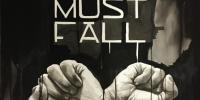
Daniel Hewson describes the use of protest posters and the work of collective, Burning Museum, and artist, Faith47, in the Fees Must Fall movement taking place in South Africa:
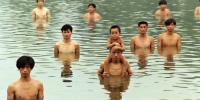
Zhuang Huan invited more than 40 men - laborers, fishermen, construction workers––who had recently migrated to Beijing from other areas of China to participate. Zhang Huan said, “In order to find these workers, I visited many of the shacks where they live.”
From Public Delivery:
"The art piece, which was showcased at the Flashpoint Gallery in Washington D.C. from February 1 to 17, 2019, allowed visitors to interact with it. The audience had a pile of crumbs placed right in front of the three-walled setup, which they would through and watch as ‘Ivanka’ vacuumed them all up.
Work ideology centers around sustainable work. Through fifteen interviews, workers and prospective workers were interviewed about their experiences with work and the job search. Those interviews are analyzed and compiled on work ideology. However, work ideology goes further than showcasing the interview results, it allows for anonymous responses to be entered as well, expanding the research’s accessibility to every worker.
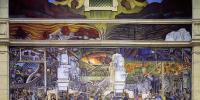
Almost all of Rivera's art told a story, many of which depicted Mexican society, the Mexican Revolution, or reflected his own personal social and political beliefs, and In the Arsenal is no different. The woman on the right side of this painting in Tina Modotti, an Italian photographer and revolutionary political activist, who is holding ammunition for Julio Antonio Mella, a founder of the internationalized Cuban communist party.
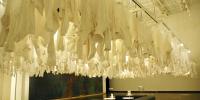
NORTHFIELD, Minn. — Exactly 1,281 white garments hang from the ceiling of the Perlman Teaching Museum’s Braucher Gallery. The collared shirts, knit sweaters, tights, and other items of clothing glow with an eerie luminosity.
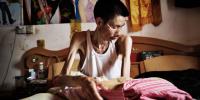
Photographer Sim Chi Yin spent more than three years documenting a Chinese gold miner who is suffering from the deadly lung disease silicosis. Despite the odds, his loving relationship with his wife has kept him alive much longer than anyone expected.
Omelia Contadina was born out of the concern of JR and director Alice Rohrwacher for the difficulties encountered by many small farmers and inhabitants of the Alfina plateau, in Italy.
Working in a grocery store has earned me and my co-workers a temporary status. After years of being overlooked, we suddenly feel a sense of responsibility, solidarity, and pride. On a private Facebook group page for my company, Trader Joe’s, one employee from Washington State posted a picture of a company-issued work shirt hanging from the ceiling of the store. A sign attached to the shirt read not all heroes wear scrubs.