Peter Marks Review from the Washington Post:
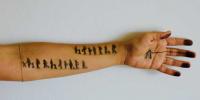
“As Far as My Fingertips Take Me,” a performance piece about the ordeal of seeking refuge by Tania El Khoury that’s being presented for the next 2½ weeks in the lobby of Woolly Mammoth Theatre. For this hypnotic, one-audience-member-at-a-time experience, you pass through the door of a white-walled booth and slip into a white lab coat before putting on a pair of headphones.
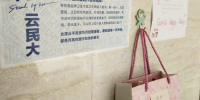
Since 2020, university students across China have launched a grassroots initiative to combat menstrual stigma by placing “menstrual pad mutual aid boxes” in campus restrooms. These boxes, often accompanied by signs reading “Take one if you need it, donate if you can,” provide free sanitary pads to anyone caught off guard by their period—offering both practical relief and a symbolic challenge to the cultural silence surrounding menstruation.
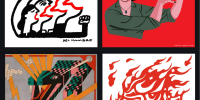
Platform ‘Iranian Women of Graphic Design’ share open-access protest posters to amplify #WomenLifeFreedom movement—triggered by the death of Mahsa Amini—in Iran and beyond.
From Public Delivery:
Located behind a resplendent Opera House in Budapest on the same road as Louis Vuitton sits Hunger King, a place that seems to be just like any other burger joint. However, it is anything but. Hunger King is a regular fast food outlet that is pushed onto the masses; Hunger King is a critical sociopolitical art installation that highlights Hungary’s significant crises of social inequality and homelessness .
A viral video of a student dance performance in southern China’s Guangxi Zhuang Autonomous Region has won praise for speaking out against so-called ghost marriages, which many today see as an archaic and even dangerous tradition.
Melissa is a down-to-earth, friendly woman in her 50s, and it seems that she has always met life with a certain amount of courage. She grew up on another continent, and after early motherhood, then divorce and a first career in business, she moved to the UK with her second husband. She then built another career working with survivors of domestic violence, before setting up a climate emergency centre in Abingdon, Oxfordshire.
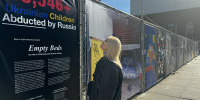
Four days before the U.S. presidential election, three Ukrainian activists gathered at a stranded fence in New York City’s East Village to hang an expansive information poster. “19546+ Ukrainian Children Abducted by Russia,” reads its headline in bold. From a black canvas, white letters jump out at the passersby, a haunting reminder of the toll the Russian invasion continues to inflict on Ukrainian families.
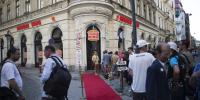
The protracted queue. That was the first thing I noticed when I arrived. It was winding, unending and impossible to see exactly where it began. I asked one of the security guards if he had any indication as to the waiting time. His response was a “your guess is as good as mine” shrug. As the mammoth line snaked around the building, my heart sank further – it is a myth that Brits love to queue; we feel compelled to, we don’t love it.
Hundreds of thousands of people worldwide marked the International Day of Zero Waste, which spotlighted solutions to the mounting environmental and social problems caused by the fashion and textile sector.
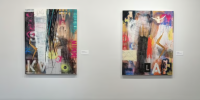
The new exhibit “MESH” at Portland Art Museum features Indigenous contemporary artists advocating for change
Visual artist, writer and activist Ka’ila Farrell-Smith says she considers herself a wartime artist.
She is a member of the Klamath tribes and lives in Modoc Point, Oregon. When asked about how history influences her work, the answer weaves through over 150 years of white colonization and Indigenous struggles in the West:
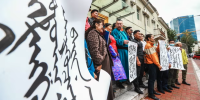
Thousands of ethnic Mongolians have protested across northern China in opposition to Beijing plans to replace the Mongolian language with Chinese in some school subjects.
The AIDS pandemic began in the early 1980s and brought with it a surge of emotions from the public: they were afraid, angry, fearful and defiant. The arrival of AIDS also brought with it a condemnation of the LGBT community. These emotions, along with the view on the LGBT community, paved the way for a new generation of artists.
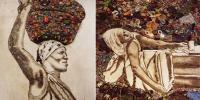
In 2008, my work as an artist took me to a gigantic landfill outside Rio de Janeiro called Jardim Gramacho. After operating for more than 30 years, the sanitary facility, once one of the largest in the world, had reached its maximum capacity and was on the eve of closing permanently.
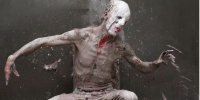
As the audience enter, Olivier de Sagazan is pacing the stage, deep in thought. A slight, barefooted figure dressed in suit and tie, he circles in and out the shadows, head bowed, sometimes muttering to himself. As the audience settle and hush, his footsteps gradually become more audible (the floor is mic-ed) and begin to pound like a calling drum.
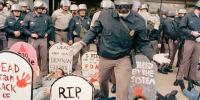
In 1987 with AIDS deaths in the thousands and government policy still criminally indifferent, activists formed ACT UP (AIDS Coalition to Unleash Power) with the purpose of turning grief and fear into rage and action.
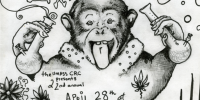
Rooted in decades of grassroots organizing, the cannabis reform activism at the University of Massachusetts Amherst is one of the longest-running student-led efforts for marijuana legalization in the United States. Led by the Cannabis Education Coalition (CEC), founded in 1991, this movement combined cultural celebration with political advocacy, using public festivals like Extravaganja to destigmatize cannabis and promote drug policy education.
The Fundred Dollar Bill Project, initiated by artist Mel Chin, is a collaborative art project aimed at raising awareness and mobilizing action against the environmental and health threat of lead contamination. It encourages individuals to create their own unique interpretations of $100 bills, symbolizing the value of human lives and the need for a lead-free future.
Spanish street artist El Rey de la Ruina uses murals and installations to critique inequality and government policies. His works, especially during the pandemic, voiced concerns over healthcare, housing, and public resources in Madrid’s urban spaces.
The Center for the Study of Political Graphics and the Esperanza Community Housing Corporation have combined forces to bring 75 powerful and engaging poster works on broad issues of health care to audiences traditionally excluded from the art world in Los Angeles and elsewhere. Both organizations have been in the forefront of social change for three decades.
CENTRO San Antonio's Art Everywhere Project will celebrate its 5th anniversary in May.
As of May 2024, the project had seen numerous artists from the city's urbancore decorate areas of the city with elaborate murals reflecting the city's history and the diversity of cultures in the city.
The Survivaball made its first appearance in 2006, when "Halliburton representatives" attended a conference on catastrophic climate change and demonstrated the functionality of the large inflatable suits ("a gated community for one"), which keep corporate managers safe from global warming. Not long afterward, in Berlin, the Yes Men learned they also work as disruptive, arrest-resistant tools.
The Milosevic regime ruled over Serbia and Yugoslavia for about 13 years. To maintain control, the Milosevic regime was infamous for arbitrary arrests, beatings, imprisonment and even murder of avid opponents.
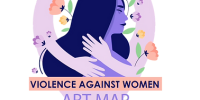
The Violence Against Women (VAW) Art Map was conceptualized in the fall of 2018, in the wake of the #MeToo movement by Dr. Lauren Stetz, as part of her doctoral research in Art Education with a minor in Women's, Gender, & Sexuality Studies at Penn State University.
At first glance, it seemed like any other Monday evening in Görlitz, the most eastern town in Germany — where Poland sits just across the river. It was July 31, and a couple hundred people had gathered as part of the so-called Monday demonstrations to protest refugees, the COVID-19 vaccine and the government’s green energy politics.