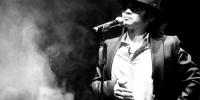
Zuoxiao Zuzhou is a Chinese singer whose accented, croaky voice is hardly ever in tune. But for his fans he's the voice of a generation — one of the very few voices who dare to speak out. After a collaboration, Cowboy Junkies member Michael Timmins called him "China's Leonard Cohen."
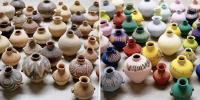
Exhibition visitors have expressed feelings of uneasiness or even pain and nostalgia when seeing Colored Vases by Ai Weiwei1. The 51 vases that make up the artwork are originally treasures from the Neolithic Age (5000–3000 BCE) and the artist has dunked them in common industrial paint.
Why did Ai Weiwei do it?
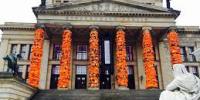
Chinese artist Ai Weiwei covered a Berlin landmark with thousands of refugee life jackets for his latest installation. The striking display was the activist's attempt to highlight the scale of migrants taking to the seas every day.
WeiweiCam is a self-surveillance project by artist Ai Weiwei that went live on April 3, 2012, exactly one year after the artist's detention by Chinese officials at Beijing Airport.[1] At least fifteen surveillance cameras monitor his house in Beijing[2] which, according to Ai, makes it the most-watched spot of the city.[3] He described his decision to put himself under further surveillance as a symbolic way to increase transparency in the Chinese g
In 2008, an earthquake devastated Sichuan province in China, claiming the lives of more than 69,000 people. Following accusations from parents that substandard construction caused the collapse of schools across in the region, the artist Ai Weiwei set upon a political investigation that would name every missing student and call the government to account for their deaths.
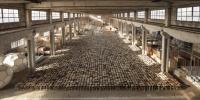
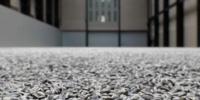
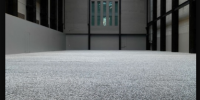
Ai Weiwei's installation Sunflower Seeds is a profound commentary on both historical and contemporary issues through the medium of art. First exhibited at Tate Modern in London from October 12, 2010, to May 2, 2011, the work features an astonishing one hundred million handcrafted porcelain sunflower seeds, spread across the gallery's 1,000 square meter Turbine Hall to a depth of ten centimeters.
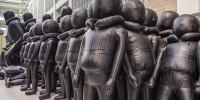
The exhibition Law of the Journey is Ai Weiwei’s multi-layered, epic statement on the human condition: an artist’s expression of empathy and moral concern in the face of continuous, uncontrolled destruction and carnage.
It can be important to reflect on the artistic recounts of activists experiences under state imprisonment. In a revealing interview with Artspace, Chinese artist and dissident Ai Weiwei reflects on his 81-day secret detention in 2011 and the psychological strategies used to dismantle identity and autonomy.
In 2009, the dissident artist created a work to honour the thousands of children who died in the Sichuan earthquake. He recalls how the project, Remembering, angered China’s rulers – and changed his career for ever
This is an edited extract from The Start podcast
Ai Weiwei’s Sunflower Seeds is made up of millions of small works, each apparently identical, but actually unique. However realistic they may seem, these life-sized sunflower seed husks are in fact intricately hand-crafted in porcelain.
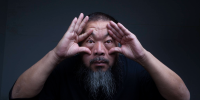
Ai Weiwei is a Chinese artist and activist. He has been vocal and openly critical of the Chinese government’s stance on democracy and human rights. His work has captured global attention and served to bring attention to social injustices, human rights violations and systemic violence. Ai never shies away from saying what he truly feels and he encourages people to state exactly what they want.
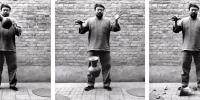
Dropping a Han Dynasty Urn (1995) by Ai Weiwei is a highly provocative work of art. This series of three black and white photographs portray the artist holding a 2,000-year-old Han dynasty urn that, frame by frame, he drops, it falls, and shatters. As much a work of photography as a work of performance art, in each still an unaffected Ai looks directly at the camera aware of his destructiveness.
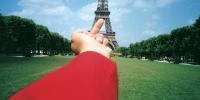
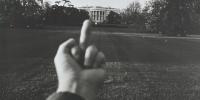
The son of an exiled political dissident, Chinese artist and activist Ai Weiwei’s work is inherently political. Since 1995 Ai Weiwei has been traveling the world, photographing himself flipping off iconic monuments of power in his Study of Perspective series.
“Everything is art. Everything is politics.” Globally renowned artist Ai Weiwei (Chinese, b. 1957) is celebrated as a disruptor of artistic canons and a champion of free expression. In his work—ranging across performance, photography, sculpture, video, and installation—he deploys humor and provocation, calling upon his viewers to examine history, society, and culture.
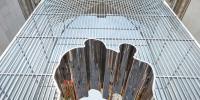
The artist has assembled a set of 300 installations around New York City, based around the concept of fences and borders, to showcase the ‘narrow-minded’ attempts used to ‘create some kind of hatred between people’
Chinese artist Ai WeiWei has drawn on the stool part of that French surrealist's pioneer work for his latest exhibition, the largest ever devoted to Ai, which opens in Berlin this Thursday. The show, entitled Evidence, is at Berlin's Martin-Gropius-Bau exhibition hall, and consists of either entirely new works, or pieces never seen in Germany before. The exhibition is huge, taking up 3,000 square metres in total and running across 18 rooms.
A major exhibition by Ai Weiwei this autumn features a new series of monumental sculptural works in iron, cast from giant tree roots sourced in Brazil during research and production for last year’s survey exhibition, ‘Raiz’, at the Oscar Niemeyer-designed OCA Pavilion in Ibirapuera Park, São Paulo.