ZERO1 is thrilled to commission artist Chico MacMurtrie/Amorphic Robot Works(ARW) Border Crosser during the week leading up to SB50. Rising 40 feet from the ground and arching across an imaginary border before forming a bridge and touching down on the “other side,” Border Crosser is the first of a series of large-scale inflatable robotic sculptures that poetically explore the notion of borders by artist Chico MacMurtrie/ARW.
The trailer for The Danish Girl, released Tuesday, introduces the world to Lili Elbe and her wife, Gerda Wegener. Elbe was a transgender woman and one of the first recipients of transition-related surgeries, which she received over a course of two years starting in 1930 in Germany.
Circus Amok is a New York City based circus-theater company whose mission is to provide free public art addressing contemporary issues of social justice to the people of New York City.
Shortly after the events of 9/11, a group of NYC women came together in protest of the Bush Administration's use of the terror attacks to justify war. Seeking out a new form of political protest, the women decided to respond to what they believed were the absurd reactions of Bush by attaching paper maché missile "dicks" and demonstrating in public.
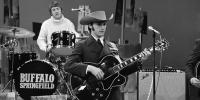
Released as a single on 23 December 1966, Buffalo Springfield’s For What It’s Worth became the short-lived but talent-packed band’s biggest hit, reaching No.7 on the Billboard Hot 100 chart in the spring of 1967.
An artist who sparked significant awareness regarding the issues of climate change was Olafur Eliasson. Eliasson’s main objective has been to catch people’s attention and make them feel emotions and care about climate change because many people do not connect to the effects of climate issues as they do with other controversial impacts solely because the effects are not played out directly in front of them.
Step into the captivating world of Zanele Muholi, the activist and masterful photographer from South Africa. Through their lens, they unveil the realities found within LGBTQI+ stories, challenging norms and reshaping perceptions of beauty. Each intimate and evocative portrait captured by Muholi becomes a vessel for social change, dismantling stereotypes, and amplifying the voices of those historically silenced.
"Brooke Shields is one of 200 famous faces that the artist Jonathan Horowitz identifies as vegetarian in head shots he has hung on the white-tile walls of a former meat locker in the south Village. Horowitz, 44, swore off meat at the age of 12, after his parents took him to a bullfight on a vacation in Mexico.
Surrounded by a jungle of tents and mud, the Good Chance Theatre was set up last year by British playwrights Joe Murphy and Joe Robertson. The refugee camp theatre has been derided by many, but for the thousands of migrants who have journeyed across the world to Calais, the small dome has been the first and only place into which they have been welcomed, and their voice valued.
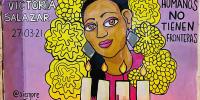
Siempre Unidas is a feminist collective in the state of Quintana Roo (Mexico) that works partly through street art. In 2021, in response to the femicide of Victoria Salazar – a refugee from El Salvador who died in police custody – the collective began an anti-femicide mural project called RestaurAmoras.
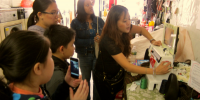
“The Garment Worker” an interactive installation piece that focuses on the daily life of a garment worker and the hardships she/he encounters working in a sweatshop. The installation in Kang Wei Laundromat simulated the sounds, motions and experiences of a garment factory while providing testimonials and information from immigrant workers on their sweatshop conditions.
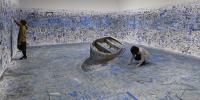
Add Colour (Refugee Boat) begins as an all-white boat in an all-white room. Ono’s instruction for this collective, participatory work reads: ‘Just blue like the ocean.’ You are invited to contribute your hopes and beliefs in blue and white.
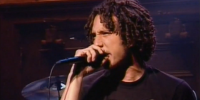
Rage Against the Machine have always been rabble rousers, but the political statement that got them banned from Saturday Night Live sounds positively prosaic compared to other acts of protest they committed in their heyday, like shutting down the New York Stock Exchange or sporting a "Free Mumia Abu-Jamal" shirt on live television.
On the night of Thursday, Nov. 13, 1969, the “March Against Death” began. By the time that weekend was over, Washington, D.C., had seen more protesters than any single event in its history had drawn. Attendance was higher, by tens of thousands, than at the 1963 Civil Rights March on Washington. And despite a name that, 45 years later, may seem overblown or vague, the march was actually about something very specific.
A set of interactive experiences at the Sziget festival in Budapest, aimed at social change to improve every day life of trans and gender-nonconforming persons.
Gender equality charity Women of the World (WOW) is launching a one-day festival of activism that invites people from all generations, genders and backgrounds to take part in conversations around sexual violence.
It was 1967, and sentiment against the Vietnam War was in the air nationwide. The counterculture was flourishing on the heels of the Summer of Love. Organizers from Mobe — the National Mobilization Committee to End the War in Vietnam — initially called for a massive march on Washington.
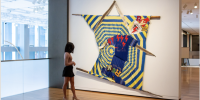
Natalie Ball’s work challenges dominant stories of Native American identities, taking to task the historical and visual legacies that misrepresent what it means to be “Indian.” She dives deeply into Indigenous histories and forms of knowledge, the use of language, and a wide range of materials—including animal hides, clothing, and synthetic hair—to create a new narrative around Indigenous experiences and identities.
One of the defining features of politics in the 21st century has been the way online cultural phenomena can cross over into the “real” world.
Unfortunately, perhaps because the internet seems to bring out the worst in people, those phenomena have largely been, well, awful.