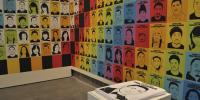
A new exhibition at the Yerba Buena Center for the Arts that showcases activism through art and media in the San Francisco Bay Area, gets its name, Take This Hammer, from a 1963 documentary about the author James Baldwin as he went around San Francisco, talking to African-Americans about what it was like for them in the city.
In 2006, art historian Claire Bishop lit a fire under the collective seat of the art world with her Artforum piece “The Social Turn: Collaboration and its Discontents.” It set off — as much as any essay in the hermetic and staid world of contemporary art theory can — an uproar. The article inspired Grant Kester, an art historian also specializing in relational art practices, to respond:
During the 1600’s the Iroquois Indian Nations, a group of several indigenous tribes in North America, engaged in warfare with many other tribes. The men controlled when and against whom they declared a war.
Tribal Iroquois women decided that they wanted to stop unregulated warfare, and thought of a way to convince the Iroquois men to give them more power in deciding issues of war and peace.
On January 17, 2011, Hong Yuping (洪玉萍), from Fujian Province, contacted Yu Jianrong (于建嵘), at the Chinese Academy of Social Sciences (CASS), about her family’s plight and requested assistance: In June 2009, their son, Yang Weixin (杨伟鑫), then age six, was abducted from their hometown, Quanzhou, and they had been searching for him ever since.1 In early 2010, Hong had recognized Yang Weixin in a photo of three children begging outside a Xiamen train statio
The Amplification Project: Digital Archive for Forced Migration, Contemporary Art, and Action (https://theamplificationproject.org) is a crowdsourced community digital archive aiming to raise the visibility of art and cultural productions inspired, influenced, or affected by forced migration and refugeehood.
A CUBAN artist's controversial photographs of children being hung from crosses has landed him in hot water.
Erik Ravelo took a series of photos of children hung like Jesus from a cross, but in the place of the cross were soldiers, surgeons, priests and Ronald McDonald.
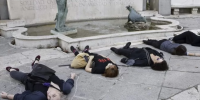
On September 2nd 2015, a die-in protest to advocate against gender violence was carried out by a group called Women in Black (Olmedilla, 2015). This form of protest was likely inspired by other die-in protests in Spain and represented Spanish women who have died due to domestic violence (DV). A group of women dressed in black clothing gathered on the streets of Madrid. One by one they fell to the ground and lay there, acting dead.