The Youth Activist Art Archive (YAAA) is a dedicated platform that highlights and celebrates the creative efforts of young individuals (26 years old and younger) actively participating in diverse social movements and causes. YAAA acknowledges the vital role and innovative vision of young activists who employ their artistic talents to envision and advocate for a brighter future.
One of the defining features of politics in the 21st century has been the way online cultural phenomena can cross over into the “real” world.
Unfortunately, perhaps because the internet seems to bring out the worst in people, those phenomena have largely been, well, awful.
Street harassment is one of the most pervasive forms of gender-based violence and one of the least legislated against. Comments from “You’d look good on me” to groping, flashing and assault are a daily, global reality for women and LGBTQ individuals. But it is rarely reported, and it’s culturally accepted as ‘the price you pay’ for being a woman or for being gay.
I am a visual activist. Most of what I have done over the years focuses on black LGBTQIA+ and gender-non-conforming individuals from South Africa and other neighbouring countries. It’s about making sure we exist in the visual archive. I call myself a visual activist — or, rather, a cultural activist, because this work is not only about the arts; I’m focusing on education, I’m dealing with culture in a way that confronts a number of issues.
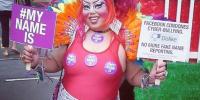
Facebook came under fire when its authentic-name policy led to San Francisco drag queen Sister Roma and others being barred from the social network. The policy allows users to report people they believe are using fake names. This caused a stir when a group of drag performers suddenly found that their Facebook accounts had been deactivated. Among them was Sister Roma, who had not registered on the site under her legal name, Michael Williams.
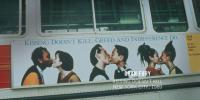
Gran Fury was an AIDS activist artist collective from New York City consisting of 11 members, all artists - but action, not art, was the aim of the collective. Gran Fury member Loring McAlpin described the collective's mass-market ambition to “...fight for attention as hard as Coca-Cola fights for attention.”
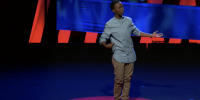
"I was the mystery of an anatomy, a question asked but not answered," says poet Lee Mokobe, a TED Fellow, in this gripping and poetic exploration of identity and transition. It's a thoughtful reflection on bodies, and the meanings poured into them.
This talk was presented at an official TED conference, and was featured by our editors on the home page.
After a spate of bullying-related suicides of LGBT youth, gay columnist Dan Savage and his partner Terry Miller decided to launch the It Gets Better project to see what they could do about it. They began with a simple YouTube video in which both of them described their experiences with bullying in high school, coming out, their families, and the story of their relationship and the adoption of their sun.
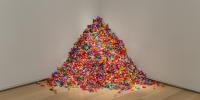
Felix Gonzalez-Torres produced meaningful and restrained sculptural forms out of common materials. “Untitled” (Portrait of Ross in L.A.) consists of an ideal weight of 175 pounds of shiny, commercially distributed candy. The work’s physical form and scale change with each display, affected by its placement in the gallery as well as audience interactions.
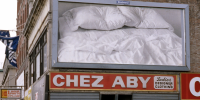
In May 1992, a series of 24 billboards displaying an identical image began appearing throughout New York City. They featured a giant close-up black-and-white photograph, without text, of a rumpled bed, pillows still indented from the heads that had rested there.
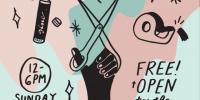
“The Feminist Zine Fest showcases the work of artists and zine makers of all genders who identify on the feminist spectrum, and whose politics are reflected in their work. For the second consecutive year, Barnard proudly hosts the zine fest, welcoming approximately 40 zine-makers eager to share their work.
For the completion of her residency as the NYU Steinhardt 2023-24 Scholar-in-Residence, Dominique Jackson collaborated with NYU students to honor the fem queen (trans women) and their historical meaning to not only ballroom but popular culture at large.
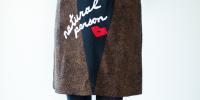
Shift Change Dress is a community fashion & art project that utilizes a shift dress sewing pattern as a medium for communication and action. Participants are encouraged to use the pattern as a blank canvas for their art or message and to share their work with the community.
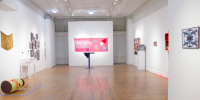
An oversized facsimile of Rush poppers, tipped over, pouring out its viscous contents: this example of underground gay iconography blown up to almost belligerent proportions perfectly represents the aims of Party Out of Bounds: Nightlife as Activism Since 1980, a new exhibition at La MaMa’s La Galleria. The group show, curated by Emily Colucci and Osman Can Yerebakan, gathers together works by a small yet distinct menagerie of queer artists.
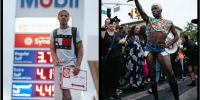
There were still bloodstains outside the Midwood Mobil gas station on Friday night; a fresh sign taped to a lamppost read “A Hate Crime Happened Here.” This is the place where, less than a week prior, 28-year-old O’Shae Sibley, a gay Black dancer and choreographer, made a pit stop with friends after a Jersey beach day.
As part of an international workshop (10-11 October 2015) with the Center for Artistic Activism, 17 trans activists and artists from 13 European countries developed a creative campaign to mark some of the spaces in Berlin which have symbolic significance for trans people.
Benito Antonio Martínez Ocasio, better known to the world as Bad Bunny, has once again proven that his artistry goes far beyond reggaeton and trap. On January 5, 2025 — the eve of Puerto Rico’s cherished Three Kings Day — the Puerto Rican superstar released DeBÍ TiRAR MáS FOToS, an album that both celebrates his homeland and delivers a sobering message about its uncertain future.
In a private Tokyo dinner party artist Mao Sugiyama served his genitals to five of the events guests. Several months prior to the event he chose to have his genitals surgically removed. He released invitations to the event on social media, 70 paid attendees were present for the event.
Self-identifed as asexual, Sugiyama stated that he intended to raise awareness for "sexual minorities, x-gender, asexual people."
A popular theme throughout media is the relationship between technology and art. While art is often bolstered and disseminated through technology, discussions arise of how technology both positively and negatively affects content. Caroline Sinders’ exhibition Within the Terms and Conditions explores the way content has been spread online.
A juried exhibition of fiber art created by the Artist Circle Alliance to protest the Trump administration’s actions and policies.
This is a traveling exhibition to 13 venues across the U.S. All work in the exhibition, as well as the nearly 560 pieces submitted for jurying, are shown on our website.
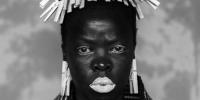
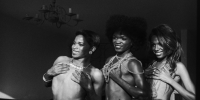
Step into the captivating world of Zanele Muholi, the activist and masterful photographer from South Africa. Through their lens, they unveil the realities found within LGBTQI+ stories, challenging norms and reshaping perceptions of beauty. Each intimate and evocative portrait captured by Muholi becomes a vessel for social change, dismantling stereotypes, and amplifying the voices of those historically silenced.
Private Dinner Party: Clothing Not Allowed
The Füde Dinner Experience gathers those who want to meet, eat and drink — only after leaving their clothes at the door.
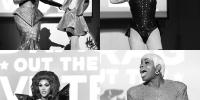
Drag Out The Vote™ is a nonpartisan, nonprofit organization that works with drag performers to promote participation in democracy. We educate and register voters at drag events online and offline, by organizing local and national voter activations. Led by fierce drag kings and queens across the nation, we advocate for increased voter access and engagement in 2020 and beyond.
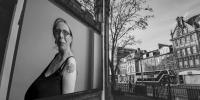
UK photographer Alicia Bruce collaborated with Zero Tolerance, a Scottish non-profit to end GBV, to produce a new version of the Violence Unseen campaign, launched for the first time in the 1990s and created by Franki Raffles. The new one was launched in 2018, 25 years after the original iconic Zero Tolerance campaign, shot by the late Franki Raffles.
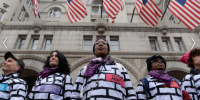
Brick x Brick is a public art performance that builds human “walls” against misogyny. It is organized by the Public Displays of Affection, a collective of artists, designers, educators and organizers that engages in nonviolent direct art action. During the wall performances, participants wear brick-patterned jumpsuits adorned with colorful brick patches bearing statements of misogynistic violence made by US President Donald Trump.