The money was supposed to be used to create modern art. And it was — but not in the way a Danish museum expected when it gave an artist the equivalent of $84,000. In return, it received two empty canvases.
The artist, Jens Haaning, says the blank canvases make up a new work of art — titled "Take the Money and Run" — that he calls a commentary on poor wages. One thing it's not, he says, is a theft.
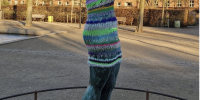
The yarn bombing started with Louise Moerup’s school run in central Copenhagen. On the walk through the park each morning, she and her 10-year-old son would often discuss a naked statue of the goddess Venus there and wonder why there weren’t more statues of real women instead.
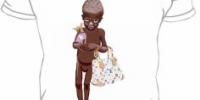
Danish 26-year-old art student Nadia Plesner designed this T-shirt depicting a Darfurian child holding a Louis Vuitton handbag as commentary on global disparity as it relates to war, developing nations, commercialism, and media.
In 2006, the fashion house sued Plesner for her appropriation of their trademark. The case was subsequently dismissed.
In September 1943, the Nazis prepared for the deportation of all Danish Jews to the concentration camps and death. But Georg Duckwitz, a German diplomat with a conscience, deliberately leaked the plans for the roundup, which was due to begin on Rosh Hashanah, the Jewish New Year. Armed with the information from Duckwitz, Danes swung into action.
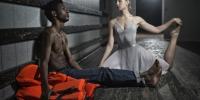
As Denmark moves to deter refugees from crossing its borders, a new theater production dramatizing their plight seeks to change how many in the country perceive their new neighbors. Uropa: An Asylum-Seeker’s Ballet, [is] a dance piece performed in part by refugees portraying themselves.
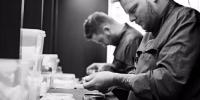
A couple of weeks ago Danish chef Rasmus Munk made Michelin-starred dishes, now he prepares pasta salad and tartlets for the homeless in Copenhagen.
In the past few weeks, COVID-19 has forced several restaurants in Denmark to close, including the well-known Alchemist.
These two works on canvas were made with my own blood, using the severed distal phalanx of my index finger as the painting instrument. They are connected to my solo anti-war action in Copenhagen in September 2026.
Their central messages are “No to War!” and “Peace & Love!” The index finger—the finger used to pull a trigger—became the central symbol of my refusal to participate in aggression and the killing of other people.