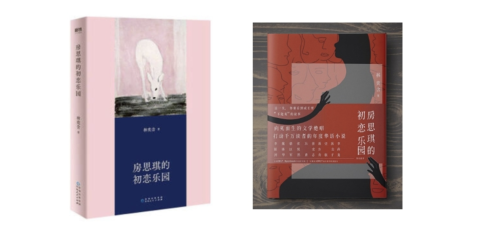
Fang Si-Qi’s First Love Paradise 6 Favorite 

Practitioner: 

Date: 

Feb 1 2017

Location: 

Taiwan

Fang Si-Qi’s First Love Paradise, a 2017 novel by Taiwanese writer Lin Yi-han, has become one of the most haunting and politically charged literary works in the Chinese-speaking world. Although presented as fiction, the novel closely mirrors Lin’s own lived experience of being groomed and sexually abused by a private tutor during her adolescence. Through poetic and fragmented prose, the novel documents the psychological disintegration of a teenage girl who is entrapped by a manipulative adult under the guise of “love” and “education.”

Published just months before Lin’s suicide at the age of 24, the novel quickly evolved from a personal catharsis into a cultural catalyst. It triggered widespread conversations about power-based sexual violence, particularly within the education system, and challenged the romanticization of predatory “teacher-student relationships” in Chinese-language media and literature. Lin’s writing is not only a testimony—it is a form of activism. By naming the violence embedded in language, patriarchy, and institutional neglect, Fang Si-Qi opened a space for collective mourning, rage, and political reckoning.

Since Lin Yichan's passing, people have never ceased to commemorate her. In Taiwan, Facebook users launch an annual “#Give Lin Yichan a Piece of Cake on Her Birthday” memorial campaign on her birthday. In mainland China, “The First Love Paradise of Fang Siquei” sparked widespread attention upon its publication. Currently, over 300,000 people on Douban have marked it as “read,” with an average rating of 9.2. On the anniversary of her death, memorial threads appear on Douban. “Fang Siquei” has also become an unspoken symbol in subsequent public discussions, constantly referenced and mentioned.

Posted by Katherine on

Staff rating: 

0

Effectiveness

How does this project help?

Timeframe For change

The long-term goal of Fang Si-Qi’s First Love Paradise as a cultural and activist intervention is to dismantle the normalized structures of gender-based violence, coercion, and silence—especially those cloaked in the language of mentorship, love, or literary idealism. The novel aspires to reframe how society perceives abuse: not as isolated tragedy, but as a systemic failure of education, family, law, and language. By offering a vocabulary to articulate trauma that resists erasure or beautification, the work aims to foster long-lasting feminist consciousness across East Asia. It seeks to inspire reforms in legal systems, educational ethics, mental health discourse, and media narratives, ultimately demanding that stories like Fang Si-Qi’s be prevented, not just mourned. In the years following the publication of “Fang Siquei's First Love Paradise,” many readers have engaged in structural reflections linking the novel to real-world society. As the afterword of the novel states, “Any violence related to sex is ‘social,’ or to put it another way, any violence related to sex is not carried out by the perpetrator alone, but rather by society as a whole assisting the perpetrator.” In the years following the publication of “Fang Siquei's First Love Paradise,” many readers have engaged in structural reflections linking the novel to real-world society. As the afterword of the novel states, “Any violence related to sex is ‘social,’ or to put it another way, any violence related to sex is not carried out by the perpetrator alone, but rather by society as a whole assisting the perpetrator.” In the years following the publication of “Fang Siquei's First Love Paradise,” many readers have engaged in structural reflections linking the novel to real-world society. As the afterword of the novel states, “Any violence related to sex is ‘social,’ or to put it another way, any violence related to sex is not carried out by the perpetrator alone, but rather by society as a whole assisting the perpetrator.” The article “What Killed Lin Yichang? The Despair and Discourse of the Lower Ranks in the Field of Power | Thought World” summarizes the discussion on how power inequality contributes to sexual abuse of minors and emphasizes the importance of constraining and regulating power. There is a huge power disparity in the relationship between minors and teachers. Whether it be connections, social resources, or literary skills (i.e., what Lin Yichang referred to as “sweet talk”), Li Guohua far exceeded his underage student. Fang Siquei's pleas for help to her friends, parents, and netizens only earned her skepticism and ridicule. The person in a position of power in a relationship does not need to explain themselves; instead, the victim is blamed, lectured, and burdened with the responsibility of explaining themselves and suffering permanent trauma. Additionally, an education system that prioritizes academic achievement as the sole goal makes students more eager for teachers' praise and recognition, leading to excessive trust in teachers. In the novel, more than one teacher exploits tutoring sessions to sexually assault minor students, presenting such behavior as care and a test. As Lin Yichan wrote in her book, the college entrance exam system is one of the accomplices of violence: “He injected such immense desire into the beautiful girl, injecting the pain, cruelty, and inhumanity of the Taiwanese college entrance exam system into her. He multiplied the will of a night spent studying by 365 days a year, then multiplied that by the tens of thousands of people an ugly girl must outshine, and injected it all into the beautiful girl. A magnificent climax, an epic seduction. Great exam-oriented education.” The lack of sexual education for minors is also an issue that has garnered increasing attention and calls for improvement following the publication of “Fang Ssu-chi's First Love Paradise.” “Xi Xi Academy,” an organization dedicated to providing sexual education for children, points out that over the past six years (2015–2020), there have been over 300 cases of child sexual abuse annually, with the youngest victim being just one year old. In 2020 alone, 332 cases of child sexual abuse were reported by the media, involving over 840 victims, with the youngest being one year old, and the perpetrators ranging in age from 10 to 86. Sex education—whether in family or school settings—is a glaring shortfall. In the novel, Fang Siquei twice attempted to tell her parents about her experiences but ultimately refrained from doing so due to their reactions when she tested the waters. When Siquei told her mother, “Our family seems to have everything, but we don't have sex education,” her mother looked at her in surprise and replied, “What sex education? Sex education is for those who need it.” Another time, she said, “I heard that a classmate is dating a teacher.” Her mother responded, “Who? At such a young age, she's already so promiscuous.” In that moment, Siquei decided she would never speak again.

Notes

Although it emerged from personal suffering, Fang Si-Qi’s impact has been profound. In Taiwan, the novel prompted intense public reflection and renewed scrutiny of sexual misconduct in the tutoring and education sectors. It became a touchstone for feminist discourse and was cited in broader East Asian #MeToo conversations. In mainland China, despite heavy censorship, the book circulated widely online and inspired waves of testimonies from readers—especially young women—who resonated with its portrayal of coercion masked as intimacy. The effectiveness of this activism lies not in legislation alone, but in narrative transformation. Lin Yi-han’s language shattered the aestheticization of abuse and offered an emotional grammar for survival, resistance, and memory. Her novel continues to act as a form of narrative justice, keeping alive the urgency of speaking the unspeakable—even in societies where silence is systematically enforced.