change
region
medium
issue
Anton
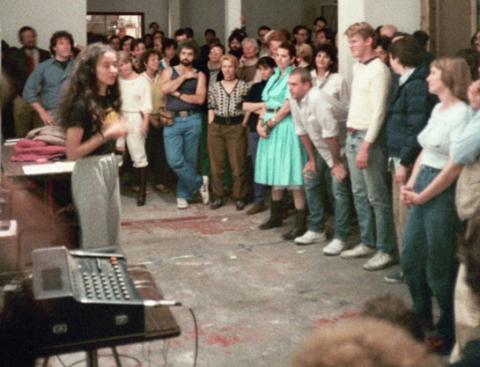
Adrian Piper's "Funk Lessons" (1982-84) was a series of performances and collaborative events in which the artist taught white participants about black funk music, its culture, and its history, aiming to deconstruct stereotypical ideas about Black culture.
Adrian Piper began to teach shortly after graduating from Harvard with a Ph.D. in philosophy. She lectured, scribbled on chalkboards, and gave precise instructions: Here’s how you do the shoulder shrug and head nod; this is how you isolate your hips while thrusting your pelvis. Piper called these performance-lectures Funk Lessons, 1982–84, and she used them to address xenophobia, an issue increasingly central to her art. Under the guise of a “get down and party together” affair, she began to teach white, primarily art-world audiences about the histories of African-American funk and soul music. Yet the lessons also underscore that “at least some perceived racial distinctions are learned, and learnable, behavior,” as critic Holland Cotter notes.
A nearly fifteen-minute video directed by Sam Samore in 1983 shows Piper giving her lessons to a large and noticeably diverse audience at the University of California, Berkeley. The work is intercut with soft-focus shots from Soul Train, sound bites of the cheerful artist interviewed postlecture, and clips of singers like James Brown and Aretha Franklin that support Piper’s improvisational points (“What Chuck Berry was for Elvis Presley . . . Bootsy [Collins] was for the Talking Heads”). Meanwhile, didactic phrases like FUNK IS MODULAR and FUNK IS IMPROVISATIONAL are overlaid in static, character-generator-driven text.
Never light with her touch, it’s worth keeping in mind that ten years earlier Piper began more outlandish performances as her male alter ego the Mythic Being; not long before that she was covering her body in vinegar, eggs, milk, and cod liver and stinking up buses, among other public spaces, with her Catalysis works. By her mid-twenties, Piper had conceived of her art as a much larger (and lifelong) project of consciousness raising, which she assiduously tracked in her self-critical essays. In Notes on Funk (1985), for instance, she writes that Funk Lessons offered a path to “self-transcendence and creative expression within a highly structured and controlled cultural idiom, in a way that attempt[s] to overcome cultural and racial barriers.” In the video, she describes it another way. When asked about stereotypes, particularly the one about why “whites can’t dance,” she replies (with a dash of skepticism): “It’s just a matter of practice.”