change
region
medium
issue
Anton
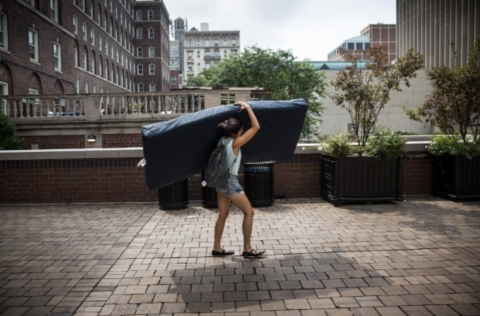
Mattress Performance (Carry That Weight) (2014–2015) was a work of endurance/performance art which Emma Sulkowicz conducted as a senior thesis during the final year of a visual arts degree at Columbia University in New York City.[1]
Begun in September 2014, the piece involved Sulkowicz carrying a 50-pound (23 kg) mattress, of the kind that Columbia uses in its dorms, around campus. Sulkowicz said the piece would end when a student Sulkowicz alleged raped her[a] in her dorm room in 2012 was expelled or otherwise left the university.[3] Sulkowicz carried the mattress until the end of the spring semester, as well as to the graduation ceremony in May 2015.[4]
Fellow student Paul Nungesser, whom Sulkowicz accused, was found not responsible by a university inquiry into the allegations, and police declined to pursue a criminal complaint against him, citing a lack of reasonable suspicion. Nungesser called Sulkowicz's accusation "untrue and unfounded" and called Mattress Performance an act of bullying.[5] In 2015, Nungesser filed a lawsuit against the university and several administrators alleging that the school exposed him to gender-based harassment by allowing Mattress Performance to go forward.[6][7] In 2017, the university settled the suit for undisclosed terms, and pledged to reform its disciplinary policies.[8]
The piece stirred controversy with praise from art critics and criticism from some commentators. Art critic Jerry Saltz called Mattress Performance "pure radical vulnerability" and one of the best art shows of 2014.[9] Journalist Emily Bazelon described the work and events surrounding it as "a triumph" for the survivor movement and "a nightmare" for the accused.[10] Caught between defending and enabling Sulkowicz's freedom of expression and Nungesser's right to due process and the university's written policies regarding confidentiality, the university was criticized by both parties and their parents for its handling of the issue.
Sulkowicz devised Mattress Performance (Carry That Weight) in the summer of 2014 as a senior thesis while at Yale University Summer School of Art and Music. Her first effort was a video of herself moving a bed out of a room, accompanied by the audio of her filing the police report, which she had recorded on a cellphone.[24] The mattress later became the focus of the piece.[25] Sulkowicz's thesis was supervised by artist Jon Kessler, a professor at Columbia. As the idea for Mattress Performance developed, Kessler and Sulkowicz discussed the nature of endurance art and the work of Tehching Hsieh, Marina Abramović, Ulay and Chris Burden.[26] Sulkowicz described the work as "an endurance performance art piece". Sulkowicz told the Columbia Daily Spectator: "I do think that nowadays art pieces can include whatever the artist desires and in this performance art piece it utilizes the elements of protest ..."[27]
Purchased online from Tall Paul's Tall Mall, the 50-lb (23-kg), dark-blue, extra-long twin mattress is of the kind Columbia places in its dorms, similar to the one on which Sulkowicz said that she was raped.[11][24] Sulkowicz spent the summer of 2014 creating the rules of engagement, which defined the parameters of the project. Written on the walls of her studio in the university's Watson Hall, these included that Sulkowicz had to carry the mattress when on university property; that it had to remain on campus when she was not there; and that she was not allowed to ask for help in carrying it, but could accept if help was offered.[24][28]
In early September 2014 Sulkowicz began carrying the mattress on campus.[29] A homeless man was one of the first to help. Sulkowicz told New York magazine: "He was the first person who helped without some sort of preconstructed belief for why they were going to help. He was like, 'Oh, look, a struggling girl—let me help her and be a nice human being.' That was probably the most honest interaction I had."[30] Sulkowicz kept a diary throughout, amounting to 59,000 words at the end of the work, recording the artist's experiences as well as the misunderstandings of commentators.[30]
Sulkowicz said the work would end when Nungesser was expelled from or otherwise left Columbia, and that she would take the mattress to her graduation ceremony if necessary.[11][25] In the end Sulkowicz carried it to the graduation ceremony on May 19, 2015,[7] despite a request from the school that students should not bring "large objects which could interfere with the proceedings".[4] Several women helped carry the mattress on stage. As Sulkowicz approached, university president Lee Bollinger, who had been shaking other graduates' hands, turned away as if to pick something up, and did not shake her hand; the university said this happened because the mattress was in the way.[10] The next day posters appeared in Morningside Heights near the university calling Sulkowicz a "pretty little liar".[31]
After graduation Sulkowicz said she had known the university would not expel Nungesser, and had expected to carry the mattress for nine months, the length of a pregnancy, which was an important part of the work: "To me, the piece has very much represented [the fact that] a guy did a horrible thing to me and I tried to make something beautiful out of it."[30]