change
region
medium
issue
Anton
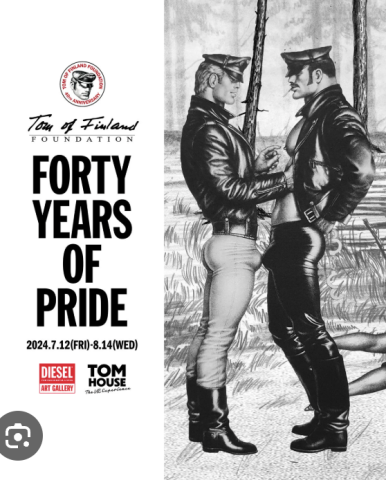
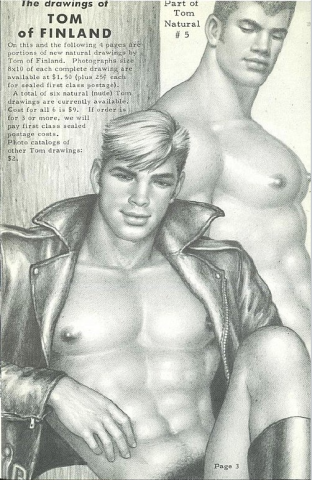
Touko Valio Laaksonen (8 May 1920 – 7 November 1991), known by the pseudonym Tom of Finland, was a Finnish artist who made stylized highly masculinized erotic art, and influenced late 20th-century gay culture. He has been called the "most influential creator of gay pornographic images" by cultural historian Joseph W. Slade.Over the course of four decades, he produced some 3,500 illustrations, mostly featuring men with exaggerated sexual traits, wearing tight or partially removed clothing.
In 1956 Laaksonen submitted drawings to the influential American magazine Physique Pictorial, which premiered the images in the 1957 Spring issue under the pseudonym Tom, as it resembled his given name Touko. In the Winter issue later that year, editor Bob Mizer coined the credit Tom of Finland. One of his pieces was featured on the Spring 1957 cover, depicting two log drivers at work with a third man watching them. Pulled from the Finnish mythology of lumberjacks representing strong masculinity, Laaksonen emphasized and privileged "homoerotic potentiality [...] relocating it in a gay context", a strategy repeated throughout his career.[3]
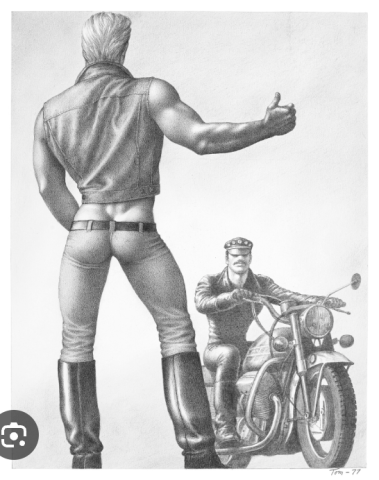
The post-World War II era saw the rise of the biker subculture as rejecting "the reorganization and normalization of life after the war, with its conformist, settled lifestyle."Biker subculture was both marginal and oppositional, and provided postwar gay men with a stylized masculinity that included rebelliousness and danger. This was in contrast to the then-prevailing stereotypes of the gay man as effeminate (sissy), as seen in vaudeville and films going back to the first years of the industry.Laaksonen was influenced by images of bikers as well as artwork of George Quaintance and Etienne, among others, that he cited as his precursors, "disseminated to gay readership through homoerotic physique magazines" starting in 1950.[Laaksonen's drawings of bikers and leathermen capitalized on the leather and denim outfits which differentiated those men from mainstream culture and suggested they were untamed, physical, and self-empowered.[This in contrast with the mainstream, medically and psychologically sad and sensitive young gay man who is passive.Laaksonen's drawings of this time "can be seen as consolidating an array of factors, styles and discourses already existing in the 1950s gay subcultures," which may have led to them being widely distributed and popularized within those cultures.
Laaksonen's style and content in the late 1950s and early 1960s was partly influenced by the U.S. censorship codes that restricted depiction of "overt homosexual acts". His work was published in the beefcake genre that began in the 1930s and predominantly featured photographs of attractive, muscular young men in athletic poses often shown demonstrating exercises. Their primary market was gay men, but because of the conservative and homophobic social culture of the era, gay pornography was illegal and the publications were typically presented as dedicated to physical fitness and health. They were often the only connection that closeted men had to their sexuality. By this time, however, Laaksonen was rendering private commissions, so more explicit work was produced but remained unpublished. Aside from his work at the advertising agency, Laaksonen operated a small mail-order business, distributing reproductions of his artwork around the world by post, though he did not generate much income this way.
In the 1962 case of MANual Enterprises v. Day the United States Supreme Court ruled that nude male photographs were not inherently obscene. Softcore gay pornography magazines and films featuring fully nude models, some of them tumescent, quickly appeared and the pretense of being about exercise and fitness was dropped as controls on pornography were reduced. By the end of the 1960s the market for beefcake magazines collapsed. Laaksonen was able to publish his more overtly androerotic work and it changed the context with "new possibilities and conventions for displaying frontal male nudity in magazines and movies." Laaksonen reacted by publishing more explicit drawings and stylized his figures' fantastical aspects with exaggerated physical aspects, particularly their genitals and muscles. In the late 1960s he developed Kake, a character appearing in an ongoing series of comics, which debuted in 1968.
When examining the reception of Laaksonen's art, it is impossible to separate it from its original purpose. His "dirty drawings", as he himself called them, served primarily as gay erotica, intended to arouse the viewer. As described by Rob Meijer, owner of a leathershop and art gallery in Amsterdam, "These works are not conversation pieces, they're masturbation pieces." Many of his drawings were published in publications like Physique Pictorial, or were advertisements and murals for bath houses, leather bars and clubs, which were erotically charged or explicitly sexual spaces.
They also contributed to the spread of a new gay masculinity and confidence. In oral histories, for example, the works of Laaksonen are repeatedly described as influential for one's own sexual biography. Many men identified with his characters, who were pictured as masculine, virile and often blue-collar, thus defeating homophobic stereotypes of effeminacy. Kate Wolf writes that "Tom of Finland helped pave the way to gay liberation".
Laaksonen's drawings were particularly popular in the flourishing leather subculture of the 1950s to 1970s. Tom's drawings were central to the development and dissemination of a more unified gay leather aesthetic, resulting in the so-called "clone look" of the 1970s and 1980s.
Tom's work wasn't pornography. It was salvation.
— Robert J. Pierce, Tom of Finland: The Case for Gay Art, The Soho News (6 February 1980)
During his lifetime and beyond, Laaksonen's work has drawn both admiration and disdain from different quarters of the artistic community. Laaksonen developed a friendship with gay photographer Robert Mapplethorpe, whose work depicting sado-masochism and fetish iconography was also subject to controversy.[
A controversial theme in his drawings was the erotic treatment of men in Nazi uniforms. They form a small part of his overall work, but the typically flattering visual treatment of these characters has led some viewers to infer sympathy or affinity for Nazism, and they have been omitted from most recent anthologies of his work. Later in his career Laaksonen disavowed this work and was at pains to dissociate himself and his work from fascist or racist ideologies. He also depicted a significant number of black men in his drawings, with no overt racial or political message in the context in which they appear; although they bear some commonality with racist caricatures of the "hypersexual" black male[according to whom?], these traits are shared by Laaksonen's white characters as well.
Sheila Jeffreys offers a radical feminist critique of Laaksonen's work in her 2003 book Unpacking Queer Politics.
Art critics have mixed views about Laaksonen's work. His detailed drawing technique has led to him being described as a "master with a pencil", while in contrast a reviewer for Dutch newspaper Het Parool described his work as "illustrative but without expressivity".
Writing for Artforum, Kevin Killian said that seeing Tom of Finland originals "produces a strong respect for his nimble, witty creation".