change
region
medium
issue
Anton
“Most people can’t imagine a futurist Africa,” says Ethiopian photographer Aïda Muluneh. She challenges this in her project, Water Life, exploring real-world issues with an otherworldly twist.
Muluneh went to Dallol, Afar, Ethiopia, an extreme landscape where it is dry and hot to capture the essence of water to life. Through her work, Muluneh highlights how water scarcity is mainly a burden on women.
Muluneh’s project, an exhibition of a series of 12 works commissioned by WaterAid with support from the H&M Foundation, is an advocacy project about the lack of access to clean water. To celebrate Aïda Muluneh’s exhibition at Somerset House as part of the 1-54 Contemporary African Art Fair, Nowness collaborated with WaterAid to create a special episode of her work. Directed by London-based filmmaker Adeyemi Michael, the film captures Muluneh in process at her studio in Addis Ababa, and in the Danakil Depression—where temperatures regularly soar to 120°F— where she shot part of the Water Life series. The film is supported by H&M Foundation.
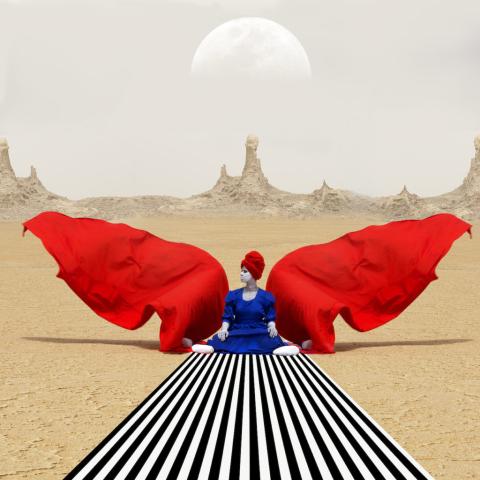
She explains that many girls do not attend school while they are menstruating because of a lack of facilities and sanitation provision. The moon is symbolic of women’s monthly cycles and the red cloth rippling up in the breeze shows that the protagonist is a “caged bird, grounded” by her period. But there is hope; the striped path indicates a future route to success, a route she can take if things change, notably traditional domestic roles and the lack of readily available water. “Water is the foundation of everything in the household, but [obtaining it] is the burden of women and I’ve always found that surprising," said Muluneh. "When you travel by car through the country you see long lines of women carrying it.”
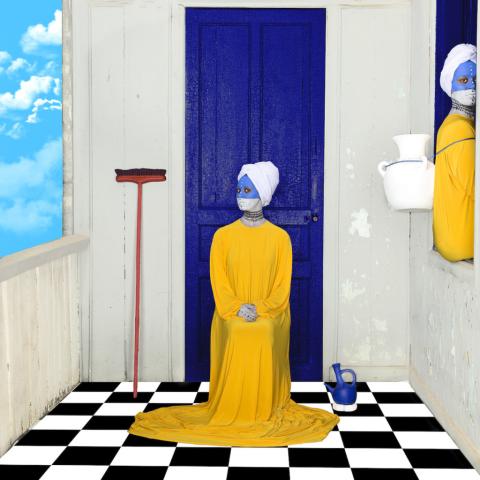
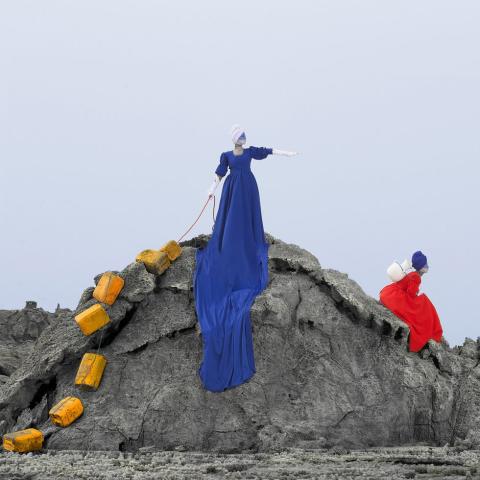
Muluneh’s images deliberately make use of bright colours that contrast against the background. The models are either wearing deep blue or red full gowns with white gloves and head ties, holding orange kegs. Muluneh’s work can be understood within the genre of Afrofuturism, a term that encompasses music, film, fashion, art and literature. It merges aesthetics of the past and present with technologies and visions of the future. Problems surrounding access to clean water continue to affect both rural and urban communities, from Flint in America, to many countries on the continent.
An estimated 783 million people do not have access to clean water. In Africa, 319 million people do not have access to improved reliable drinking water sources. In rural areas, more money is spent on getting water. Muluneh’s work looked at the impact lack of access to water has on “women particularly in rural regions."
From Muluneh:
"As part of building the collection, my main goal is to address the plight of water access and its impact not only on society but also on women in rural regions. For those of us who live in cities, we often take for granted the privilege that we have in relation to water access, while the realities of those living beyond the city grid encounter challenges that not only impact their health but also their ability to contribute to the development of their communities. With this in mind, each piece is a reflection of addressing the impacts of water access as it relates to women’s liberation, health, sanitation, and education.
Having worked in several regions in Ethiopia, I often encounter on the roads a stream of women traveling on foot and carrying the heavy burden of transporting water. I have understood that women spend a great deal of time fetching water for the household, which has an adverse effect on the progress of women in our society. We cannot refute that the majority of transporting water to the household is a responsibility of our women—a burden that has far greater implications on our future towards developing a nation. Hence, the urgency of supporting access to water in rural regions in Africa tackles various social issues and also is a determining factor in the self-sustainability of a community. I have chosen to create a few of these pieces in Dallol, Afar, Ethiopia, to place emphasis on the message I am transmitting and to also create a body of work that advocates through art a message with a different approach. The world is continually bombarded with the social plight of Africa; therefore, my focus in this project was to address these topics without the cliché that we see in mainstream media. In a sense, to advocate through art."