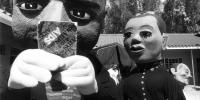
"Puppets Against Aids was launched by Gary Friedman on 1st December 1988 in time for 'World Aids Day' in Johannesburg, South Africa. During 1987, Friedman had been studying with Muppet master, Jim Henson, in Charleville-Mézières, France. Henson provided the initial financial contribution to launch the African Research and Educational Puppetry Programme 'Puppets Against Aids'.
Last Friday, Pablo Picasso’s Buste de Femme, (1943), was put on display at the International Art Academy Palestine in Ramallah. Marking the very first time that the Picasso’s work has been shown in Palestine and as the result of a loan request to the Van Abbemuseum in Eindhoven, this project is the tenacious vision of artist Khaled Hourani (also the Artistic Director of IAAP).
From creativetimereports.org:
Artist-activist collective MTL's clickable collages connect disparate aspects of Palestine's geographical and political landscape, offering provocative insight into "how Palestinians suffer and struggle in ways that are parallel to those elsewhere" according to philosopher Michael Hardt.
Notice Nature was a public engagement action undertaken by participants in the Erasmus+ funded training 'Creativity and Change: Empathy 2 Action - nurturing response-able global citizens' which took place in Cork from 8th - 13th April 2017. The team members were Marie-Michele Tessier, Aoife Dare, Ann Foulds, Zsofi Toth and Claire Faithorn.
Women in China are covertly resisting government crackdowns on discussions over their Me Too movement with a clever workaround.
The phrase “rice bunny” (米兔), pronounced as “mi tu,” has popped up on social media networks after censors removed posts that mentioned sexual harassment or the hashtag #MeToo. While those phrases are heavily monitored, Rice Bunny isn’t.
The TRANSummer Camp on the Croatian coast inspired members of the Croation trans community to become creative activists, and led to a public media campaign, video series and event advertising the “opening” of a (fake) clinic for trans health. The project included an ambitious survey on the healthcare experiences and needs of trans and gender variant people in the Balkans in multiple languages.
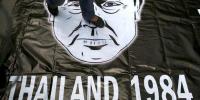
There are no whistles, no loud speakers, and no placards held up high in this quiet act of subversion. Pimsiri Petchnamrob stands silently in a mass of sharply dressed Bangkok commuters, her hands clutched around a copy of George Orwell's 1984.
Next to her a small group of young men and women, their faces sombre and their heads bowed low, also read books about fictional and real totalitarian worlds in silence.
Rooted in Native American and indigenous practices,[11] restorative justice is a set of principles and practices that aims to help communities heal from conflict and harm by developing a common understanding of the root causes and effects.[12] Restorative justice can occur in a variety of different contexts: in the workplace, at schools and within, or instead of, the criminal justice system.
The Great Game is a Java applet consisting of a realtime 3d terrain map of the Afghanistan region, depicting munitions, aircraft, targets, and troop movements for each day of the conflict. The Artist culls by hand the daily data from Department of Defense press briefings. Available information regarding type, quantity, and location of munitions and strikes are represented by play pieces created by the Artist from military diagrams.
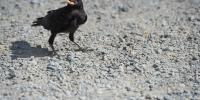
Oh, to be a crow.
Maligned as scavengers that torment their dead brethren. Portrayed as aerial killers in the 1963 Alfred Hitchcock classic, “The Birds.”
In France, though, the wily crow is getting a makeover. Puy du Fou, a historical theme park in the Loire region about four hours from Paris, has trained six crows to pick up cigarette butts and bits of trash and dump them in a box.
Mon Dieu! Are the pigeons of Paris next?
The Kiss of Love campaign in India is a non violent protest against moral policing. It started out as a Facebook page but gained momentum across India when a mob of conservative, right-wing party members attacked and demolished a coffee shop in Kozhikode, Kerala. Their grounds to do so was public display of affection by couples inside the coffee shop, which they saw as immoral activity.
Thich Nhat Hanh reads his poem "For Warmth" in Vietnamese, Krista Tippett reads the translation in English, excerpted from the episode "Mindfulness, Suffering, and Engaged Buddhism."
It’s been a historic year for women. There are more serving in Congress than ever before, and a record number are currently running for president in 2020. But even with these significant gains, women—both in the U.S. and around the world—can still find gender equality elusive.
Since summer 2011, FARM’s activists have been paying people $1 each to watch a 4-minute video depicting the inherent cruelties of raising animals for food. This tactic, known as “pay-per-view,” has led 80% of participants to reduce meat consumption, sparing tens of thousands of animals from abuse and slaughter.
The group Art Not Oil did a campaign to raise awareness about the oil industry, and their funding of Art. "Art Not Oil has campaigned against Big Oil cultural sponsorship since 2004.
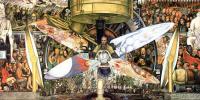
In 1932, Rivera was commissioned by Abby Aldrich Rockefeller and her husband John D. Rockefeller Jr. to paint a mural for the lobby of Rockefeller Center. Rivera kept the original, approved plan for the two outer sides of the mural but changed the inner panel to include a critique capitalism. This inner panel ultimately included: Lenin, prostitutes, and the upper class drinking alcohol and covered in signs of venereal disease.
Dylan Marron is a Venezualan-American actor, writer, and director who noticed something about the film industry: in most of the major films, people like him (and other non-white groups) were not being well represented.
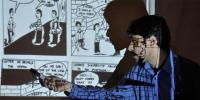
With World Comics India, the organization he started, Sharad has pioneered a cheap and easy medium for poor people to communicate meaningfully on issues that are neglected by the conventional media. While the urban elite dominates public media, the grinding day-to-day concerns of millions are rarely heard. Layers of discrimination and abuse heaped on huge numbers of people keep their problems out of sight and out of mind.
Our project aims to show people that joy can be an act of resistance and resilience in the face of global justice issues when harnessed in the right way. The sharing of joy can also act as a connector in a society that continues to grow more polarised through the division of social media and mainstream media.