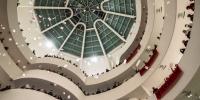
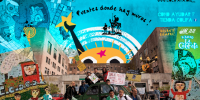
The scraps of paper swirled through the Guggenheim Museum in New York on Saturday night like confetti, thrown from an upper walkway into the central rotunda before floating to the ground.
The Milosevic regime ruled over Serbia and Yugoslavia for about 13 years. To maintain control, the Milosevic regime was infamous for arbitrary arrests, beatings, imprisonment and even murder of avid opponents.
Three months ago, when New York government officials ordered nonessential businesses closed to slow the spread of coronavirus, high-end retailers sheathed their stores in plywood barriers, as though readying for civil unrest.
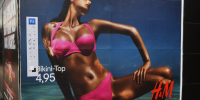
Artist Daniel Soares pasted Photoshop toolbar stickers on these H&M posters as a nice little reminder that not all is as it seems. Y'all know how Photoshop messes with our perception of beauty, and I think this is a smart little stunt to snap us back into reality when we start to wonder why we never look like the girls on the posters we walk past every day.
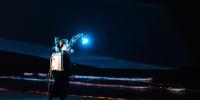
China's only seaside theater festival has been held in the resort town of Aranya in north China's Hebei Province. Artists from around the world traveled there to take deep dive into the world of dramatic performance. For theatergoers, there were interactive activities including cross-border installations such as seaside talks, environmental drama readings, screenings, theater houses, parades and bonfires by the sea.
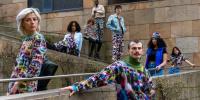
A start-up has launched a line of clothing that confuses artificial intelligence (AI) cameras and stops them from recognizing the wearer.
Italian start-up Cap_able is offering its first collection of knitted garments that shields the wearer from the facial recognition software in AI cameras without the need to cover their face.
Called the Manifesto Collection, the clothing line includes hoodies, pants, t-shirts, and dresses.
The image is stark. And shocking.
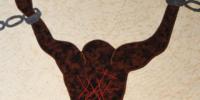
A black man, his ankles shackled, his head hanging away from the viewer, stands in relief on a field of white. Chains stretching to the image's borders on the left and right pull his arms taut. Fourteen crimson marks crosshatch his back. Within the dark fabric that frames "86 Lashes to Go," a small rectangle is labeled simply "salt."
Zhang Huan is a very talented performance artist in China. In the famous work "Twelve Square Meters", he was covered with fish oil and honey sitting in a dirty public toilet in Beijing's East Village for an hour, not only making swarms of flies greedily surround him, but also People feel extremely uncomfortable and even nauseous.
More than 20 years ago, a psychology student doing his training at one of Argentina's oldest psychiatric wards kept being asked by his family and friends what it was like to work in there. So he came up with an idea: to let the patients explain in their own words.
The first radio station to broadcast from inside a mental hospital was born.
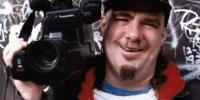
Documentarian Clayton Patterson captured video of police brutality during the Tompkins Square Park riots in the summer of 1988. When District Attorney Robert Morgenthau ordered Patterson to hand over his camera and tapes as evidence, Patterson refused, citing distrust of the criminal justice system. He was sentenced to 90 days in jail, but after a 10-day hunger strike, his lawyers negotiated a deal to free him.
Women in China are covertly resisting government crackdowns on discussions over their Me Too movement with a clever workaround.
The phrase “rice bunny” (米兔), pronounced as “mi tu,” has popped up on social media networks after censors removed posts that mentioned sexual harassment or the hashtag #MeToo. While those phrases are heavily monitored, Rice Bunny isn’t.
Late last month, Chinese citizens took up a creative means of protest over the nation’s strict “zero-COVID” policy. In a place with little tolerance for large public demonstrations, protesters have been holding up blank pieces of paper. Their ingenuity inspired a local artist Yolanda He Yang to stage a public art demonstration to subtly communicate their dissent.
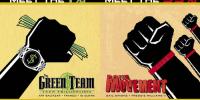
Following in the strong tradition of using graphic novels to explore social ills, DC Comics is releasing two new politically activist issues in their "New 52" series.
The first is called "The Movement" and is written by Gail Simone. Simone describes that "The Movement is an idea I’ve had for some time. It’s a book about power–who owns it, who uses it, who suffers from its abuse."
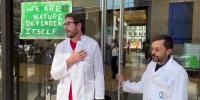
A Nasa scientist who went viral over his tearful protest on the climate crisis has told The Independent that his activism comes from a sense of desperation to “find something that actually has an impact and moves the needle”.
Peter Kalmus was among a group of scientists arrested last week after they chained themselves to a JPMorgan Chase building in Los Angeles in protest of the bank’s financing of fossil fuels.
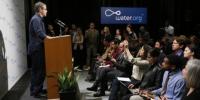
For the launch of a new organization fighting to end the water crisis, Matt Damon, Co-founder of Water.org, has produced a video using humor to shed light on the issue of access to clean water. In the spoof, he holds a press conference at which he announces that he will "not go to the bathroom until everyone has access clean water," calling for a "toilet strike."
On the small island of Teshima in Japan’s Seto Inland Sea, Multibasket – No One Wins invites visitors to reconsider competition, collaboration, and the intersection of art and play.
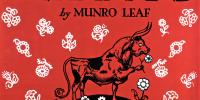
On a damp and rainy Sunday in October of 1935, Munro Leaf sat down to write a story. He had been eager to work with his friend – the illustrator Robert Lawson – for some time and so he decided to pen a book which he felt might suit the illustrator’s skills. Lawson was a master at drawing animals but horses, dogs, cats, rabbits and mice had all been done a thousand times already.
When Jonathan D. Chang visits the 626, he often wears a black hoodie emblazoned with a colorful print of Guangong on the back. A military general from the Three Kingdoms era turned Taoist guardian deity, Guangong, or Guan Yu, is known throughout China and parts of Vietnam as a symbol of wealth and protection. Chang’s hoodie features his own design of the deity, which he drew in classic chibi fashion with a big head and smaller limbs.
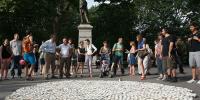
ŠTO TE NEMA is a public monument created as a response to Europe’s worst atrocity since World War II - the systematic killing of 8,372 Muslim men and boys in the UN-protected safe area of Srebrenica in Bosnia and Herzegovina in July of 1995.