After a spate of bullying-related suicides of LGBT youth, gay columnist Dan Savage and his partner Terry Miller decided to launch the It Gets Better project to see what they could do about it. They began with a simple YouTube video in which both of them described their experiences with bullying in high school, coming out, their families, and the story of their relationship and the adoption of their sun.
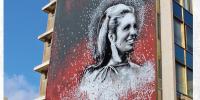
Mural artists add color and flavor on 800 South in the Granary District of downtown Salt Lake City. There’s an old-fashioned bar on the side of a locally-owned brewery, and a Southern Utah landscape on another building. Down the street, on the south corner of 800 South and 300 West, there’s a new mural that’s far more potent.
Leilei Zhang was harassed on a public bus when a man gripped her hand, glared at her and refused to let go. With the determination to raise public awareness, Leilei began a crowd-funding campaign to raise money for what could have been China's first public anti-sexual harassment advertisement. She approached the authorities of her home city, Guangzhou, but it did not want to take on the advertising for fear it would panic the public.
The series "No Violence Against Women" depicts famous cartoon couples transformed into victims of abuse. The women are left bloodied and with black eyes with the slogan "What Kind of Man are You?" above. The images are a commentary on domestic violence and were released in honor of International Women's Day
Wafaa Bilal's childhood in Iraq was defined by the horrific rule of Saddam Hussein, two wars, a bloody uprising, and time spent interned in chaotic refugee camps in Kuwait and Saudi Arabia. Bilal eventually made it to the U.S. to become a professor and a successful artist, but when his brother was killed at a U.S. checkpoint in 2005, he decided to use his art to confront those in the comfort zone with the realities of life in a conflict zone.
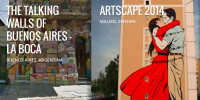
Google entered the art game in 2011 with the introduction of its Art Project, working with 17 museums and expanding further to over 150 institutions in 2012. Last June, Google added 5,000 images of street art from around the world to the project and today it has announced that it will be doubling that number to 10,000 with the launch of the second edition of its Street Art Project.
"The thing about this is that sculptures like these in art history were for the male gaze. Photoshop a phone to it and suddenly she’s seen as vain and conceited. That’s why I’m 100% for selfie culture because apparently men can gawk at women but when we realize how beautiful we are we’re suddenly full of ourselves…" —Kiyun Kim
"Surround Congress”: as soon as we’d heard this, in our minds we were there. To make the Government resign and demand they start a new constituent process seemed like a great idea. We immediately got to work.
Fast-casual chain Chipotle Mexican Grill added some spice to its long-running "Food With Integrity" sustainable farming campaign by teaming with Academy Award-winning design firm Moonbot Studios for The Scarecrow, an animated short film and accompanying mobile game created to increase consumer awareness of animal confinement, synthetic growth hormones, toxic pesticides and other fixtures of industrial food production.
“Discovering Columbus,” by the Japanese artist Tatzu Nishi.
Nishi built a living room around the sculpture in Columbus Circle in New York City. The living room is mounted on scaffolding and turns the sculpture into a domestic center-piece.
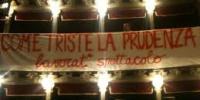
A changing cast of theater workers — actors, seamstresses, lighting technicians and prop masters — are protesting the privatization of a stage once graced by some of Europe’s greatest thespians, from Sarah Bernhardt to Vittorio Gassman.
“Cabaret Con-Sensual is an effort comprised of actors, dancers, comedians, producers, writers, and other artists who strive to champion consent and discuss rape-culture through the subversive, yet expressive medium of the performing arts.”
The show was created by Bitsy La Bourbon, founder of the anti rape campaign and non profit organization More Than No.
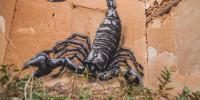
Djerbahood Project, which took place during the months of July and August on a small island called Djerba and is located in the Gulf of Gabes. Better known as the island of dreams, the tiny village of Djerba boasts a traditional and authentic Tunisian setting which acted as a blank canvas for hundred and fifty street artists from thirty different countries.
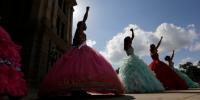
On Wednesday, a group of 15 teenage girls, dressed in brightly colored gowns, stood in front of the Texas State Capitol to participate in one of Latin American culture’s most cherished traditions: the quinceañera.
John Shore and his wife Catherine had been attending the First Presbyterian Church of San Diego for six years when they were nominated to serve as deacons. But before they could be ordained, they were asked to sign a document agreeing that no person in a same-sex relationship should hold any position of authority within the church, which is one of the city’s oldest. It was 1990.
Climate activist Greta Thunberg has teamed up with UK band The 1975 to record a song in she calls for mass civil disobedience to force action on greenhouse gas emissions.
In the track, titled “The 1975,” Thunberg recites an essay over ambient music, urging listeners to join a popular rebellion against climate change.
“Everything needs to change. And it has to start today,” she says in the song, released July 24.
Yazan Halwani is a young Beiruti artist who paints murals of revered Lebanese and Arab figures on prominent walls in a bid to help overcome sectarianism in this fragmented city. “What I try to do,” he explains down a fuzzy line from Beirut, “is write the stories of the city, on its own walls – creating a memory for the city.”
The protracted queue. That was the first thing I noticed when I arrived. It was winding, unending and impossible to see exactly where it began. I asked one of the security guards if he had any indication as to the waiting time. His response was a “your guess is as good as mine” shrug. As the mammoth line snaked around the building, my heart sank further – it is a myth that Brits love to queue; we feel compelled to, we don’t love it.
Lady Gaga said something interesting about her song “Born This Way” during a March 2011 interview at Google headquarters. “What's so funny [is] when I put that song out, everybody was like, ‘Oh, the lyrics are so literal,’ and I'm like, ‘Yeah,’” she shared, almost with a fuck-you cadence. She wasn't angry—but you could tell how important the track was to her, and how she didn't want its message muddled.