"Formerly incarcerated people, activists and family members of people detained on Rikers Island released dozens of white balloons into the air from the base of the Rikers Island Bridge.
The balloons, each one representing someone who had died at Rikers, transversed the heavily guarded bridge that separates the island from mainland Queens, disappearing out of sight.
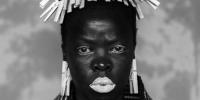
I am a visual activist. Most of what I have done over the years focuses on black LGBTQIA+ and gender-non-conforming individuals from South Africa and other neighbouring countries. It’s about making sure we exist in the visual archive. I call myself a visual activist — or, rather, a cultural activist, because this work is not only about the arts; I’m focusing on education, I’m dealing with culture in a way that confronts a number of issues.
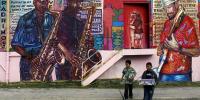
CENTRO San Antonio's Art Everywhere Project will celebrate its 5th anniversary in May.
As of May 2024, the project had seen numerous artists from the city's urbancore decorate areas of the city with elaborate murals reflecting the city's history and the diversity of cultures in the city.
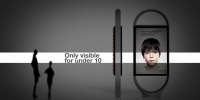
In an effort to provide abused children with a safe way to reach out for help, a Spanish organization called the Aid to Children and Adolescents at Risk Foundation, or ANAR for short, created an ad that displays a different message for adults and children at the same time.
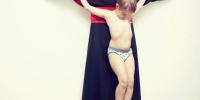
A CUBAN artist's controversial photographs of children being hung from crosses has landed him in hot water.
Erik Ravelo took a series of photos of children hung like Jesus from a cross, but in the place of the cross were soldiers, surgeons, priests and Ronald McDonald.
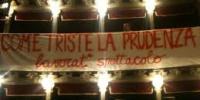
A changing cast of theater workers — actors, seamstresses, lighting technicians and prop masters — are protesting the privatization of a stage once graced by some of Europe’s greatest thespians, from Sarah Bernhardt to Vittorio Gassman.
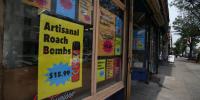
Brooklyn deli re-brands as artisanal emporium to protest rent hike
The owners of an imperiled Boerum Hill deli have staged an “artisanal takeover” of their 25-year-old corner store, re-branding products with yuppified names and jacking up prices to illustrate the kind of shop that could afford the 250-percent rent hike they say the store’s landlord is demanding.
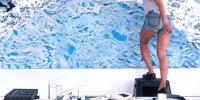
Her name is Zaria Forman, a leading artist in contemporary art with a cause. She is not only an exceptional human being; she is also an incredible American drawer who uses art to convey the emergency of climate change.
Zaria’s ultra-realistic drawings explore moments of raw beauty, peace in the landscape, power in the ice and transition that allow the viewers to emotionally connect with places they may never see in real life.
The problem with feminism is that it’s just too familiar. The attention of a jaded public and neophiliac media may have been aroused by #MeToo, with its connotations of youth, sex and celebrity, but for the most part it has drifted recently towards other forms of prejudice, such as transphobia. Unfortunately for women, though, the hoary old problems of discrimination, violence and unpaid labour are still very much with us.
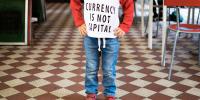
The People’s Bank of Govanhill uses social and activist art practices to involve people in re-imagining the local economy, looking at how we can put feminist economics into practice in the local community.
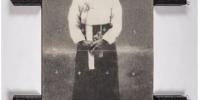
In the series The History of Korean Women, Cho's suggests that the cost of that gain cannot be paid for by a cultural amnesia masking the pain and suffering of previous generations. Here the semantic emphasis is on the official - the status of women and their contribution to the survival and growth of Korea. Their efforts have gone uncelebrated due to their relegated status within a five hundred year old social system.
In a case of voter fraud, an investigation revealed that the party in power had won fifty votes from the residents of a single apartment.
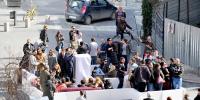
A group of activists reproduced the apartment in a downtown square and invited 50 people inside.
The action took just one part of the case, literally brought it into three dimensions, and showed the absurdity that this could ever be legitimate.
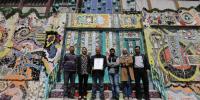
A group of Syrian artists in Damascus has created the world's biggest mural made of recycled materials, a rare work aimed at brightening public space in a city sapped by war and sanctions.
The brightly coloured, 720-sq metre work was constructed from aluminum cans, broken mirrors, bicycle wheels and other scrap objects and displayed on a street outside a primary school in the centre of the Syrian capital.
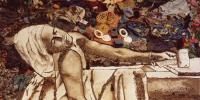
The project involved creating portraits of garbage pickers from the Jardim Gramacho landfill near Rio de Janeiro, Brazil, using materials found in the landfill itself.
Muniz worked with the garbage pickers to create the portraits, which were then photographed and exhibited in galleries around the world. The project aimed to raise awareness of the plight of the garbage pickers and the environmental issues associated with landfill waste.
It was a long time coming - but it was worth the wait.
Nearly two years ago, more than a dozen of Mexico’s biggest performing artists came together in a mega-event aimed at saving Wirikuta, one of the country’s most sacred sites, from devastation at the hands of Canadian gold and silver mining operations.
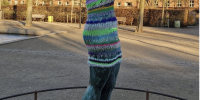
The yarn bombing started with Louise Moerup’s school run in central Copenhagen. On the walk through the park each morning, she and her 10-year-old son would often discuss a naked statue of the goddess Venus there and wonder why there weren’t more statues of real women instead.
The Voice of Dissent
“I am not here to entertain you; I am here to disturb you. Those who are here for entertainment, I request them, please go.” It’s unusual, if not rare, for a live performer to begin by saying that to the audience. The compact of patronage that’s implicit is what Sambhaji Bhagat smashes right at the onset of his performance. For him, this art is a quest for the truth that will liberate the people he represents.