Glowing softly in the West Texas desert night, artist Guadalupe Maravilla’s Mariposa Relámpago, was once an ordinary school bus but is now a richly decorated, mobile site for remembrance and healing. Like much of the artist’s work, this piece commemorates and confronts the artist’s journey to the United States as an unaccompanied, undocumented minor fleeing civil war in El Salvador in the 1980s.
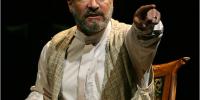
The snapshots are thrust at us urgently, as if they were passports being shown at a border crossing, official proofs of national identity. Mostly, they are prosaic pictures of family members or houses. Sometimes a diploma will be offered up instead, or theater reviews clipped from newspapers or a membership card to a duck-hunting club. Later, other, more frightening, pictures will be shown, but they all serve the same function.
Tranvía Cero is a group of artists from Ecuador who have been creating artistic projects with the aim to empact community lives and change the ideas of art as an exclusive terrain. The describe their goal as a redefinition of art through the social engaging experiences.
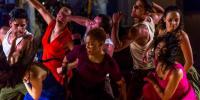
Contra-Tiempo’s first Miami dance performance will bring Ana Maria Alvarez back to her roots. Her father’s family settled in Miami after leaving Cuba in the early ’60s. Most of them, including his four siblings and their spouses and children, still live here, and Alvarez expects much of the clan to attend her show.
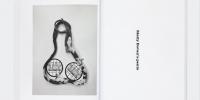
You might think that pictures of dicks (usually unsolicited) aren’t particularly hard to come by on the internet. And most of those dick pics aren’t particularly expertly composed. But that’s not the case for Penile Papers, a new collection of phallic art curated by London-based artist Dominic Myatt.
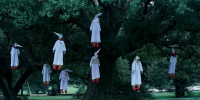
A Richmond, VA.-based activist group called Indecline has recently installed a street art resistance installation of several hung clown figures dressed like the KKK from a tree in Richmond’s Bryan Park.
Five leaders of British political parties called for dramatic action to confront climate change in a televised debate on Thursday, just two weeks before the country’s general election.
A melting ice sculpture stole the show.
Zubair Magray, who goes by the stage name Haze Kay, raps about the conflict in Indian-administered Kashmir. The 23-year-old, one of the first rappers to emerge from the valley, blames the Indian military for "ruining" his homeland.
Fresh off the Boat examines the immigrant struggle told from the perspective of Eddie Huang, a modern day chef and video entrepreneur who has found a way to use food to explore culture, diaspora, and more through food, television, and the book that I am discussing now.
This book serves as an important storytelling experience of the immigrant and helps bridge the generational struggles often seen in these stories.
In early 2012, a group of artists, activists and assorted other odd balls got together to form People's Tours. The idea was to give walking tours in the Boston area. Standard enough. But instead of the usual history, we would talk about social justice, contested spaces, important protests, and shady corporations.
So far, the group has consisted of Dave Taber, Heather McCann, Kristin Parker, Neil Horsky, and Tim Devin.
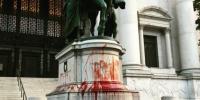
Just weeks after activists staged an alternative tour of the American Museum of Natural History to call for its removal, among other things, the equestrian statue of Teddy Roosevelt was vandalized early Thursday morning.
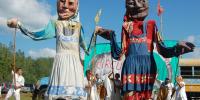
The Bread and Puppet Theater was founded in 1963 by Peter Schumann on New York City’s Lower East Side. Besides rod-puppet and hand puppet shows for children, the concerns of the first productions were rents, rats, police, and other problems of the neighborhood. More complex theater pieces followed, in which sculpture, music, dance and language were equal partners. The puppets grew bigger and bigger.
It’s almost no surprise that the Supreme Court overturning of Roe v. Wade happened this past week.
Since its enaction in 1973, there have been numerous occasions where politicians and people alike have tried hacking away at its success in reaffirming a women’s right to choose.
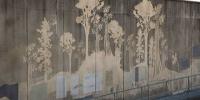
Reverse graffiti is form of street art that involves carving into the dirt and dust that surrounds us. Artists subtract from a surface in order to create a negative image within the positive, often quite dark layer of grime.
Dawn Jones Redstone’s short film about reproductive justice features women of color leading the resistance.
The year is 2023.
Health care of any kind is highly inaccessible and in some cases outlawed.
Public utilities such as water are privatized and severely restricted.
Streets are filled with protesters clutching signs that say “Water is a human right” and chanting “Whose streets? Our streets.”