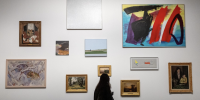
Swiss doctors are expanding the range of prescriptions for patients with mental health conditions and chronic illnesses to include strolls in public gardens, art galleries and museums.
The city of Neuchatel, in western Switzerland, launched the pilot project with doctors last month to help struggling residents and to promote physical activity.
A trio of far-right, pro-gun provocateurs is behind some of the largest Facebook groups calling for anti-quarantine protests around the country, offering the latest illustration that some seemingly organic demonstrations are being engineered by a network of conservative activists.
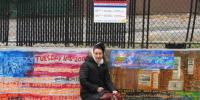
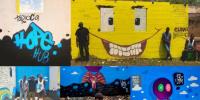
The "Democracy Wall" in the Carroll Gardens section of Brooklyn, New York was established in 2009. This wall is a long-term, community art activist project that is part wall mural, part past information archive.
"Michelle Obama’s mission of encouraging kids to eat healthier is getting a global spin — and a few puppet allies. The former first lady is launching a kids’ cooking show on Netflix as part of the production deal between Netflix and the production company she founded with her husband, former president Barack Obama.
A major exhibition by Ai Weiwei this autumn features a new series of monumental sculptural works in iron, cast from giant tree roots sourced in Brazil during research and production for last year’s survey exhibition, ‘Raiz’, at the Oscar Niemeyer-designed OCA Pavilion in Ibirapuera Park, São Paulo.
The Violence Against Women (VAW) Art Map was conceptualized in the fall of 2018, in the wake of the #MeToo movement by Dr. Lauren Stetz, as part of her doctoral research in Art Education with a minor in Women's, Gender, & Sexuality Studies at Penn State University.
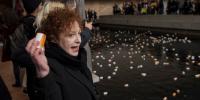
Anti-opioid activists unfurled banners and scattered pill bottles on Saturday inside the Sackler Wing of the Metropolitan Museum of Art in New York, which is named for a family connected to the powerful painkilling drug OxyContin.
The protest, which was organized by a group started by the celebrated photographer Nan Goldin, started just after 4 p.m., when several dozen people converged at the Temple of Dendur inside the wing.
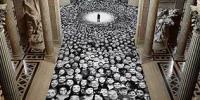
After winning the TED Prize on March 2, 2011, the French-artist JR launched the Inside Out Project, in his first TED Talk. Using his own artistic practice as inspiration, this participatory platform helps individuals and communities to make a statement by displaying large-scale black and white portraits in public spaces. Through their “Actions,” communities around the world have sparked collaborations and conversations.
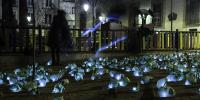
Luzinterruptus turns their art activism towards the overabundance of dog doo littering the city’s streets.
The studio inflated 500 poop-scoopin' plastic bags and placed a lightbulb inside each one.
Installation lasted nine hours.
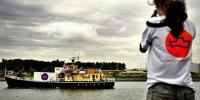
Women on Waves sails a ship to countries where abortion is illegal. With the use of a ship, early medical abortions (till 61/2 weeks of pregnancy) can be provided safely, professionally and legally.
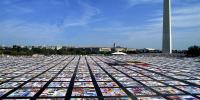
Cleve Jones's powerful vision for memorializing those lost to AIDS was realized in October 1987 in Washington D.C. It showcased the artistic contributions of people who'd lost loved ones to the virus from a number of US metropolitan centers. The quilt has continued to grow for the nearly 40 years since. By 1992, the AIDS Memorial Quilt included panels from every state and 28 countries.
Artists: Cindy Maguire, Assistant Professor Art Education Adelphi University and Teaching Artist with Artistic Noise and girls ages 13-17 from the Brentwood Residential Center on Long Island.
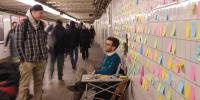
Matthew “Levee” Chavez sits at a table in New York City’s Union Square, sporting a thrift store suit and tie, holding a sign that reads “Subway Therapy.” This act of social practice, which started as an invitation for conversation, went viral after he set up shop at the subway the day after the 2016 presidential election. He wrote “Express Yourself” on a Post-It and stuck it to the tiled wall.
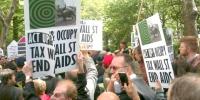
Gran Fury was an AIDS activist artist collective from New York City consisting of 11 members, all artists - but action, not art, was the aim of the collective. Gran Fury member Loring McAlpin described the collective's mass-market ambition to “...fight for attention as hard as Coca-Cola fights for attention.”
This Anti-Abortion Influencer Is Using ‘Magical Birth Canal’ Videos to Supercharge the Movement
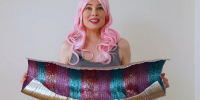
Laura Klassen is using props, satire, and a pink wig to pioneer a young and edgy approach to anti-abortion messaging in Canada.
By Valerie Kipnis and Elizabeth Landers
May 4 2020, 12:45pm
As part of the commemoration of this year’s World Art Day (April 15), Ghanaian-based Tapioca Foundation and Imposters Art Collective have embarked on a campaign to educate the public about environmental sustainability.
The project, which was launched in Ada in the Greater Accra Region, is intended to use art pieces to highlight issues relating to environmental protection and climate action to boost awareness in local communities.
WEST MIAMI-DADE, FLA. (WSVN) - A seminarian and faculty member at a South Florida school is taking a creative approach to engaging with students about challenging issues during this time of uncertainty, including the coronavirus pandemic. He made a rap video.
Gender equality charity Women of the World (WOW) is launching a one-day festival of activism that invites people from all generations, genders and backgrounds to take part in conversations around sexual violence.
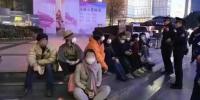
In the south-western city of Chengdu, by all accounts a city on the edge coping with heavy pollution but also with authorities scrambling to put a lid on simmering discontent. That night police detained a number of artists who managed to stage a silent demonstration, while wearing face masks.
Animal Collective, Mumford and Sons and Duran Duran among performers who have turned concerts in state into fundraisers as part of NC Needs You movement
Even as North Carolina’s governor, Pat McCrory, refused to comply with federal officials over his state’s so-called “bathroom bill”, experimental pop group Animal Collective went forward with its scheduled show in the state over the weekend.
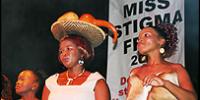
To change Bostwana’s regional misconceptions about HIV, Kesego Basha-Muebli, founded the Miss HIV stigma free pageant. A pageant designed for women who are currently receiving health and wellness counseling and HIV antiretroviral treatment to come out to their friends and family as being HIV positive.
Long before the red ribbon became an innocuous symbol of AIDS
“awareness” and celebrity philanthropy, there was the pink triangle and
there was ACT UP and there were thousands of people taking to the
streets for their lives. Once a symbol used to mark suspected queers for
death in the Holocaust, ACT UP appropriated the pink triangle for
Rights activists in Mozambique have marched through the capital Maputo to protest a colonial era law still included in new legislation that allows rapists to go unpunished if they marry their victims.
The "marriage effect" clause sees convicted rapists given a five-year suspended sentence if they marry their victims and stipulates that the perpetrator should stay married to the victim for at least five years.