change
medium
issue
region
Anton
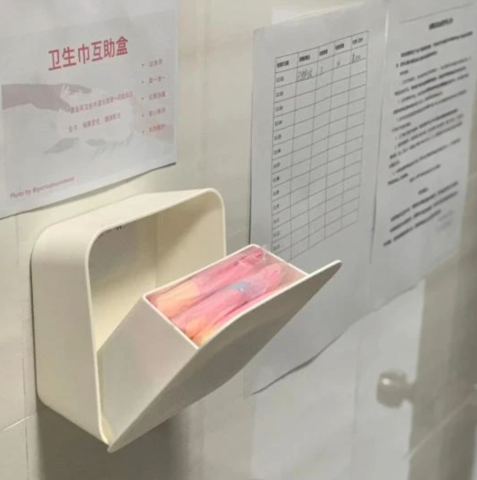
From October to December 2020, Chinese university students nationwide launched a viral movement to install “menstrual pad mutual aid boxes” in women’s restrooms—free, wall-mounted containers stocked with disposable pads on a take-one, replace-one basis. Nearly 250 campuses joined within weeks. Some sustained their boxes for over a year, while others saw them vanish after bureaucratic pushback, logistical hurdles, or dwindling volunteer resources. Below is an English-only narrative of how these grassroots initiatives arose, evolved, and in some places became institutionalized.
Origins and Early Expansion
Shanghai International Studies University (SISU):
Late October 2020: A small dormitory-corridor discussion among 16 English-interpretation majors led to forming the SISU Menstrual Mutual Aid Group.
November 1, 2020: Seven sealed, wall-mounted boxes were placed in women’s restrooms across the Hongkou campus library and teaching buildings. Volunteers designed posters, drafted a take-one, return-one user agreement, and secured logistics-office approval.
Campus Buzz: The project dominated student social feeds; 72 percent of 613 surveyed students across SISU’s two campuses agreed it helped break menstrual stigma, and 59.5 percent praised its urgent-need relief.
Beijing Normal University (BNU):
October 2020: Inspired by SISU and other campuses, a student “Z” and three friends purchased sealable food boxes and supplies in one day and installed multiple aid boxes without formal approvals. Their boxes were removed—first by building staff mistaking them for unauthorized ads, then by administrative order citing safety, hygiene, and sensitivity around gender topics.
Sun Yat-sen University (SYSU) and Others:
Similar rapid installs occurred at SYSU’s Guangzhou campus and at Shantou University, each facing distinct challenges from property managers or faculty advisors who feared gender division or facility damage.
Operational Challenges and Adaptations
Empty-Box Problem: High foot traffic emptied supplies within days. Many students failed to replace pads promptly, leading boxes to run dry.
Hygiene Concerns: Closed-box designs, daily cleaning rosters, and sealed medical-grade bags were introduced to address sanitation worries.
Funding and Sustainability:
Some groups relied on student-raised funds, quickly exhausting resources.
BNU piloted a “take-one/return-one + QR-code donations” model, charging 0.5 RMB per pad to cover costs.
Chongqing Yitong University secured a corporate sponsorship providing 5,000–10,000 pads annually, solving stock shortages but raising concerns about mutual-aid purity.
Institutionalization and Legacy
China University of Political Science and Law: Volunteers formed the Elile Gender Equality Society, won official approval, and secured university seed funding. They standardized sealed-box storage, conducted brand-preference surveys, and rotated volunteer shifts to maintain ten boxes, later upgrading to electronic dispensing units that track usage.
SISU Continuity: Original 2019 graduates recruited successors to ensure maintenance even through Shanghai’s COVID lockdowns, sharing costs evenly among group members.
Beyond Campuses: On March 11, 2022, the initiative expanded beyond universities when boxes were installed in Shanghai’s Lujiazui China Resources Plaza, marking a shift from campus activism to broader public amenity.
Impact and Reflection
Stigma Reduction: Many female students report now speaking openly about menstruation, viewing restroom boxes as practical symbols that “someone cares.”
Policy Conversations: Several universities surveyed student needs, and some faculty publicly supported the concept—demonstrating how small, visible actions can prompt broader discussions of gender equity and health access.
Grassroots Mobilization: The movement illustrated how informal student groups can navigate university bureaucracies by installing first and seeking permission later—a tactic that both showcased urgent needs and forced administrations to reckon with them.
Conclusion
The menstrual pad mutual aid box phenomenon underscores the power—and fragility—of student-led public-health activism in restrictive or risk-averse institutional contexts. While some boxes disappeared amid administrative resistance or operational fatigue, others evolved into formally supported programs that continue to meet urgent needs and normalize conversations around menstruation.