One of the defining features of politics in the 21st century has been the way online cultural phenomena can cross over into the “real” world.
Unfortunately, perhaps because the internet seems to bring out the worst in people, those phenomena have largely been, well, awful.
For some, October 14, 1968, was a clarion call to the future.
On that day, a group of 12 black students at UC Santa Barbara, tired of the unequal treatment and passive-aggressive racism they received as Black athletes — and as members of the campus community at large — barricaded themselves in the university’s North Hall.
Glowing softly in the West Texas desert night, artist Guadalupe Maravilla’s Mariposa Relámpago, was once an ordinary school bus but is now a richly decorated, mobile site for remembrance and healing. Like much of the artist’s work, this piece commemorates and confronts the artist’s journey to the United States as an unaccompanied, undocumented minor fleeing civil war in El Salvador in the 1980s.
User @ArmoredSuperHeavy on Twitter recently posted a master document detailing their explorations into bookbinding, fanfiction preservation, and the online gift economy. Their bookbinding venture, named Dead Dove Publishing, is a project that seeks to preserve and legitimize fanworks and celebrate the fandom gift economy. The document explains their actions and the work they have done since they began two years ago.
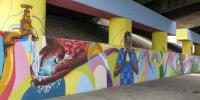
In a bid to fight the spread of COVID-19, the EU Delegation to Ghana on Wednesday 27 May joined the International Organisation for Migration (IOM), the Accra Metropolitan Assembly (AMA) and artists from the Ghana Graffiti Collective, to launch an initiative to use street art and graffiti to create awareness about coronavirus and migration.
The artwork created by the Ghana Graffiti collective speak about hope, tolerance, love and solidarity.
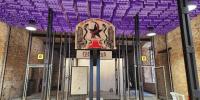
The Mexican Pavilion is an immersive space based on a 1:1 scale fragment of the expanded model of the campesino basketball court, an infrastructure that has become repurposed as a space for poly- and pluri-valent processes of decolonisation in Mexico’s indigenous communities.
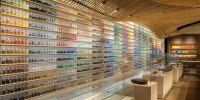
Established in 2015 in the Tennōzu neighborhood of Tokyo, and attracting industry professionals and art enthusiasts from both Japan and abroad, PIGMENT TOKYO has emerged as an art supply store specializing in the materials and tools used in traditional Japanese painting, such as mineral pigments, washi paper, and brushes. However, it’s more than just a store.
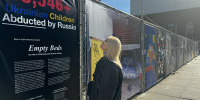
Four days before the U.S. presidential election, three Ukrainian activists gathered at a stranded fence in New York City’s East Village to hang an expansive information poster. “19546+ Ukrainian Children Abducted by Russia,” reads its headline in bold. From a black canvas, white letters jump out at the passersby, a haunting reminder of the toll the Russian invasion continues to inflict on Ukrainian families.
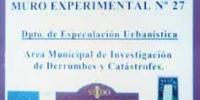
This action was suggested in the workshop assembly by a neighbor of Arrayán street itself. At the end of this street giving the market there was a wall in a state of collapse that
concerned the neighborhood. On several occasions, either neighbors or from the same Peña Bética in front of them, they had
given by the City Council, but without results. And every day having to go all the way through that gorge with two
The user muchachafanzine on instagram is an activist who writes a "decolonial native xicana feminist fanzine". They are an online activist and they spread their message through their page, the zine, and through merchandise. Daisy Salinas began Muchacha Fanzine as a feminist punk zine in 2011. Over the years, Muchacha has grown into a larger, submission-based compilation of work by marginalized voices from around the world.
Children in marginalized communities often lack access to healthy foods, especially fresh fruits and vegetables. Poor nutrition, in turn, has significant negative impacts on a child’s health and ability to focus in school. Learning and academic achievement often plummet.
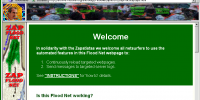
FloodNet was a conceptual artwork and a tool for online collective action.
Developed by the collective Electronic Disturbance Theater (EDT), it took the form of a Java applet that allowed users to send useless requests or personalized messages to a remote web server in a coordinated fashion, thereby slowing it down and filling its error logs with words of protest and gibberish—a kind of virtual sit-in.
The resistance to Trump’s ICE militia is strong and is documented in the online art exhibition, “ABOLISH ICE” https://sites.google.com/view/abolish-ice/home The participating artists-activists are from New York, Connecticut, Pennsylvania, New Jersey and California.
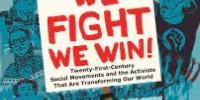
Greg Jobin-Leeds, a long-time social activist, collaborated with AgitArte, a collective of artists and organizers, to capture the stories of today’s social movements and the activists behind their success with the release of When We Fight, We Win: Twenty-First-Century Social Movements and the Activists That Are Transforming Our World.
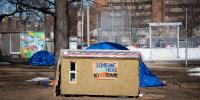
On his way to work on a construction site, Khaleel Seivwright surveyed the growing number of tents lining an intercity highway and in parks with increasing discomfort. How would these people survive Toronto’s damp, frigid winters, let alone the coronavirus, which had pushed so many out of overcrowded shelters?
He remembered the little shanty he had once built out of scrap wood while living on a commune in British Columbia.
In 2016 an eye-catching sparrow was spotted in Scotland. The bird had ingested feed pellets from a nearby salmon farm, turning its feathers pink. Cramped in underwater feedlots, farmed salmon have no access to the prey that colour their flesh in the wild. Instead, they are fed artificial colourants mixed with supplements, drugs, and hormones, causing them to relentlessly produce the additive-filled flesh that fills supermarket shelves.
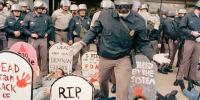
In 1987 with AIDS deaths in the thousands and government policy still criminally indifferent, activists formed ACT UP (AIDS Coalition to Unleash Power) with the purpose of turning grief and fear into rage and action.
In 2013, Ghana ThinkTank received a Creative Capital Award for Emerging Fields, enabling them to begin the multi-year ThinkTank at the Border project. In this project, they are collecting problems from civilian border patrols like the Minutemen, "Patriot" groups, and Nativist organizations, and bringing them to be solved by think tanks of undocumented workers in San Diego and recently deported immigrants in Tijuana.
Joseline de Lima was wandering the dusty alleys of her working-class neighborhood in the capital of Togo one day last year, when a disturbing thought crossed her mind: Who would take care of her two boys if her depression worsened and she were no longer around to look after them?
In September 1943, the Nazis prepared for the deportation of all Danish Jews to the concentration camps and death. But Georg Duckwitz, a German diplomat with a conscience, deliberately leaked the plans for the roundup, which was due to begin on Rosh Hashanah, the Jewish New Year. Armed with the information from Duckwitz, Danes swung into action.
“Everything is art. Everything is politics.” Globally renowned artist Ai Weiwei (Chinese, b. 1957) is celebrated as a disruptor of artistic canons and a champion of free expression. In his work—ranging across performance, photography, sculpture, video, and installation—he deploys humor and provocation, calling upon his viewers to examine history, society, and culture.
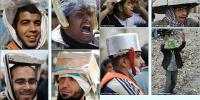
from "Laugh, O Revolution: Humor in the Egyptian Uprising" by Anna Louie Sussman, in 2011.
Revolutions can be messy. They can be tragic. As long as the Internet is working, they can be tweeted. And, as Egyptians demonstrated during their 18 days of protest, they can also be funny.
“Undanced Dances Through Prison Walls During a Pandemic” features six dances written inside a prison, a 35-minute dance film, and 11 artists (seven choreographic interpreters and four formerly incarcerated narrators) conversing on dancing in carceral spaces.
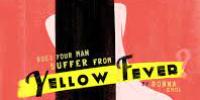
New York artist Donna Choi wanted to create a “weird, memorable way” to discuss fetishization of Asian women, so she put together a satirical series about how to diagnose Yellow Fever—the specific obsession many Western men have with Asian culture.
The over-the-top series is a discussion of race crafted for the attention span of the Internet.
I emailed with Choi about her thinking behind the Yellow Fever series.
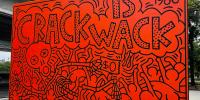
Without having been commissioned—or even given legal permission at all—Haring set out to create Crack Is Wack on the wall of an abandoned handball court in a park at 2nd Avenue and East 128th Street on June 27, 1986. Upon the completion of the mural, Haring was arrested by the New York City Police Department for vandalism of city property and faced potential jail time in addition to heavy fines.