change
region
medium
issue
Anton
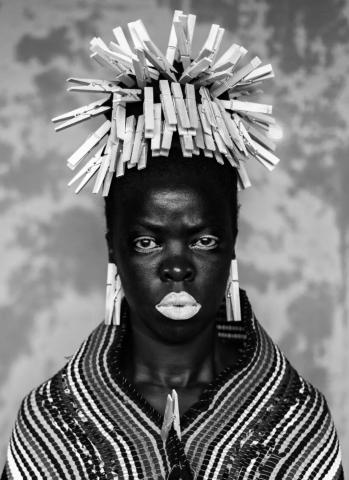
In the portrait Bester I, Mayotte, the sitter’s eyes stare directly at the camera, practically boring a hole in the lens. Their lips are painted white, their hair and ears adorned with clothespins. The self-portrait of Zanele Muholi is striking on its own, but it does not stand alone. It’s a continuation of the work they have been doing for close to two decades, documenting the lives of Black lesbian, gay, bisexual, transgender and intersex people in townships in South Africa.
Muholi’s visual projects are all rooted in their desire to create a Black queer and trans visual history of South Africa. They see their work as a form of resistance, showing lived experiences that have long been marginalized, and even erased. A major retrospective of that rich body of work is now on display at London’s Tate Modern, the largest such exhibition of Muholi’s work. Originally scheduled to open in April, and postponed twice due to the pandemic, the show will be on display until June 2021 with timed ticketing and social distancing measures in place, before touring across Europe at institutions in Paris, Berlin and Umeå in Sweden.
The mid-career retrospective arrives during a year of two major global events: the coronavirus pandemic and the resurgence of the Black Lives Matter movement. Muholi’s lifelong work has always been a celebration of Blackness and queerness, but they see the present as a time of great possibility. “It’s this togetherness, this unity and humanity that is attached to this exhibition that makes me happy,” they told TIME during a recent phone call. “These things mattered to me before we even spoke about it. But, at this particular period, we’re talking of radical change that is happening around the world, when people are talking about inclusion in all true senses.”
Muholi has always pushed for radical change within their work, using visual images to put forward a political agenda that insists that Black LGBTQIA+ South Africans are not only seen, but intentionally take up space in the world. Eschewing the categories of “artist” and “activist,” they refer to their role as a visual activist, seeing the two as inextricably linked. “In each and every thing we do, there is some element of activism,” says Muholi.
As the Black Lives Matter movement reignited the fight for racial justice both in the U.S. and globally earlier in the year, Muholi followed the events “with pain, to think of so many lives that have been claimed unnecessarily, and people are not being held accountable for it.” They also observed a rise—a continuation, really—in visual activism by everyday citizens. Around the world, people with smartphones digitally documented acts of racial injustice against Black people, uploading the evidence for all to see on social media. The video of the police killing of George Floyd in Minneapolis, the live stream of the Nigerian Army appearing to shoot at protesters in Lagos, the filming of a white woman in New York City’s Central Park threatening to call the police on an unarmed Black man all gained international attention—and spurred action—after being posted online. Muholi sees the umbrella of visual activism as large enough to cover both their own practice and instances like these. “When you ask me about visual activism—so you have your camera in your hands and then you see something happens. What do you do?” they ask, not just in answer to an interview question but as an entreaty to those who have never considered that they, too, might fulfill such a role. “You have a responsibility to document that crime scene and circulate it so that the world sees what is going on and takes action.”
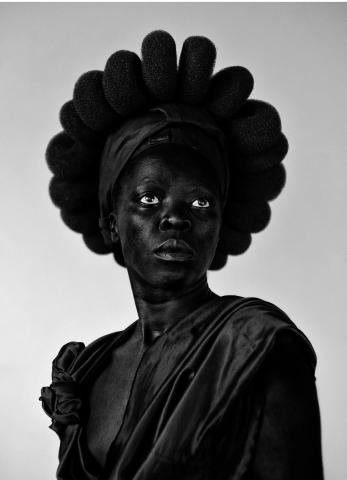
Muholi knows well what it means to both document and act. Their exhibition includes work spanning from 2003 to the present day, from the intimacy of the everyday life documented in the Only Half the Picture series (2003-2006), to the striking, assertive portraits of transgender women and beauty queens in Brave Beauties (2014-ongoing). Muholi, who studied documentary photography in the early 2000s, refers to the people they photograph as “participants” rather than “subjects.” They photograph people they are familiar with, people within their community, or friends of friends. The ongoing Faces and Phases project, which started in 2006, now numbers several hundred photographs creating a rich archive of Black lesbian, transgender and non-binary individuals.