change
region
medium
issue
pol
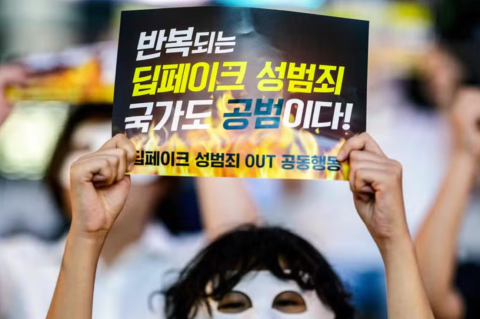
A few dozen women, wearing white masks, held up signs protesting against pornographic deepfakes. On the afternoon of Friday, August 30, several South Korean feminist collectives demonstrated in Seoul to fight these sex crimes that are flooding the country. While warnings against these hyper-edits, which superimpose faces on sexual content thanks to artificial intelligence (AI), have multiplied in recent months, concern turned into a tidal wave as summer draws to a close.
It is not easy to grow up as a young woman in South Korea. Despite efforts to shake off the country’s pervasive culture of sexism, technology seems to enable a new wave of misogynistic crimes every few years.
First there was the spy cam epidemic, in which thousands of women were secretly filmed using public toilets and changing rooms. The problem was so prevalent that I still check to see if there are any hidden cameras whenever I enter a public bathroom.
Now, artificial intelligence is fuelling a crisis in deepfakes. Altered images and videos, which often superimpose women’s faces on to explicit content without their consent, are easy to make and widely shared. Last year it emerged that a 40-year-old graduate of Seoul National University had targeted dozens of his fellow female students, making pornographic deepfakes from their online images and sharing them via Telegram.
The case sparked public outcry and has led to an increase in police investigations. In the first nine months of 2024, more than 800 deepfake sex crimes were investigated — compared with 156 for all of 2021. Still, the problem continues to grow.
Part of the problem is that making deepfakes is not difficult. Easy-to-use mobile apps like Face Swapper and Reface allow users to take a selfie or upload a picture and choose the image or video they want to swap faces with. Within seconds, they automatically reface and generate synthetic digital images and videos that look believable.
Lee Myung-hwa, director of the Aha Seoul Youth Culture Centre, which counsels young sex offenders, also points out that not all perpetrators understand how serious the crime is, or what impact they have.
“Teenagers, who are good at using digital tools, make deepfakes as a game or prank out of sexual curiosity,” she says. They do not always understand how serious the consequences are. “The victims can’t lead their daily lives, being afraid to go out and unable to trust their acquaintances.”
I am not an active user of social media. Still, the new digital menace has made me and other women I know feel anxious about the images of us that may exist online.
Although deepfake porn is a global problem, South Korea has been hit particularly hard. Many of the country’s best-known female singers and actors have been affected.
Experts say deepfakes are just the latest manifestation of the country’s deep-rooted misogyny. “Online gender-based violence is an increasing problem globally but is especially widespread in South Korea,” Heather Barr, an associate director at Human Rights Watch, said last year. “Women seeking police help are often dismissed, retraumatised and even ridiculed. There is very little sexuality education in South Korea’s schools to help young people understand how wrong this conduct is.”
Sera Cho, a 27-year-old school teacher in Seoul, experienced this first hand after a stranger took pictures of her legs when she was taking a stroll with her dog in her apartment complex. She immediately reported the case to police but was told there was no way to punish the perpetrator because she was not wearing leggings. “I felt like I would not be protected even if there were more serious crimes,” she says.
Faced with growing calls for stronger protection, South Korea has begun to criminalise the purchase, possession and viewing of sexually explicit deepfakes. It has also developed a digital tool that can automatically track, monitor and delete them.
Even so, authorities struggle to rein in the problem. Activists say the government should have acted earlier. The country has only just begun to crack down on the creation and sharing of sexually explicit deepfakes.
Lee says limiting access to technology is not enough. “The deeper problem is people’s lack of awareness on gender equality. Without a cultural shift, the problem will probably continue.”
Meanwhile, women like Cho are doing their best to protect themselves from digital manipulation by removing their pictures from social media and deactivating their accounts. I have done the same. As Cho puts it: “It is tiring and fearful.”