change
region
medium
issue
Anton
On the small island of Teshima in Japan’s Seto Inland Sea, Multibasket – No One Wins invites visitors to reconsider competition, collaboration, and the intersection of art and play.
Created by conceptual artists Jasmina Llobet & Luis Pons for the Setouchi Triennale art festival, this playful installation experiments with sculptural form while encouraging human interaction and creates a personal and memorable experience akin to an art playground. The lines blur between play and performance, competition and connection, making every visitor both participant and spectator.
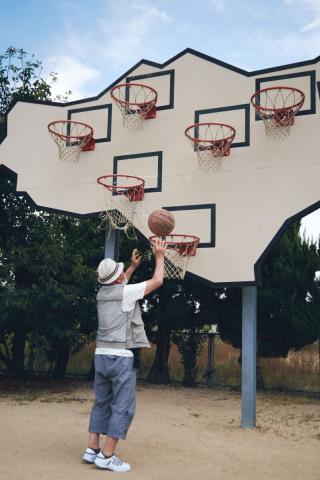
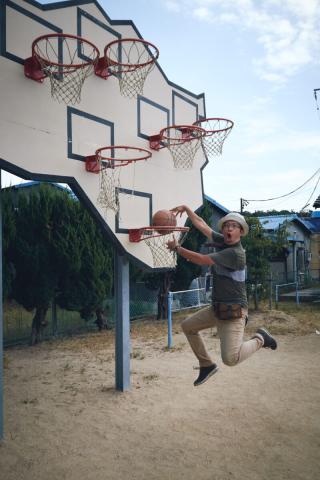
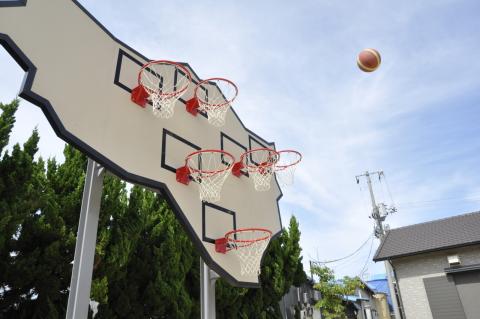
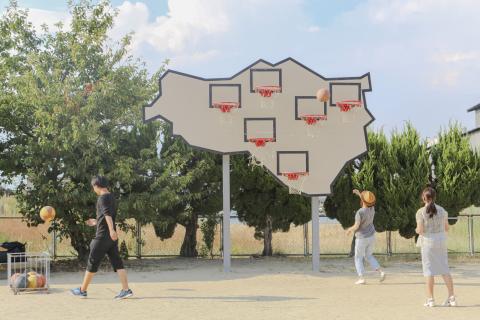
Approaching along a path leading from the rice fields, visitors encounter a full-sized basketball court sunk into the hillside, with vivid orange backboards and hoops at either end. The backboard, cut in the shape of Teshima, features six hoops that represent the island’s towns, and is therefore designed for simultaneous play by six people.
The court has no dividing lines, with both baskets intertwined at the center in a spiraling form reminiscent of a DNA double helix. The integrated steel sculpture, an artistic intervention in the landscape, seems to emerge directly from the land, drawing attention to the relationship between art and nature.
While the intertwined baskets prevent the space from being used for normal basketball games, people are encouraged to pick up one of the available balls from the dusty area and take shots together from either side. The setup invites collective play, with the focus shifted from competitive scoring towards a shared experience between players.
The work highlights ideas of communication and collaboration, as players must coordinate their actions so as not to interfere with shots being taken concurrently from the opposite end of the court. This design not only challenges the conventional structure of a basketball court but also symbolizes the interconnectedness of players and viewers.
Multibasket is a reflection of contemporary art’s shift towards interactive and public engagement. Set in Teshima, it resonates with the cultural ethos of community and collective experiences prevalent in Japanese society. This artwork, by inviting playful interaction in a non-competitive manner, aligns with the communal values and challenges the typically competitive nature of sports.
While deeply rooted in its local context, the artwork also holds global appeal through its universal themes of play, collaboration, and the merging of different artistic disciplines. It symbolizes a broader movement in the art world that values accessibility, community involvement, and the breaking down of traditional art boundaries, resonating with audiences beyond its immediate cultural setting.
"The idea of creating an artwork that people could use, without needing to ‘understand’ it, felt very connected to the Japanese appreciation for experience and play. We don’t like to create sculptures that become invisible. Public sculptures must mean something to the people who see them every day," said Llobert and Pons.
In a world reeling from the effects of the pandemic, interactive public spaces have gained new significance.
Llobet said, "After the pandemic, people need art more than ever. They need artworks that brings them together in new ways. Interactive public spaces have taken on new meaning. They’re vital for fostering connection.
In combining elements of land art, architecture, landscape design, and sporting facilities within one integrated structure, Llobet and Pons question traditional boundaries between artistic disciplines. The sculpture adapts features of a familiar sports arena to a new conceptual purpose, seamlessly blending into the existing coastal environment. This creative reinterpretation of basketball disrupts traditional team dynamics, fostering an environment where the usual competitive edge gives way to creativity and collaboration, where no one wins.
Like much of the artwork showcased at Setouchi Triennale, this permanent fixture encourages us to view public spaces and structures as fluid intersections of different fields that shape collective life.
Llobet said, "What I like about this artwork, is that it’s about playing more than seeing art. Of course, it’s an artwork, but the interesting part is that it can be just played without needing to understand it. It’s about creating an experience visitors will remember—maybe even for their whole lives."
Creating the sculpture wasn’t without its challenges. The artists faced both cultural and practical obstacles. When you put an object in a public space, it’s very fragile, they noted. There are storms, and people are playing very rough with the installation and hanging themselves from the hoops. And, of course, this gets very easily broken and deteriorated.
While the artwork’s conceptual and artistic dimensions are compelling, its practical accessibility and inclusivity add another layer of significance. This site-specific installation exemplifies accessibility in art through its public, open-air location and interactive design. It invites participation from a broad audience, regardless of their art expertise or basketball skills, fostering an inclusive environment.
Another visitor was intrigued by the six goals and pondered the ‘right’ way to engage with the installation. They mentioned the condition of the available basketballs, which were old and deflated, raising the question of whether visitors should bring their own.
The lack of competitive structure in the game played here subtly addresses inclusivity, as it reduces barriers created by skill level or physical ability, promoting a more inclusive form of engagement.
"This artwork challenges the hierarchies of sport—the taller or fitter doesn’t always win. Instead, we wanted something that levels the playing field and allows anyone to succeed," said Llobert and Pons.
The economic foundation of Teshima primarily revolves around agriculture. The island is facing a demographic challenge, with a declining and aging population due to the movement of residents to larger urban areas. This migration trend is leading to a gradual depopulation of the island, and as a result, its infrastructure is aging and becoming less utilized. There is a noticeable absence of facilities for recreation and sports on the island.
Llobet and Pons said, "Our motivation was to do something for this community, which is in a very strong process of depopulation. People are fleeing, and our goal was to create a symbol that the community could accept as their own object—a shared experience that encourages identification.
Multibasket reflects the Setouchi Triennale’s vision of revitalizing forgotten rural areas in the Seto Inland Sea through ambitious, site-specific artwork since 2010. The isolated yet peaceful spot selected for this installation allows visitors to contemplate how public artworks can enhance their appreciation of a particular place.
With its exterior basketball court doubling as an informal viewing platform to take in the panoramic views, Multibasket seems to celebrate the rich cultural landscape it has emerged and reconnects people with regional cultures, highlighting a blend of contemporary art with traditional community values.