change
region
medium
issue
Anton
The “Occupy Men’s Toilets” movement, initiated by Chinese feminist activists including Li Tingting (Li Maizi) and Wu Rongrong, emerged in 2012 as a creative, non-violent protest against gender inequality in access to public facilities. Inspired partly by global “Occupy” movements and grounded in the lived experience of Chinese women, this campaign targeted the structural disparities in toilet design and urban planning, which disproportionately impacted women in public spaces.
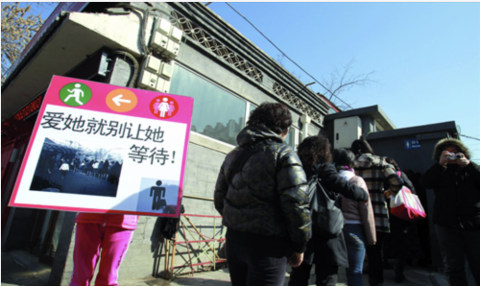
In cities like Guangzhou and Beijing, female activists entered men’s restrooms—usually with signs like “Don’t let her wait if you love her”—and politely asked male users to yield space to waiting women. Rather than attempting to permanently take over the facilities, activists timed their actions, occupying men’s restrooms for three out of every ten minutes. Their goal was not to “invade” but to highlight the invisible gendered labor of waiting and to propose a more equitable distribution of restroom resources.
The protest sparked significant public discussion and even policy response. In Guangzhou, local authorities adjusted toilet construction ratios to 1.5:1 in favor of women—an institutional acknowledgment of the problem. The movement garnered wide public support, media coverage (including from state-run outlets like China Daily), and endorsements from feminist scholars and public health advocates, who pointed out the physical and psychological toll of long wait times on women.
What made the campaign particularly resonant was its strategic simplicity and symbolic clarity: everyday acts like using the restroom became sites of feminist resistance, calling attention to the material inequalities inscribed in public infrastructure. It also marked a critical moment in the rise of contemporary Chinese feminist activism, prefiguring the more politically repressed actions of the Feminist Five three years later.
In hindsight, “Occupy Men’s Toilets” stands as a rare example of grassroots feminist direct action in China that yielded tangible, short-term policy changes, while also exposing deeper structural and cultural biases about gender, space, and bodily autonomy.