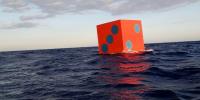
"Featuring giant ocean dice that originally appeared in the booklet "drift" by Max Mulhern, these dice were launched in international waters to create a visually stunning ode to chance and luck. This project can also be found under the title: "the greatest floating craps game on earth"." --AquaDice website
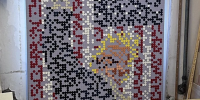
A blind artist has unveiled an image of Donald Trump in Braille dots, which spell out his conversation with Secret Service agents following the assassination attempt in July 2024.
Seconds after the shooting in Butler, Pennsylvania, agents tried to move Trump to safety, but he demanded to retrieve his shoes and then paused to make a fist pump gesture.
The money was supposed to be used to create modern art. And it was — but not in the way a Danish museum expected when it gave an artist the equivalent of $84,000. In return, it received two empty canvases.
The artist, Jens Haaning, says the blank canvases make up a new work of art — titled "Take the Money and Run" — that he calls a commentary on poor wages. One thing it's not, he says, is a theft.
"Under the Same Sky" bearing the name and the first part of my project completed. I collected the letters written to 40 Armenian young people from 40 random Turkish young people. The mutual translations of all letters and video subtitles were made. Letters and photographs are handed out to young people, friendships are being established.
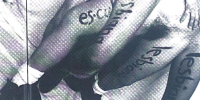
As a result of the social stigma of homosexuality, lesbian feminists were rejected and silenced as a radical minority within the mainstream Movimiento Feminista (MF). Lesbianas Sin Duda (LSD) is a queer activist group based in Madrid that arose in the early 1990s as a response to this erasure.
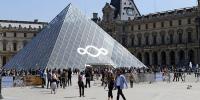
For the first time since its controversial installation in 1989, the I.M. Pei-designed Louvre Pyramid has been decorated in a museum-sanctioned act of anti-capitalist activism.
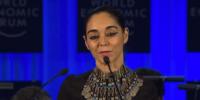
Shirin Neshat is an Iranian visual artist who works and resides in New York City. Her work refers to the social, political and religious codes of Muslim societies. She particularly addresses the psychological dimensions of women's experience in contemporary islamic societies. Using Persian poetry and calligraphy she has examined concepts such as martyrdom, space of exile, and the issues of identity and femininity.
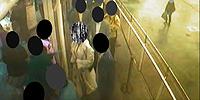
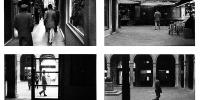
FACELESS was produced under the rules of the 'Manifesto for CCTV Filmmakers'. The manifesto states, amongst other things, that additional cameras are not permitted at filming locations, as the omnipresent existing video surveillance (CCTV) is already in operation.
In 2012, VOW Media worked with young girls - who have been victimized by, or are at the risk of falling victim to “loverboys”, as well as girls who have gone through severe traumatic experiences, such as repeated emotional, physical and/or sexual abuse – in a series of workshops where they learned how to utilize different forms of media to create their very own self-portrait with photography, radio, and video.
After artists learned that London's Design Museum was connected to Leonardo, a large arms dealing company, and hosted an event for them, many of the artists featured in their Hope to Nope: Graphics and Politics 2008-2018 asked the museum for their work to be removed. After receiving no response, one third of the show's artists removed their work from the show.
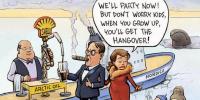
In 2013, Shell sent out press releases about their upcoming event, the Science Slam, which would aim to “celebrate the company’s responsible oil production” and “showcase ideas for renewable energy by scientists and students.” Essentially, Shell organized this event in the hopes that it would allow the multinational oil company to appear as if it is actually concerned about the environment and finding alternatives to oil.
Seattle Times:
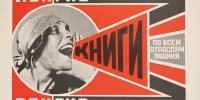
In 1921, just four years after the Bolshevik Revolution, American journalist Albert Rhys Williams wrote: “The visitor to Russia is struck by the multitude of posters — in factories and barracks, on walls and railway-cars, on telegraph poles — everywhere.”
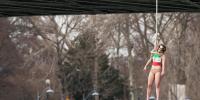
A Femen activist, Sarah Constantin, is hanged from a noose-like rope from a Paris bridge to call attention to the large number of executions in Iran as she stages a protest against visiting Iranian President Hassan Rouhani in Paris, Thursday, Jan. 28, 2016. A near-naked woman hanging from a noose-like rope from a Paris bridge has sent a message to visiting Iranian President Hassan Rouhani.
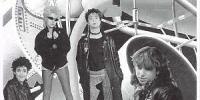
Las Vulpes was the first spanish punk rock band formed only by women. It was founded in Baracaldo (Vizcaya, Basque Country) in the summer of 1982, as a result of the guitarist´s desire on creating an all women punk band. After a few changes, the final formation consisted on: Loles Vázquez (guitar), Mamen Rodrigo (voice), Begoña Astigarraga (bass) and Lupe Vázquez (drums), all between 17 and 22 years of age.
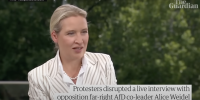
"A live interview with the leader of the far-right Alternative für Deutschland was interrupted by protesters. During the live television interview with ARD, Alice Weidel, co-leader of AfD, appeared at times to struggle to hear the questions being asked of her as protesters gathered below the provisional stage for the interview in Berlin.
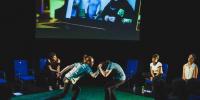
Breach Theatre’s multimedia play The Beanfield joins a growing trend of artists using documentary inquiry to hold violent and corrupt institutions to account.
Sophie Calle's works discuss the issue of "privacy", the composition of an individual's identity at the social level, and the relationship between "private" and "public/group/society", including personal information, personal records, public surveillance, and other topics. An obvious feature of her works is the unique and extremely subjective criteria of judgment and reference for measurement.
Máximas de Seguridad, a survival manual written and illustrated by Jhafis Quintero creates a new voice for the voiceless, vulnerable and underprivileged groups in prisons and creates empathy for those that are labeled as dangerous by society. The manual aims to provide empathy and humanity in light of the public scrutiny that ex-prisoners endure in the transition to social reintegration.
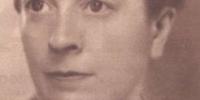
Encarnación Aragoneses Urquijo (886-1952), commonly known by her literary pseudonym Elena Fortún, was a Spanish writer who focused in children and teenagers literature.
She was born in Madrid, where she studied Philosophy and Humanities. In 1908 she married Eusebio de Gorbea y Lemmi, a member of the republican army. They left the country after the Civil War to live frist in France and then in Argentina.
This piece is fascinating because of its use of just a few words and country names, muted colors, and the recreation of famous art. The artist used this canvas to depict a concern about events happening in the Gaza strip.
The performance, “Lambrakis LivZ”, concerns the re-enactment of the political speech of Grigoris Lambrakis given in Athens in 1962. Grigoris Lambrakis was a peace-activist, assassinated by a paramilitary plot on June 1963 at Thessaloniki, Greece.
In 2003 Amsterdam police headquarters decided their security cameras needed a little bling after Jill Magid approached them through her company System Azure Security Ornamentation. Originally turned down as an artist proposal, Magid founded her company as a possible means of executing her project. It worked. Not only did she receive the proper permits to beautify police security cameras, but the city paid her to do it.
This project was made by the foundation Obra Social la Caixa with the intention to change the conversation and strategies while working with youngsters. Before this initiative, say the Director Claudio Zulian, the foundation would speak only about the lives of these girls and boys. However, they decided to involve them inside other stories as actors of a film project.
Eva Koťátková is one of the most outstanding contemporary artists of the Czech Republic, working in the interdisciplinary art genre, emphasizing themes of the human body, society, and psychology. Her art often occupied the space of the thorny, tangled, and complicated human environment and did not remain indifferent.