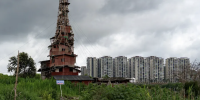
The structure teeters over fields of knee-high grass, looking like a cross between a camping tent and a giant wedding cake. Eleven stories of dark red wooden rooms, diminishing in size as they ascend, balance atop one another, seemingly held together by only the thicket of cords that stretches from the peak to the ground.
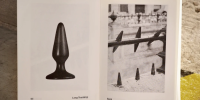
Hostile architecture—urban design features like ground spikes that deter the homeless from lying down or slanted benches that prevent lingering—inscribes exclusion into our streets. In response, a Chinese artist will launch the Free Butt Plug Catalogue, an art-activism project that documents fifteen such spikes and anti–loitering benches across London and pairs each with a commercially available butt plug of the same shape.
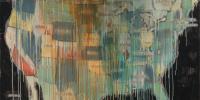
"State Names" is a painting by Jaune Quick-To-See Smith. You immediately recognize the outline of the United States, but at the same time, that map is obscured and made difficult to read. It’s at once recognizable and not recognizable. She describes her use of icons as a ploy, as something that brings the viewer closer, and they think they know what they’re going to see.
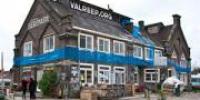
In the summer of 2011, squatters take over an unused building, once an animal shelter, and begin renovating it into a social and cultural center for a neighborhood on the outskirts of Amsterdam. They call it Op de Valreep ("in the nick of time").
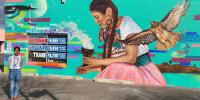
In a collaboration with fellow artist @vyalone on Instagram, Lucinda Hinojos or La Morena as the artist is known recently completed this mural in Phoenix which showcases the Native American culture of the people indigenous to the area. La Morena said in a post about the project on Facebook, "This mural is about reclaiming space, reclaiming our roots, our identity and finding our truth.
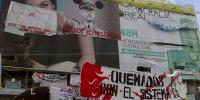
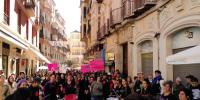
Just over a decade ago on May 15, 2011, a wave of social outrage began as the Spanish people collectively decided that they had had enough of the corruption, cuts, and inequalities affecting their country.
Brian Larney is an AI.tivist or American Indian artist. He is also an Artivist where he performs Artivism, a concept that includes art as a form of activism.
La Casa Invisible project was started in 2007 in Malaga, Spain, when a group of socially involved participants squatted in a run-down building, aiming to eventually claim the legal rights to the property (Moor & Smart, 2016). The space was opened to local artists and creators, quickly becoming a hub for free local music, performances, and seminars as well as creating an important meeting space for social groups (Moor & Smart, 2016).
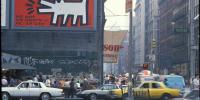
It’s the radiant baby, the barking dog and the dancing man; the badges and the t-shirts; the unmissable mural spelling out CRACK IS WACK. Keith Haring’s career was short but spectacular, and he leaves behind a lasting legacy. From his chalk drawings in city-wide subway stations, to his collaborations with the superstars of his day, Haring’s life was founded on a belief in the power of people to change the world.
It was October 31st, 2012, when a new artist appeared on social media. In a series of video clips, she proposed with a soft and slow speech that Peru hide its poverty. Her project consisted of installing vinyl pieces to avoid what she called "the visual pollution." She titled the project Don't be poor, be fashion(able).
The Ogden Ar(t)chives Mailbox is a community project that was initiated by Ogden poet, Angelika Brewer. The project involves a metal sculpture of a mailbox, which has various decorative elements such as a typewriter, a birdcage, and a heart. The mailbox serves as a platform for the public to submit their creative works such as poems, drawings, letters, or anything that can fit in an envelope.
Bogus building inspection notices with the forged signature of city Building Inspection Director Frank Chiu appeared on buildings in San Francisco's South of Market area, prompting an investigation by exasperated city officials.
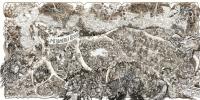
The Beehive Design Collective is a wildly motivated, all-volunteer, activist arts collective dedicated to “cross-pollinating the grassroots” by creating collaborative, anti-copyright images for use as educational and organizing tools. We work as word-to-image translators of complex global stories, shared with us through conversations with affected communities.
“My intention was not to disappear in the environment but instead to let the environment take possession of me” Said Liu Bolin. With his strong photography, Bolin vanishes into the city, creating a powerful statement about our relationship, as humans, to our surroundings.
Covenant House has started a ‘Sleep Out’ movement that shines light on the youth homelessness crisis and raises funds for young people who seek shelter. "Covenant House empowers young people to overcome homelessness and trafficking by providing them with safe housing, food and clothing, and relentless support. Sleep Out events are held for people who want to join the movement as they give up their bed for one night in NYC.
It's an evocative image — and it was intended to be: Diana, Princess of Wales, wearing a protective visor and flak jacket, walking through a live minefield in Huambo, Angola. The image of the princess, at the time one of most famous women in the world, surrounded by danger, made headlines across the world.
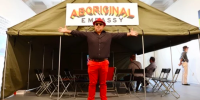
Richard Bell has often called himself ‘an activist masquerading as an artist’. Aboriginal journalist and radio broadcaster Daniel Browning has suggested that Bell is also ‘a megaphone.
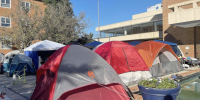
Dozens of Howard University students are sleeping outdoors in a tent encampment on campus grounds to protest what they describe as "poor" and "unlivable" conditions in the college dormitories.
Students told ABC News that portions of the university living quarters have mold and insect and rodent infestations, as well as leaky ceilings and flooding -- all of which they say put their health at risk.
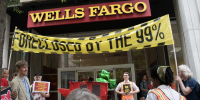
On the eve of Wells Fargo’s annual shareholders meeting in San Antonio, TX on Tuesday, home defenders, students, community groups, and activists in ten cities took peaceful action against the bank. Petitions signed by thousands of people were delivered to Wells Fargo branches and offices across the country calling on CEO John Stumpf to change the bank’s predatory practices.
In response to white gentrifiers trying to silence go-go music on the corners of Florida Avenue and 7th Avenue, activists and D.C. residents poured into the streets by blasting go-go music and celebrating its rich history within the city. For those unfamiliar, go-go music is at the heart of D.C. culture and features live bands playing covers of, and sometimes original, music with all different types of drums and other percussion instruments.
Benito Antonio Martínez Ocasio, better known to the world as Bad Bunny, has once again proven that his artistry goes far beyond reggaeton and trap. On January 5, 2025 — the eve of Puerto Rico’s cherished Three Kings Day — the Puerto Rican superstar released DeBÍ TiRAR MáS FOToS, an album that both celebrates his homeland and delivers a sobering message about its uncertain future.
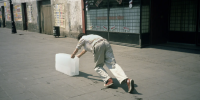
What is Francis Alÿs known for?
Francis Alÿs is known for using poetic and metaphorical techniques to highlight the political and social realities of his city. Often, the issues he addresses range from national border politics to globalism and areas of conflict in his community and the effects of modernism.
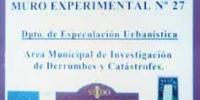
This action was suggested in the workshop assembly by a neighbor of Arrayán street itself. At the end of this street giving the market there was a wall in a state of collapse that
concerned the neighborhood. On several occasions, either neighbors or from the same Peña Bética in front of them, they had
given by the City Council, but without results. And every day having to go all the way through that gorge with two
In May of 2011, tens of thousands of people crowded Puerta del Sol in the center of Madrid in the most visible manifestation of sit-in protests against austerity and corruption. 15-M was an expression of the devastating effects of the 2008 recession, which harshly affected the middle class and condemned millions of people to poverty because of the crash of the housing bubble (Altares, 2021).