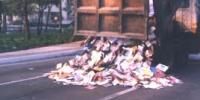
Aníbal López, also known by his government identification number A-153167, is a pioneer of performance art in Central America. ArtBus describes his work as, "Generally aimed at immersing viewers into the region’s social and political tensions, his works combine the dry language of 1960/1970s conceptual art with the revolutionary ethos of a Latin American guerrillero.
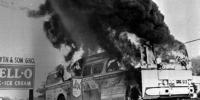
The first legislative victory of the Civil Rights era was obtained by hundreds of people going where they weren't invited. In 1961, Black and white Freedom Riders, well trained by SNCC in nonviolent action, rode Greyhound buses from Washington DC southwards primarily in order to wait, together, in waiting rooms that were still unconstitutionally segregated.
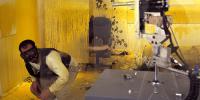
Wafaa Bilal's childhood in Iraq was defined by the horrific rule of Saddam Hussein, two wars, a bloody uprising, and time spent interned in chaotic refugee camps in Kuwait and Saudi Arabia. Bilal eventually made it to the U.S. to become a professor and a successful artist, but when his brother was killed at a U.S. checkpoint in 2005, he decided to use his art to confront those in the comfort zone with the realities of life in a conflict zone.
Art of the Umbrella movement refers to artistic works created as part of the Umbrella Movement in Hong Kong which demanded democracy in the election of the territory's top leader. Most of the physical works of art are located within the three main protest sites of Admiralty, Causeway Bay and Mong Kok.
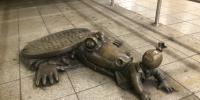
At the Eighth Avenue subway station, sewer alligators are not an urban legend.
Anyone who’s been through the 14th St./Eighth Ave. station has probably seen the bronze gator sculpture — and probably wondered what it means and why it’s there.
The underground gators — along with dozens of other whimsical creatures — are part of the permanent art installation housed at the intersection of the A,C,E, and L lines.
A video collaboration betweenHayley Silverman and Emily Shinada. Using clips from a Japanese pornography film, the video highlights fears of interpersonal connection and explores the objectification of women. It was on view at Alogon Gallery for theWomen Get Fucked exhibition.
Haiti is a conservative society where Roman Catholicism shapes many of its social norms. Patriarchal norms, says Haitian feminist Pascale Solages, co-founder and general coordinator of feminist organization Nègès Mawon, have informed its strict views on abortion. In Haiti, women can’t legally access voluntary abortions. Doctors can’t perform them unless the woman’s life is in danger.
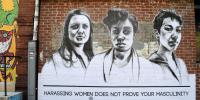
publicly displayed posters feature the portraits of women, along with a quote relaying their experiences with street harassment. Fazlalizadeh hopes the captions speak directly to offenders by placing the posters outside in public spaces where harassment happens.
About us
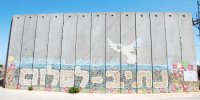
"Path to Peace" - is a joint mosaic creation, by thousands of people, towards hope, love, and happiness among all people. The creation is placed upon the border wall that divides the Gaza Strip and Israel, adjacent to the homes of Moshav Netiv HaAsara.
The creation is seen from both sides of the wall, spreads on the gray security wall and completely changes the place's atmosphere.
Face Your World was set up as a tailor-made educational program for the youngster to explore and participate in the process of city renewal. The project used Interactor software, an interactive tool to enable users to rebuild their neighborhood. The software creates a virtual environment which represents the neighborhood and enables users to see the result of its modification while it has been used.
In a conceptually odd but undeniably memorable PSA campaign, the Mexico City Metro has installed a “penis seat” in one of its subway cars, featuring a molded likeness of a man’s torso and penis, to get male riders thinking about the sexual harassment that women endure every day.
The seat is labeled “For men only.”
An artist who sparked significant awareness regarding the issues of climate change was Olafur Eliasson. Eliasson’s main objective has been to catch people’s attention and make them feel emotions and care about climate change because many people do not connect to the effects of climate issues as they do with other controversial impacts solely because the effects are not played out directly in front of them.
“There are many problems in rural areas. For example, agriculture is declining, no one is farming, traditional things are falling apart, farmers are brainwashed by the idea of urbanization, and they don’t like their hometown. They all want to move to the city.”Activist Ou Ning said. Rural construction is an important issue. As an activist, he chose Bishan village in Anhui, China as the field to start his experiment, which is “Bishan Project”.
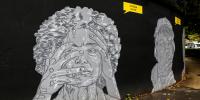
Paris inaugurates its first fresco, on the Human Rights Wall, in tribute to six contemporary activists. To be discovered in the capital's 12th arrondissement, this XXL work of committed street art is by Mahn Kloix.
The Breath of China is a thematic photo exhibition of thousands of air-quality images taken by 44 photographers in 34 Chinese capital cities. The exhibition was displayed on the 14th Pingyao International Photography Festival (PIPF) in Shanxi Province, from September 19th to 27th, 2014.
Harry Belafonte, the singer, actor and activist whose wide-ranging success blazed a trail for other Black artists in the 1950s, died on Tuesday at age 96.
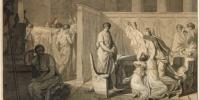
Jacques-Louis David was an active member of the French Revolution, and his works often depicted his political affiliations. David’s painting The Lictors Bring to Brutus the Bodies of His Sons portrays the scene of Brutus, an important figure of the Roman Republic, reacting to the death of his sons. Since they wanted to overthrow the government and restore the monarchy, Brutus ordered their death.
In 1972, something unheard of happened on national television. An Asian American singer-songwriter duo was invited to perform on the widely-watched The Mike Douglas Show by guest hosts John Lennon and Yoko Ono. “They’re beautiful singers,” Lennon said in his introduction. “And they have a story to tell.”
Brief History is part of a series produced by Carlos Motta between 2005 and 2009 that presents two chronologies of events in Latin America: one of U.S. interventions in the region since 1946, and one of the area’s leftist guerrilla movements. One side of the print outlines the interventions’ interconnected narratives in text; the other depicts two bloody handprints and the symbol of the Mano Blanco death squads from 1980s El Salvador.