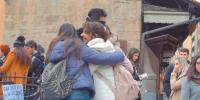
Massimiliano Martigli Jiang was born in Wenzhou, China but moved with his parents to Italy when he was still a child. The 29 year-old grew up in Italy and considers himself as much Italian as Chinese.
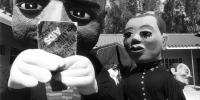
"Puppets Against Aids was launched by Gary Friedman on 1st December 1988 in time for 'World Aids Day' in Johannesburg, South Africa. During 1987, Friedman had been studying with Muppet master, Jim Henson, in Charleville-Mézières, France. Henson provided the initial financial contribution to launch the African Research and Educational Puppetry Programme 'Puppets Against Aids'.
To protest unethical labor practices in Bangladesh, specifically unsafe working conditions, 99 Pickets, The Illuminator, and Ismail Ferdous took action during New York Fashion Week.
For more than 20 years, Metronome, which includes a 62-foot-wide 15-digit electronic clock that faces Union Square in Manhattan, has been one of the city’s most prominent and baffling public art projects.
SACRAMENTO, Calif. (AP) — In director Adam McKay’s “Don’t Look Up,” a 2021 satire about two scientists who try in vain to warn the world about a planet-destroying comet, the scientists’ desperate plea for action ultimately doesn’t work.
But don’t take that as McKay’s view on the power of activism to change the course of the climate crisis, the existential threat his movie was really about.
Originally written for the Onion, “Amèrikan Takes Over the Fashion New World,” is an article that speaks of a fictitious company that has broken through the clothing market. This company was created as a way to inform the consumer of the appropriation different companies often get away with due to their consumers lack of knowledge.
The project was based on the creation of a restaurant in the neighborhood of El Lewa, Cairo – one of the many neighborhoods built illegally, known as Ashguahiyats, a term meaning 'leaving things to chance'.
Directed by Fernando Sariñana, Todo el poder centers around the politics and corruption that shroud the Mexican police system. Featuring Demián Bichir as Gabriel, a filmmaker whose career has left him assaulted and robbed in broad daylight more times than he cares to remember, the film itself was inspired by Sariñana's personal experience with urban crime oftentimes perpetrated by the police themselves. ~ Tracie Cooper, Rovi
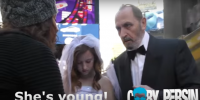
The statistics in regards to older men marrying young girls is mind boggling and disgusting. Every day 33,000 girls are married to older men, denied their rights to education and opportunity and robbed of their childhood.
Many countries around the world find this practice normal, thankfully we do not find it normal here in the United States. More than 91 countries allow girls as young as six-years-old to be married. This is a problem.
On March 24, 1992, a fake inter-office memorandum from the then Mayor of the City of New York, David Dinkins, was leaked to the press. A handwritten Post-it note was attached which read "Thought you might be interested in seeing what the Mayor's up to! 'Mayor to Sell the Brooklyn Bridge!' Think this will fly?? I love New York!!!"
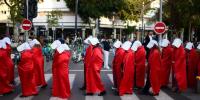
Hundreds of women clad in red, their heads bowed and topped with white wimples, moving slowing in formation with clasped hands is the most unforgettable image from the weeks of recent protests throughout Israel against the judicial reforms proposed by the extreme right-wing government.
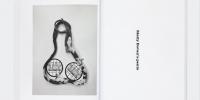
You might think that pictures of dicks (usually unsolicited) aren’t particularly hard to come by on the internet. And most of those dick pics aren’t particularly expertly composed. But that’s not the case for Penile Papers, a new collection of phallic art curated by London-based artist Dominic Myatt.
Loophole for All is a service to democratize offshore business for people who don't want to pay for their riches. It empowers everyone to evade taxes, hide money and debt, and get away with anything by stealing the identities of real offshore companies.
Loophole for All exploits tax and legal accountability loopholes available by registering a company in countries considered
offshore centers.
Before Chance the Rapper performed at sold-out concert venues, he practiced his rhymes in front of an intimate crowd of roughly a dozen people at Harold Washington Library. Now the rapper is trying to return the favor, one open mic at a time.
On Sunday December 18th from 6-8pm, the night before the Electoral College meets to vote, join me in lighting a candle for humanity.
The lit candles will be a peaceful
protest against Donald Trump being selected the 45th President of the United States of America.
More importantly,
we will send a message to any Elector who would like to vote faithless that we support them.
From the screaming queens of the Stonewall Riots to the contemporary Human Rights Campaign corporate gays, the politics and methods of queer activism have clearly fluxuated. By the late 1970s, the radicalism of stonewall was replaced with a more formal Gay Liberation movement that focused on civil rights.
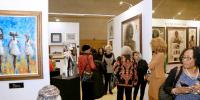
The International Harlem Fine Arts Show (HFAS) is the largest traveling African Diasporic art show in the United States. Inspired by the Harlem Renaissance, HFAS provides a platform for African Diasporic visionaries and American visual artists to exhibit and sell their artwork. The show also aims to create economic empowerment, educational opportunities and professional recognition within the multicultural community.
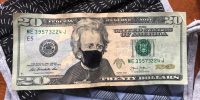
#thisisnotamask
Covid-19 Pandemic Rubber Stamp Currency Intervention
Website: https://thisisnotamask.tumblr.com/
For more information:
Joseph DeLappe artist/activist – j.delappe@abertay.ac.uk
Brent Richardson media artist – brent@BrentRich.com
Let’s mask the presidents!