Yu Hong’s Female Writer, a painted and photographic portrait of the writer Zhao Bo 趙波 (b. 1971), recalls courtly images of idealized beauties. Yu, however, deliberately complicates the perspective in her composition: she asked the sitters for her She series to select photographs of themselves that could be paired with her paintings, meaning that the images together convey dual female perspectives, both the artist’s and the subject’s.
Uncle Sam's Cultural Dissonance looks at the issues facing The United States, including Canada and Mexico. In countries like the United States, where some states are dotted with countless lakes and many people live within easy reach of an ocean, it may be easy to assume that drinking and recreational waters are limitless. This is absurd. This series focuses in on excessive overuse in by agricultural, residential, and industrial sectors.
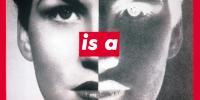
A woman’s head is bisected by a line that splits her face into positive and negative halves. Over the image, a commanding text, stated in the second person, reads: “Your body is a battleground.”
Students at art colleges across China are taking a strong stance in the midst of the largest wave of protests to have gripped the country since 1989. As demonstrations against the government’s strict Covid-19 policies erupted across the country over the weekend, students rallied on campuses to create protest art and graffiti.
In this space, Teaching Artist contributors from around the U.S. and the world bring you stories of their work at the crossroads of art and learning. The stories that our bloggers bring to ALT/space are born inside the practice of teaching and art making in all artistic and expressive mediums: visual arts, dance, traditional arts, outsider art, music, theater, storytelling, writing and…?
“My intention was not to disappear in the environment but instead to let the environment take possession of me” Said Liu Bolin. With his strong photography, Bolin vanishes into the city, creating a powerful statement about our relationship, as humans, to our surroundings.
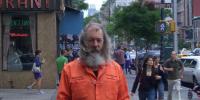
In July 1976, prankster and satirist Joey Skaggs, calling himself Giuseppe Scaggoli, appeared before a rabid crowd, dressed in sharp-lapeled finery. He had some unfortunate news: that day’s planned auction of rock star sperm was cancelled due to a mysterious theft. All he could offer in the way of comfort were his assurances that more donations were to be sought as soon as possible.
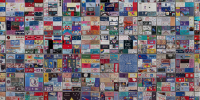
The Quilt was conceived in November of 1985 by long-time human rights activist, author and lecturer Cleve Jones. Since the 1978 assassinations of gay San Francisco Supervisor Harvey Milk and Mayor George Moscone, Jones had helped organize the annual candlelight march honoring these men. While planning the 1985 march, he learned that over 1,000 San Franciscans had been lost to AIDS.
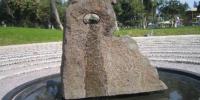
The Eye that Cries (El Ojo que Llora, in Spanish) is a memorial that was born as a private initiative designed to honor the thousands of victims as a result of terrorism in Peru, to strengthen the collective memory of all Peruvians and to promote peace and reconciliation in the country.
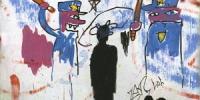
Jean-Michel Basquiat was an American artist who rose to fame in the 1980s. He is known for his graffiti-inspired paintings that often engage with issues surrounding racism and inequality. Basquiat's work challenged the status quo and incited a powerful social commentary on the struggles of marginalised social groups.
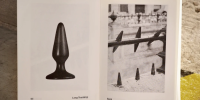
Hostile architecture—urban design features like ground spikes that deter the homeless from lying down or slanted benches that prevent lingering—inscribes exclusion into our streets. In response, a Chinese artist will launch the Free Butt Plug Catalogue, an art-activism project that documents fifteen such spikes and anti–loitering benches across London and pairs each with a commercially available butt plug of the same shape.
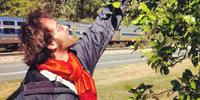
The Falling Fruit project was born from a passion for food and the environment. It is organised in an open-source database that brings together the entirety of maps made by foragers from the Internet. The database also includes edible species found in municipal tree inventories: databases of street (and sometimes private) trees used by many cities, universities, and other institutions to manage the urban forest.
In the context of the PhD research “Consciousness-raising: Activism in Digital Art” (by Ana Barata, Faculdade de Ciências Sociais e Humanas da UNL, Lisbon, Portugal) Carlos Latuff was interviewed concerning his political graphical work that focuses on present conflicts and issues.
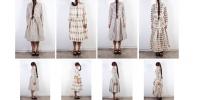
Fashion designer and social scientist, Lucia Cuba, has taken up the task of using fashion as a vehicle to bring attention and awareness around Articulo 6, an article in the Peruvian constitution that declared a law of forced sterilization of women in the country. Cuba has taken the testimonies of the victims of this article and integrated them into the very fabric of her designs.
On November twelfth, 2008, over 80,000 copies of a replica of the New York Times were distributed in several cities around the United States. The paper included 14 pages of “best case scenario” news set nine months in the future.
See the The New York Times Special Edition website.
This shop is more interested in people than it is in profits. If you've got some mad dance skills, or even just some mediocre ones, you can purchase a variety of goods at The Merit Shop in San Francisco.
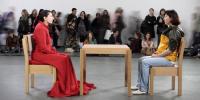
From March 14, 2010 to May 31, 2010, in the Museum of Modern Art, Marina Abramović held an activist art called The Artist Is Present. In the exhibition, there were simply a pair of chairs and a desk. Abramović sat on one chair, and the participators could sit on another chair voluntarily. Without a word, Abramović and the participators just looked at each other’s eyes.
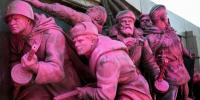
Since the beginning of Bulgaria's transition to democracy, the monument’s meaning and future has been the subject of heated debates. Opponents to the monument aren’t happy about the presence of such a dominating foreign army monument in the country that is situated higher and more central than national symbols. In recent years, the monument has turned into a canvas for anonymous political statements on multiple occasions.
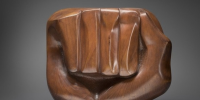
Sculptor and printmaker Elizabeth Catlett (1915-2012) used her art to advocate for social change in both the U.S. and her adopted country of Mexico. Much of her work focuses on the experience of African American life and political struggle during the middle of the 20th century. Her posters of well-known activists, including Angela Davis and Malcolm X, were widely circulated at the time.