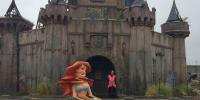
In August 2015, Weston-Super-Mare - a sleepy seaside town in Somerset, England - suddenly became the top destination for the metropolitan elite, welcoming celebrity guests like Brad Pitt, Jack Black and Mark Ronson. Overnight this quaint town, just 18 miles from Bristol, was transformed by anonymous street artist Banksy when he opened his very own dystopian Disneyland style theme park called ‘Dismaland’.
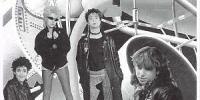
Las Vulpes was the first spanish punk rock band formed only by women. It was founded in Baracaldo (Vizcaya, Basque Country) in the summer of 1982, as a result of the guitarist´s desire on creating an all women punk band. After a few changes, the final formation consisted on: Loles Vázquez (guitar), Mamen Rodrigo (voice), Begoña Astigarraga (bass) and Lupe Vázquez (drums), all between 17 and 22 years of age.
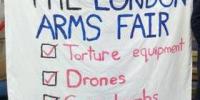
A group of women arrested at the DSEI arms fair in 2013 have begun private prosecution proceedings against arms companies who exhibited illegal weapons at the fair.
Matthew Connors spent much of 2012 in Lower Manhattan making portraits of the protesters in the Occupy Wall Street movement. But a chance encounter during the course of that project made him do a 180-degree turn after meeting some Egyptian activists who had participated in a different uprising: the Jan. 25 revolution that led to the ousting of President Hosni Mubarak. They convinced Mr.
I have several theories about why song rewrites work well. Theory aside, people know the tunes and can learn the words. Scholars differ on whether you should make it as simple as possible or let the crowd be the artist by recognizing their ability to learn and perform something a bit tricky. Either way, it's great when songs are repurposed and people get to shout and sing instead of just chanting or listening to speeches.
Both Johnson and Lewis recognize that the personal is political, and vice versa. By making connections between storytelling and activism, the two young women are using creative approaches to achieving justice and equity.
On the International Day of Education with students we have organized that creative action to ironizing the phenomenon of corruption in education.
We founded “University of Corrupted Sciences” as a symbol of all the issues that have characterized the education system in our transition years.
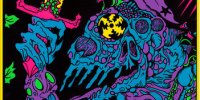
King Gizzard & The Lizard Wizard have released a pair of live albums to benefit relief efforts in response to devastating wildfires in their native Australia.
TEL AVIV
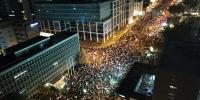
Thousands of people took to the streets in Israeli cities Saturday for a fifth straight week to protest the government of Prime Minister Benjamin Netanyahu concerning proposed judicial reforms.
Demonstrators from non-governmental organizations, lawyers, and technology sectors staged the protests/
Police closed roads leading to squares in Tel Aviv during the day and took security measures in the surrounding area.
Brick x Brick is a public art performance that builds human “walls” against misogyny. It is organized by the Public Displays of Affection, a collective of artists, designers, educators and organizers that engages in nonviolent direct art action. During the wall performances, participants wear brick-patterned jumpsuits adorned with colorful brick patches bearing statements of misogynistic violence made by US President Donald Trump.
For a brief moment on Wednesday night it appeared that Belgium had disappeared. The main French language television station hoodwinked the country into thinking that it had split in two when it reported that Flanders had issued a unilateral declaration of independence.
Creative Time, Social Practice Archive: In 2000 Heavy Trash, an anonymous arts organization of designers, architects, and urban planners, implemented its Aqua Line project throughout various parts of Los Angeles. The project involved the installation of false "Future Station Location" signs in the downtown area, notifying passersby of the impending construction of a subway that would connect the downtown to the Westside.
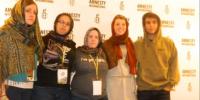
"At the recent Amnesty International Annual General Meeting, we decided to do an action stating we stand with Shaima Alawadi and Trayvon Martin. Check out the action, even Asma Mahfouz, one of the founders of the April 6th Movement in Egypt and nominated for a Nobel Peace Prize participated in the action." -#MillionHijabMarch
After a first illegal exhibition on the walls of the Cité des Bosquets, JR settles in the heart of this neighborhood and the neighboring projects of La Forestière, in Clichy-sous-Bois, where the 2005 riots started in the French suburbs.
The first portraits are displayed on the walls of the last popular neighborhoods of the capital, in Eastern Paris.
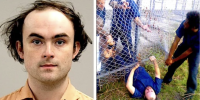
William Banks is a comedian and artist who, prior to his viral prison saga in 2025, was best known for a community that he led called Call World, which he describes on the website as “a planet in an alternate universe ruled by human-headed Worms sexually obsessed with William Banks.” The story goes that Banks was first visited by a worm from Car World after getting stuck in an industrial freezer and coming to terms with his death before eventually being
September 5th, 2013, Raleigh, NC - As Walmart workers petition managers to reinstate employees who have been unfairly treated, a flash mob breaks out.
SEE VIDEO.
There are over 200,000 migrant domestic workers living in Lebanon
today — a large number when you considered that Lebanon’s population is
only a little over 4 million. Most migrant workers live with their
Lebanese employers, cleaning their houses, washing their clothes,
cooking their food and looking after their children. Yet these workers
are not included under Lebanon’s labor laws — they are not entitled to