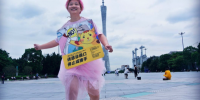
Late last month, Chinese citizens took up a creative means of protest over the nation’s strict “zero-COVID” policy. In a place with little tolerance for large public demonstrations, protesters have been holding up blank pieces of paper. Their ingenuity inspired a local artist Yolanda He Yang to stage a public art demonstration to subtly communicate their dissent.
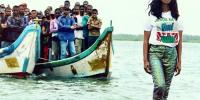
The video for “Borders,” a song off MIA's album Matahdatah, features images recalling all sorts of migrations from the developing world—there are people crossing deserts, fences, and bodies of water. Though much of M.I.A.’s work has been about women and children, this video is filled with brown men: the ultimate bogeyman for many in the West, stereotyped as terrorists, criminals, and job-takers.
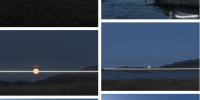
Located off the west coast of Scotland are the Outer Hebrides, an island chain where Finnish artists Pekka Niittyvirta and Timo Aho decided to install their piece, Lines. The installation is composed of lines of light wrapped around buildings or hovering on a grass field. At high tide, the lights turn on, illuminating the serene landscape, and marking the height of future sea-level rise on the low-lying archipelago.
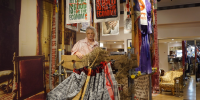
The Vivienne Foundation exists to honour, protect and continue the legacy of Vivienne's creativity and activism.
Since the start of her career in the 1970s, Vivienne was renowned not only for her fashion design, but also her activism. Vivienne always utilised her platform of prestige to make the world a better place.
The slogan of 2015 is "Art changes Perceptions, Perceptions change people, People change the world". The organization has created an online community where anyone can post digital images of poverty existing in the Arab world. The action was created in response to the 2000 United Nations Millennium Summit declaration to eradicate extreme poverty throughout the world by 2015.
If the way to one’s heart really is through the stomach, Rirkrit Tiravanija must have more than his share of admirers. Now at GAVIN BROWN, the Buenos Aires-born artist with a history of dishing out tasty edibles in his exhibitions invites viewers to enjoy a bowl of soup in his interactive show, Fear Eats the Soul.
Najah al-Bukai cannot forget.
As an accomplished artist in Syria before the war, Mr. Bukai had long thought his photographic memory was his greatest asset, allowing him to recreate scenes on his sketch pads and canvases days, months and even years after he witnessed them. But now, after he has survived two stretches in the Syrian government’s notorious detention centers, his sharp memories only serve to haunt him.
Neighbors in modern cities have less and less communication, and they all go about their business as soon as they close the door. In Switzerland, a woman dies every week as a result of domestic violence, so in an effort to get everyone to act, the charity has put up an interactive billboard in a shopping mall that shows a man in a family doing violence to a woman.
Trash Tycoon is an upcycling social network game developed by Guerillapps. The game applies traditional social gameplay features to highlight real-world issues such as waste, water, and “green” activities. Gameplay includes cleaning trash, recycling, and constructing products and decorations out of recycled material.
Injustice is an interactive VR experience themed around racially motivated police brutality. Guests witness an act of racial discrimination in front of them, forcing them to make moral and ethical decisions on the spot. Injustice is an experience aimed at exploring the emotional impact of VR space vs. traditional film.
Bogus building inspection notices with the forged signature of city Building Inspection Director Frank Chiu appeared on buildings in San Francisco's South of Market area, prompting an investigation by exasperated city officials.
Photography has long been associated with acts of resistance. It is used to document action, share ideas, inspire change, tell stories, gather evidence and fight against injustice.
This group exhibition at the SLG, organised in collaboration with the V&A, brings together works by international artists and collectives who are using the camera to challenge and move beyond traditional protest photography.
One interesting thing about this stunt is that there is no record of it other than the Yippies' wonderful testimony. We believe that it actually happened, but it shows that storytelling is the most important part of any action of this sort.
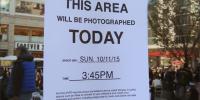
"This area will be photographed" is a public performance of implied photographic consent, inspired by Google's street view and satellite surveillance. Posted signs and handbills alerted the public present in Union Square, New York, NY that a photograph would be taken of the area at a precise time.
In March 2016, Chinese feminist activists had planned to launch a crowdfunding campaign against sexual harassment advertisements, and they worked hard to raise 40,000 yuan in a month and a half. However, after perfunctory, evasive, and rejection by the relevant departments, anti-sexual harassment advertisements finally failed to go online.
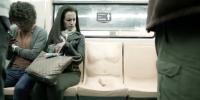
In a conceptually odd but undeniably memorable PSA campaign, the Mexico City Metro has installed a “penis seat” in one of its subway cars, featuring a molded likeness of a man’s torso and penis, to get male riders thinking about the sexual harassment that women endure every day.
The seat is labeled “For men only.”
Mis(s)placed Women? (2009-2022), is a collaborative art project, consisting of performances, performance series, performance art workshops and delegated performances, including contributions by over 180 individuals from six continents. Many of them are artists, mainly identifying themselves as women from diverse backgrounds. Mis(s)placed Women?
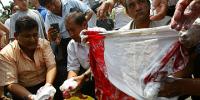
“It might not seem that an act of public laundry could unsettle a president with a well-deserved reputation for inflexibility, corruption, and brutality. But mass washing ceremonies were a key element in getting rid of Peru’s unpopular president, Alberto Fujimori, after more than a decade in power.
When dancer Sheen Jamaal saw a video of protestors doing the Cupid Shuffle in New Jersey, inspiration struck to do something similar in New York. He immediately called his friend and collaborator Allison “Buttons” Bedell, and the seed for the Dance For George protest was planted.