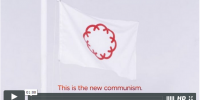
Imagine for a brief moment, that the world’s last five remaining communist countries decided to unite forces and hire the world’s top advertising agencies to re-brand and create a resurgence in the ideologies of Communism?
In the 2012 presidential election, did you know that one of the underdog anti-party runners was Gumby?!
In the attached video, you will hear Gumby offer transportation alternatives (Pokey and friends), challenges of not believing in vice presidents, and the importance of people and clay-people working together.
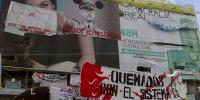
Just over a decade ago on May 15, 2011, a wave of social outrage began as the Spanish people collectively decided that they had had enough of the corruption, cuts, and inequalities affecting their country.
From Public Delivery:
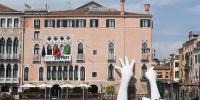
"He calls his work Support, which involves two giant hands rising from a canal to support the building that houses Ca’ Sagredo Hotel. The idea is to depict that the sculpture is helping Venice. It also symbolizes humankind’s capability to destroy the world and an equal ability to save the world too."
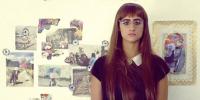
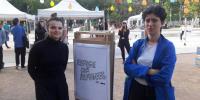
It was October 31st, 2012, when a new artist appeared on social media. In a series of video clips, she proposed with a soft and slow speech that Peru hide its poverty. Her project consisted of installing vinyl pieces to avoid what she called "the visual pollution." She titled the project Don't be poor, be fashion(able).
#ChallengeAccepted, also known as the Challenge Accepted campaign, is an Instagram tagged challenge as well as an awareness campaign on empowering women involving sharing posts of black-and-white selfies.
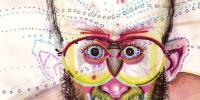
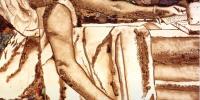
Artist Bryan Lewis Saunders took it upon himself to draw a self portrait every time he took a psychoactive substance. These ranged from zoloft to morphine to marijuana and it is an amazing subjective experience to witness. We can almost get a taste of what each drug must feel like on the inside, at least to Saunders, and an experiment like this raises some important questions like what are drugs and what place do they have in society?
From a Universe of Trash, Recycling Art and Hope
By STEPHEN HOLDEN
“We are not pickers of garbage; we are pickers of recyclable materials,” Tião, an impoverished Brazilian catadore, or trash picker, declares to a talk-show host in Lucy Walker’s inspiring documentary “Waste Land.”
"In 2006 members from a coalition of environmental groups posed as a government agency—the Oil Enforcement Agency—that should have existed, but didn’t. Complete with SWAT-team-like caps and badges, agents ticketed SUVs, impounded fuel-inefficient vehicles at auto shows, and generally modeled a future in which government takes climate change seriously."
“Piano Stairs” is an interactive playful musical stairway installation created into the Odenplan underground station of Stockholm to make people use stairs more often than elevator. The project was part of a Wolkswagen initiative called “The fun theory” whose main objective and mission is to “change people’s behaviour for the better by making it fun to do.”
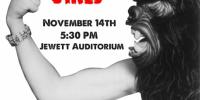
They call themselves feminist masked avengers in the tradition of Robin Hood, Wonder Woman and Batman. They wear costume gorilla masks to remain anonymous, and they are devoted to fighting sexism and racism within the visual art world internationally.
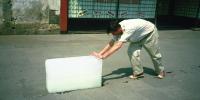
In many of his works, the Belgian-Mexican conceptual and performance provocateur Francis Alÿs questions the relationship between action, effort, and outcome. His works tend to inspire one toward a blurring of lines between the actions done in artistic expression and those in social response, making the viewer question the value and effect of the toil.
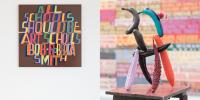
Bob and Roberta Smith has been at the forefront of activist art for 2 decades; so who better to ask about how art is responding to these politically bleak times?
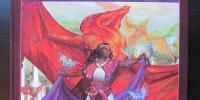
Julie Dillon is a critically acclaimed illustrator, having been nominated and won multiple awards, including two Hugos and a Chesley. Her work often deals with science fiction and fantasy stories, and her work in the field has made her aware of the lack of diversity in this optimistic speculative fiction.
Whether your family’s traditional dress is a Mexican huipil, an Indian saree, or a Scottish kilt, where do you usually wear these clothes?
In Ukraine, the traditional attire is a vyshyvanka. Typically made of cotton or linen, these shirts feature embroidered patterns along the front, collar and sleeves.
Many girls in China may have seen the advertisements of egg donation as a surrogate, in hospitals, schools, public toilets, shared bikes, ATMs...... They are everywhere and the number of this kind of advertisements is large. Though there are lots of girls who have never seen such advertisements or would never believe in them, there would still be some girls who would dial the numbers on the advertisements.
For the Midsummer Festival in Cork, Ireland, SUPERFLEX encouraged Lord Mayor of Cork Cllr. Dara Murphy to bring a proposal to the city council that would ban the use of the word 'Recession' in the city.
Two design students were awarded the Futurapolis prize last Wednesday for their project to adapt the Furan (underground river) , a response to the migration crisis.
Artistic Activist, Charlotte Claire, is at the forefront of initiating revolutionary change in mental health care. Her project, The Babyfacedassassin, is dedicated to improving mental health care and inspiring people to care for their mental health.