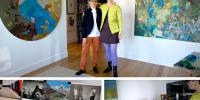
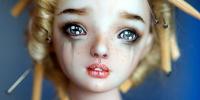
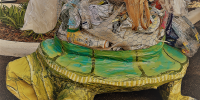
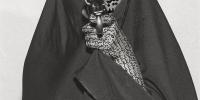
The Enchanted Doll is the famous brand of the Russian jeweler artist and designer Marina Bychkova who makes absolutely incredible porcelain and polyurethane dolls for adults. Marina was born in the city of Novokuznetsk in the USSR and since 1997 she lives in Vancouver, Canada.
While meditating in front of a Nepalese Sarasvati statue on New Year's Day in 1991 at her California home, Mayumi received a calling that brought a sudden halt to painting. Having witnessed the horrors of atomic bombings as a child and later, watching her beloved Japan become a leader in nuclear-energy, and seeing the effects of depleted uranium, Mayumi had to pursue a global cause greater than her art or feminism.
Local artist fnnch wants San Francisco to decriminalize certain types of art.
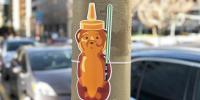
You’re not seeing things: A whopping 450 “honey bears”—variations on the immediately recognizable and widely imitated bear-shaped honey bottles sold in seemingly every store in America--appeared all over SoMa late Sunday night, from the Embarcadero to Fifth Street.
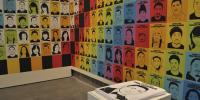
A new exhibition at the Yerba Buena Center for the Arts that showcases activism through art and media in the San Francisco Bay Area, gets its name, Take This Hammer, from a 1963 documentary about the author James Baldwin as he went around San Francisco, talking to African-Americans about what it was like for them in the city.
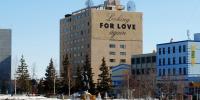
Abandoned buildings have become such a common sight that they often slip quietly into the backdrop of our cities like an accepted part of our landscape. Looking for Love Again is a participatory public installation that renews attention to an abandoned high-rise in downtown Fairbanks, Alaska to celebrate its past and future.
Two weeks ago, the University released the final version of its diversity and inclusion action plan, which could not have been compiled without the exhaustive efforts of students throughout last semester.
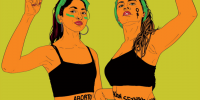
The rise in feminism and feminist advocacy has changed history forever in terms of how women are viewed and treated in society. Though great progress has been made, women are still fighting for their rights even today. Abortion and body vulnerability are just two issues that are still being confronted and fought for in the public view.
The inspiration for the creation was the Common Snapping Turtle. A big shout-out to local member, Kristin Rubin and local college students, Sarah Lockhart and Alanis Gonzalez, for their assistance in the construction of the artwork.
This month’s blast of arctic air may have roused climate-change skeptics. But the composer Laura Kaminsky and the painter Rebecca Allan were unfazed. Holed up in their apartment in Riverdale in the Bronx on one of the coldest days in decades, these longtime artist-activists were doing what came naturally: fighting the planet’s warming.
“There are many problems in rural areas. For example, agriculture is declining, no one is farming, traditional things are falling apart, farmers are brainwashed by the idea of urbanization, and they don’t like their hometown. They all want to move to the city.”Activist Ou Ning said. Rural construction is an important issue. As an activist, he chose Bishan village in Anhui, China as the field to start his experiment, which is “Bishan Project”.
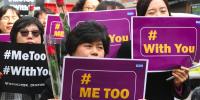
Young women in South Korea are fighting for a new future. The #MeToo movement which has highlighted sexual harassment and abuse around the world has taken a surprising hold in this socially conservative country.
Children in marginalized communities often lack access to healthy foods, especially fresh fruits and vegetables. Poor nutrition, in turn, has significant negative impacts on a child’s health and ability to focus in school. Learning and academic achievement often plummet.
NAME OF PROJECT: ‘CHILDREN SHOULD BE SEEN AND HEARD’
TEAM MEMBERS: Caroline, Yasir, Sile, Audrey & Mary
GLOBAL CHALLENGE: To give children a voice and create empathy
among adults for children
♯childrenshouldbeseenandheard
Shirin Neshat’s Women of Allah is a photographic series exploring the complex identities of Muslim women in post-revolutionary Iran. Combining black-and-white portraits, Persian calligraphy, and symbolic elements such as guns and veils, Neshat interrogates themes of martyrdom, violence, femininity, and resistance.
A coalition of more than twenty national arts funders has launched an emergency relief fund that will provide millions of dollars to artists struggling financially in the wake of the COVID-19 outbreak in the United States, which has more than 400,000 confirmed cases of the virus. The Andrew W.
It was a long time coming - but it was worth the wait.
Nearly two years ago, more than a dozen of Mexico’s biggest performing artists came together in a mega-event aimed at saving Wirikuta, one of the country’s most sacred sites, from devastation at the hands of Canadian gold and silver mining operations.
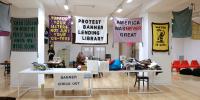
The Protest Banner Lending Library is a space for people to gain skills to learn to make their own banners, a communal sewing space where we support each other’s voices, and a place where people can check out handmade banners to use in protests.
It’s been a historic year for women. There are more serving in Congress than ever before, and a record number are currently running for president in 2020. But even with these significant gains, women—both in the U.S. and around the world—can still find gender equality elusive.
HeForShe is a solidarity campaign for gender equality initiated by UN Women. Its goal is to engage men and boys as agents of change for the achievement of gender equality and women’s rights, by encouraging them to take action against negative inequalities faced by women and girls.
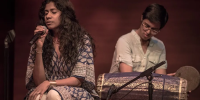
In Hong Kong in 2014 the song Raise Your Umbrella by Denise Ho and Anthong Wong became an anthem for the pro-democracy movement known as the Umbrella Revolution. The song was written after police fired tear gas into the crowds when protestors filled the streets.
Rokudenashiko is on a mission to free the vagina. In her native country of Japan, the vaginal slang word “manko” is considered taboo while the penis equivalent, “chinko,” is used freely. Rokudenashiko (the pseudonym of artist Megumi Igarashi) uses her manko art to destigmatize the vagina, using it as the basis for whimsical figurines, iPhone cases, dioramas, and, in her most infamous piece, a kayak.
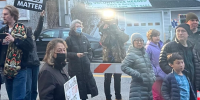
Some 70 or 80 local activists, politicians and other concerned citizens gathered outside Irvington Village Hall Sunday evening, two days after the release of gut-wrenching video of the murder of 29-year-old Tyre Nichols at the hands of policemen in Memphis.