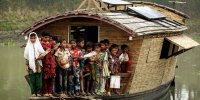
Many artists are inspired to bring climate change into their work after a direct experience with it. Catherine Sarah Young hopes her work helps people understand and talk about their experiences with climate change.
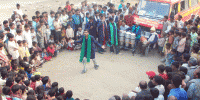
In 1989, playwright, actor, and activist Safdar Hashmi was fatally attacked by political thugs while performing a street play outside of Delhi. His death led to the founding of Sahmat, an influential artist collective that has taken a consistent stance against the threats of religious fundamentalism and sectarianism in India through a vibrant mix of high art and street culture.
A new, three-minute ad by Coca-Cola, "Small World Machines," starts with a relatively straightforward premise: India and Pakistan do not get along so well. It ends with the promise of peace: "Togetherness, humanity, this is what we all want, more and more exchange," a woman, either Indian or Pakistani, narrates as the music swells. Sounds great. How do we get there? By buying Coke, of course.
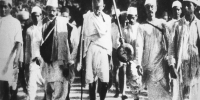
In 1930, the Indian National Congress adopted satyagraha (essentially, nonviolent protest) as their main tactic in their campaign for independence. Mahatma Gandhi was appointed to develop a plan of action; he proposed marching to the sea to make salt in defiance of the Salt Act of 1882.
As the No. 59 bus hurtled down Ratchadamnoen Klang road in Bangkok's Old Town, its passengers diverted their attention from the intense midday heat to a small crowd on the concrete below. About 25 people were marching and chanting, photographers scuttling in front of them.
Seeking to use war-time waste for social good, Saught was set up by Pamela Yeo, Adeline Heng and Ng Sook Zhen in December 2010. Based in Singapore, the company uses the metal from de-activated landmines to create pieces of jewellery. The organisation employs citizens from conflict-ravaged regions, offering a source of employment for those who may have lost as a result of the fighting in their nation.
Concept
1. This is a participatory art action initiated by Action Office, aiming at questioning current democratic elections in Singapore and shaping an alternative possibility.
2. Design the pocards to resemble ballots, inviting people to fill out election results and mail them to the corresponding country’s polling stations or current government.
In the country formerly known as Burma, these free thinkers are a force in the struggle for democracy.
By Joshua Hammer
Photographs by Adam Dean
Smithsonian Magazine, March 2011
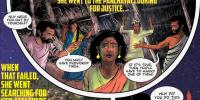
A new comic book with a female rape survivor as its "super hero" has been launched to focus attention on the problem of sexual violence in India.
Priya's Shakti, inspired by Hindu mythological tales, tells the story of Priya, a young woman and gang-rape survivor, and Goddess Parvati as they fight against gender crimes in India.
Hok Kolorob. Let there be noise.
It was perhaps these two words of protest that eventually led to the arrest of two engineering students for allegedly molesting a fellow student at Kolkata’s Jadavpur University last month.
In response to a memo from Afghanistan's education ministry, Ahmad Sarmast, the founder of Afghanistan's Institute of Music, began a Twitter campaign with the hashtag #IAmMySong. In response to the hashtag, Afghan girls have taken to Twitter with videos of themselves singing tagged with Sarmast's hashtag and spreading petitions against the ban. The ministry memo banned girls 12 years old and older from singing at school functions.
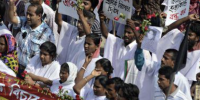
"Thousands of people, some wearing funeral shrouds, staged demonstrations at the site of the Rana Plaza factory complex on Thursday on the one-year anniversary of the Bangladesh disaster that claimed 1,138 lives.
Mukti Caravan, the Campaign on Wheels, is a mobile cultural group of former child bonded labourers. Started by the Bachpan Bachao Andolan (Save Childhood Movement), a movement started by now Nobel laureate Kailash Satyarthi, it involves activists visiting villages to create awareness about need for education, emphasizing on the need for improving access to education and quality of education, to completely eradicate child labour from the society.
The bruised and beaten faces of these beautiful Hindu goddesses have an important point to make -- that despite the reverence for women that is a part of Hinduism, India's most populous religion, the country has become extremely unsafe for its female citizens.
The Kiss of Love campaign in India is a non violent protest against moral policing. It started out as a Facebook page but gained momentum across India when a mob of conservative, right-wing party members attacked and demolished a coffee shop in Kozhikode, Kerala. Their grounds to do so was public display of affection by couples inside the coffee shop, which they saw as immoral activity.
Chuu Wai Nyein felt an overwhelming sense of guilt when she first arrived in Paris from Myanmar at the end of April. “I was pushed to leave the country, but it was not how I wanted to leave,” says the 28-year old. As an artist working for the last ten years, mostly in the central city of Mandalay, Chuu built up an international reputation for her expressive paintings of women.
To call attention to bullying, the Singapore Coalition Against Bullying for Children and Youth has released a video that gets shorter each time it is viewed.
Hosted on a site called Share It To The End, the short animated video depicts a boy getting bullied at school and telling us he always feels alone and doesn’t feel safe anywhere.
There are no whistles, no loud speakers, and no placards held up high in this quiet act of subversion. Pimsiri Petchnamrob stands silently in a mass of sharply dressed Bangkok commuters, her hands clutched around a copy of George Orwell's 1984.
Next to her a small group of young men and women, their faces sombre and their heads bowed low, also read books about fictional and real totalitarian worlds in silence.
Alokananda Roy walked into Calcutta's Presidency Jail on International Women's Day, 2007. The Indian classical dancer had been invited to watch female inmates perform, but it was the men who caught her eye.
"They shook me," she says. "Their body language — it was as though they had no future, nothing to look forward to."
Most nights since a coup returned Myanmar to military rule on Feb. 1, a spectral symbol of protest has glowed on a mildewed side of a building.
Where the next illumination will appear in Yangon, the country’s biggest city, is a mystery. But, suddenly, a projected image appears in the dark. Three fingers raised in a rebellious pose. A dove of peace. The smiling face of Daw Aung San Suu Kyi, whose government was ousted in the army putsch.
With World Comics India, the organization he started, Sharad has pioneered a cheap and easy medium for poor people to communicate meaningfully on issues that are neglected by the conventional media. While the urban elite dominates public media, the grinding day-to-day concerns of millions are rarely heard. Layers of discrimination and abuse heaped on huge numbers of people keep their problems out of sight and out of mind.