The message we keep hearing over and over again from government and health officials is that it’s imperative to practice social distancing during the COVID-19 crisis: To benefit public health, we have to stay at home. But what if your home isn’t a safe space?
A video campaign titled Sympathy Cards, initially released in 2018, is going viral again.
The chilling video depicts, via hidden cameras, shoppers walking by or browsing the greeting cards section at a shop. Shocked, confused, some visibly upset, shoppers freeze when they notice that, along with the traditional selection of greeting cards, is a section devoted to school shootings.
The first legislative victory of the Civil Rights era was obtained by hundreds of people going where they weren't invited. In 1961, Black and white Freedom Riders, well trained by SNCC in nonviolent action, rode Greyhound buses from Washington DC southwards primarily in order to wait, together, in waiting rooms that were still unconstitutionally segregated.
Shake Girl is a massive collaborative effort between fifteen students and two instructors over the course of one quarter (Winter 2008). These students comprise the first edition of the Stanford Graphic Novel Project -- a group dedicated to acheiving this monumental task on an annual basis.
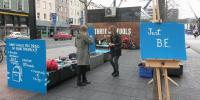
This is continued exploration of some work I recently had published for a culture jam project in response to the documentary "The Corporation". There are a lot of layers working here. There are thoughts about food deserts, how multinational corporations prey upon them, and finally how particular images regarding development are used to sell the idea of what hunger should look like.
A start-up has launched a line of clothing that confuses artificial intelligence (AI) cameras and stops them from recognizing the wearer.
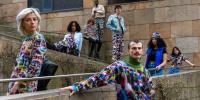
Italian start-up Cap_able is offering its first collection of knitted garments that shields the wearer from the facial recognition software in AI cameras without the need to cover their face.
Called the Manifesto Collection, the clothing line includes hoodies, pants, t-shirts, and dresses.
A couple of weeks ago, a group of activists working with Rainforest Action Network’s Energy and Finance campaign hit the streets of San Francisco to bring a little truth about Bank of America’s misdeeds to its customers—not in the lobbies of the bank’s local branches, but at its ATMs throughout the city.
My skin is black,” the first woman’s story begins, “my arms are long.” And, to a slow and steady beat, “my hair is woolly, my back is strong.” Singing in a club in Holland, in 1965, Nina Simone introduced a song she had written about what she called “four Negro women” to a young, homogeneously white, and transfixed crowd.
Mass media using propaganda to brainwash citizens. Confusion and ignorance causing a divide. People rising up against an oppressive government. Humans being torn between rage and love. These are the themes of Green Day’s widely successful 2004 album, “American Idiot.” These themes still sound familiar. Nearly two decades later, the world, especially the United States, faces these same issues.
The Strangers Project is a celebration of the stories we’re surrounded with every day—both from the strangers we share our space with every day, and our own stories we carry. It’s about a connection with ourselves, with people around us, and with something greater than ourselves.
Activist Boniface Mwangi on confronting corruption in his homeland, and director Sam Soko on recording his campaign
Kenyan director Sam Soko’s debut documentary feature, Softie, opens with the film’s protagonist, Boniface Mwangi, sourcing 1,000 litres of pigs’ blood. “I’ve found a van for you. When do you want it? When are you getting the blood?” Mwangi asks.
The action art performance themed "War on smog, we are taking action" was held by some environmental activists and volunteers on the commercial center and famous tourist spot Yangren Jie (Foreigners’ Street) in Nanan district, Chongqing municipality in Southwest China on Friday, Febuary 28.
"The Surveillance Camera Players (SCP) is a small, informal group of people who are unconditionally opposed to the installation and use of video surveillance cameras in public places.
PERIPLUS is a transoceanic route through community arts (music, performing arts and interdisciplinary projects) across five continents. It aims to disseminate knowledge and enhance the visibility of education, social and artistic initiatives by critically analysing the synergies which arise from connections in these three fields.
Internet spreads word as networks shun adverts for Buy Nothing Day
Duncan Campbell in Los Angeles
The Guardian, Friday 24 November 2000
Today is America's Buy Nothing Day. An event that was started to poke pointed fun at consumerism is now being celebrated in more than 40 countries, embarrassing television networks and demonstrating the power of the internet as a political organising tool.
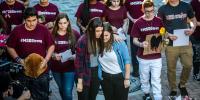
Shine, written by Stoneman Douglas students Sawyer Garrity and Andrea Peña in response to the tragic shooting at their school on February 14, 2018 to inspire unity, hope, and change. MSD alum Brittani Kagan collaborated with students and faculty to create this music video to honor the victims and the school.
On 17 June 2007, a horrific vision was offered to the viewers of the Czech morning program Panorama: instead of idyllic hills, the image of a mushroom cloud was broadcast by a weather camera installed in the Krkonoše mountains, which caused a brief moment of panic in a country that is regularly agitated by debates on nuclear power. The panic wasn’t justified.
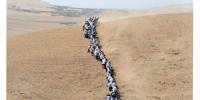
Five hundred volunteers with shovels gathered at a huge sand dune on the outskirts of Lima, Peru, and over the course of a day moved it by several inches. Alÿs developed the idea after first visiting Lima in October 2000. The political context was inescapable: “This was during the last months of the Fujimori dictatorship. Lima was in turmoil with clashes on the streets, obvious social tension and an emerging movement of resistance.